


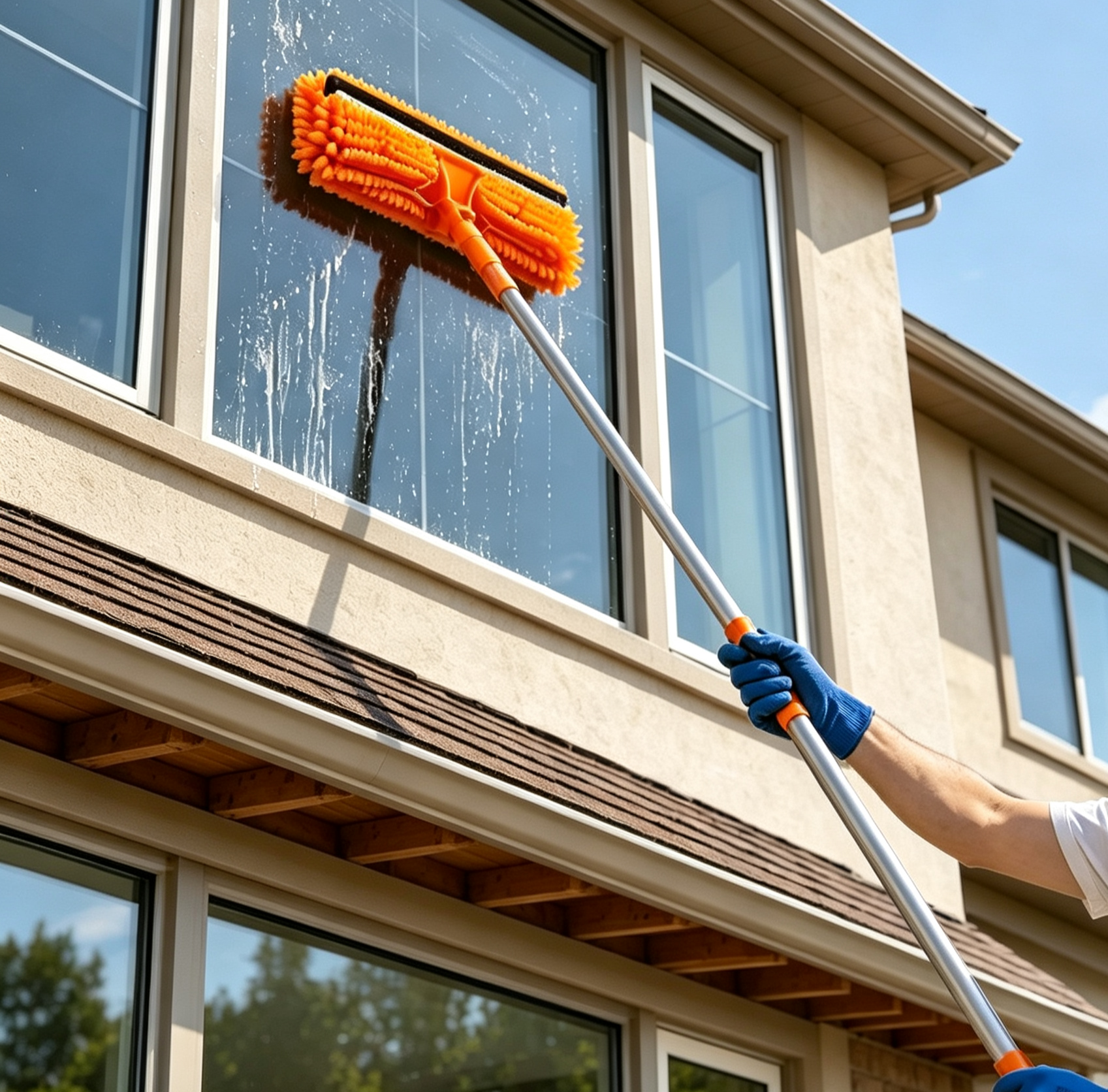
In 2026, a better home-cleaning tool is not judged only by whether it can remove dirt. Consumers increasingly ask a broader set of questions. How fast can I finish the job? How many steps does it require? How much repetitive wiping will I have to do? Can I use it without reading a complicated manual? Will it fit into a realistic weekend routine? And, perhaps most importantly, will the result be obvious enough to justify keeping the tool within easy reach?
Window cleaning is one of the clearest examples of this new purchasing logic. Glass is beautiful because it creates light, openness, and connection to the outdoors. The same transparency that makes a window attractive also makes every imperfection visible. Fingerprints, water spots, pollen, dried rain, dust, cooking film, pet nose marks, and leftover cleaning haze can all stand out when sunlight hits the pane at the wrong angle.
That creates a simple consumer problem: people want crystal-clear glass, but they do not want to spend an unreasonable amount of time chasing streaks. A smart window squeegee addresses that problem in a direct way. It does not need to be connected to an app or powered by a battery to be smart. Its intelligence can come from the workflow it enables: loosen the dirt, control the water, clear a defined section of glass, move to the next section, and finish the perimeter.
For Amazon and direct-to-consumer brands, this gives the category a strong 2026 message: Smart. Less Effort. Crystal Clear. Those words are useful because they speak to what shoppers actually care about—efficiency, visible results, and a DIY process that feels manageable.
Why efficiency has become a major home-cleaning value
Recent consumer research makes the time-saving angle credible. The American Cleaning Institute’s 2026 Spring Cleaning Survey found that 80% of U.S. adults engage in spring cleaning at least once a year. The same survey found that 72% consider coming home to a clean, organized space more relaxing than a massage. Cleanliness is not a minor concern; it has emotional and lifestyle value.
Yet wanting a cleaner home does not mean people have unlimited time to create one. American Home Shield’s 2026 survey of homeowners found that 82% planned to spring clean. The average spring-cleaning routine took roughly fourteen hours, and 37% said they did not have enough time to clean their homes as well as they would like. Window cleaning also appeared among the less-favored seasonal chores.
That tension is the foundation of a compelling product story. Shoppers do not need to be convinced that clear windows look better. They need to believe that the path to that result can become shorter, more predictable, and less annoying.
The squeegee is well suited to that message because its purpose is straightforward. Instead of relying on repeated rubbing to absorb water from a large pane, it moves water off the surface in controlled passes. The job is still real work, but the workflow is more organized.
The large-glass trend makes window maintenance more visible
The product story becomes even stronger when viewed alongside current home-design trends. Qualified Remodeler reported in June 2026 that residential window and door products continue to move toward wider views, larger glass areas, slim profiles, multi-slide systems, and stronger indoor-outdoor connections. That trend is no longer confined to ultra-luxury projects. Larger glass formats are increasingly familiar across a wider range of renovations.
For homeowners, the design benefit is obvious: more daylight, broader views, and rooms that feel more connected to a patio, yard, garden, or balcony. The maintenance consequence is equally obvious: more glass means more square footage that can show dirt.
Cleaning a small kitchen window with a cloth may feel easy. Cleaning a floor-to-ceiling living-room panel, a large sliding door, or a sunroom creates a different experience. Every additional square foot increases the number of hand movements required if the method depends on repeated wiping and buffing.
That is why one of the strongest exposure points for a window squeegee is not simply “cleans glass.” It is fast coverage for large residential glass. The bigger the surface, the easier it is for the consumer to understand the value of a broad, controlled pass.
Smart does not have to mean another device
Window-cleaning technology continues to evolve. In 2026, newer robotic window cleaners attracted attention for improved spraying systems, navigation, battery options, and support for large panes. This confirms that the industry sees window cleaning as a pain point worth solving.
But automation is only one answer. A robot may be useful for certain hard-to-reach surfaces, but it can also involve setup, charging, pad maintenance, supervision, storage, and compatibility questions. A manual squeegee solves a different problem: the need to clean accessible glass immediately.
If the patio door has fresh fingerprints, the homeowner does not necessarily want to unpack an appliance. If sunlight suddenly reveals haze on the living-room window before guests arrive, the user may only need five minutes and a tool that is already hanging in the utility area.
That is why “smart through simplicity” is an important positioning idea. In a home filled with technology, a simple tool can feel intelligent precisely because it does not create a new task before solving the old one.
Less Effort should be defined honestly
“Less Effort” is strong e-commerce language, but it becomes more persuasive when it is specific. A squeegee does not make cleaning disappear. It changes the water-removal stage of cleaning.
Consider a cloth-only routine on a large pane. The user sprays or applies solution, wipes the surface, changes to a dry cloth, looks across the glass, finds a cloudy area, buffs again, changes cloths, and checks from another angle. The same square foot may be touched repeatedly.
With a squeegee, the process can be divided into clear sections. A clean blade contacts the surface, moves the water in one direction, and creates a visible cleared path. Slight overlap between passes helps reduce missed lines. Wiping the blade between sections reduces the chance of carrying dirty water back onto a cleaned area.
So “Less Effort” can be translated into practical benefits: less rubbing, fewer random re-wipes, fewer repeated motions, and a clearer sequence of work.
Crystal Clear is an outcome shoppers can judge immediately
Many household products promise benefits that are difficult to verify quickly. Glass cleaning is different. A streak appears when the light changes. A clean pane looks transparent. A consumer can judge the result from across the room.
This makes “Crystal Clear” unusually powerful language. It describes the real goal rather than the tool. The shopper does not ultimately care about owning a rubber blade. The shopper wants a clearer view and a brighter-looking room.
Credibility matters, however. A squeegee cannot compensate for every cleaning mistake. Loose grit should be removed first. Heavy grease or sticky residue may need to be loosened before water is pulled away. A damaged blade can leave lines. A dirty edge can redistribute residue. Direct sunlight can cause solution to dry too quickly on the glass.
The most persuasive brand therefore teaches technique instead of promising magic. This is especially relevant because the American Cleaning Institute’s 2026 survey found that 39% of respondents turn more often to digital tools such as social media, Google, or AI for cleaning advice. A product page that teaches becomes part of the customer’s research process.
Why big windows are the best demonstration surface
A squeegee is naturally visual. That makes it a strong e-commerce product. The best demonstration is not a studio photo of the tool on a white background. It is a wet pane of glass and a clear stripe appearing in one controlled pass.
Large windows amplify the demonstration. On a small bathroom mirror, the viewer may think a microfiber cloth would do the same job. On a sliding patio door or floor-to-ceiling panel, a broad cleared stripe shows exactly why the tool exists.
For U.S. households, strong use cases include picture windows, sliding glass doors, sunrooms, shower enclosures, mirrors, and large fixed panes. In European homes, useful examples include balcony doors, glazed extensions, conservatories, wide contemporary windows, and large shower screens.
When the actual product instructions permit those uses, brands should show more than one environment. Visual variety helps shoppers imagine the tool in their own homes.
The patio door: a perfect everyday use case
Sliding and hinged patio doors are particularly persuasive because they combine several common cleaning problems. They are large. They are touched frequently. Children and pets may leave marks at different heights. Outdoor dust and weather affect the exterior. Indoor fingerprints and pet nose marks affect the interior.
They are also highly visible because they are often placed in living rooms, dining areas, or kitchens where people spend a lot of time. If the glass looks dirty, the entire room can feel less finished.
A squeegee positioned around patio-door maintenance therefore tells a complete story: large surface, visible dirt, frequent use, and an immediate before-and-after result.
Picture windows and floor-to-ceiling glass change the cleaning economics
The larger the pane, the more important each motion becomes. A cleaning method that saves only a few seconds on a small window can save much more time when repeated across several large panels.
This is the “cleaning economics” behind the product. The squeegee has the greatest perceived value where repeated wiping would otherwise be most noticeable.
For marketing, that means the product should not be described only as a “window cleaner.” It can be described as a large-glass cleaning tool when the physical dimensions and intended use genuinely support that claim.
DIY control is part of the value proposition
Professional window cleaning remains important for exterior glass at height, multi-story work, and any situation requiring ladders, ropes, or specialized safety equipment. A handheld squeegee should never be marketed as a reason to take unsafe risks.
But much household glass is accessible. Interior windows, mirrors, reachable patio doors, shower screens, and certain balcony surfaces can be maintained safely by the homeowner.
DIY gives the consumer control over timing. One pet-marked door does not require an appointment. Three fingerprints do not require a deep-clean package. A short cleaning task can be completed when the problem appears.
This is especially attractive to busy households because it reduces the friction between noticing a problem and fixing it.
From a seasonal project to five-minute maintenance
Window cleaning often feels difficult because people imagine cleaning every window in the house at once. That turns the task into a major event.
A simple squeegee supports a different habit. Clean one patio door after a rainy week. Clear fingerprints from one picture window before guests arrive. Remove shower water at the end of a bathroom-cleaning session. Handle one room today and another room later.
This reframes the tool from “something for spring cleaning” into “something that helps prevent spring cleaning from becoming overwhelming.”
How to clean more effectively with a squeegee
Remove loose dust and grit first. Dry particles should not be dragged across the surface. A soft brush, dry microfiber, or appropriate preliminary wipe can help.
Wet the glass evenly. Use a cleaning solution appropriate for the glass and nearby frame materials. The surface should be wet enough for the blade to move smoothly.
Loosen heavy marks. Fingerprints, grease, dried rain, or sticky spots may require light agitation before the squeegee stage.
Start at the top. Gravity helps keep the workflow organized.
Use steady, controlled passes. A consistent movement is more reliable than rapid, erratic wiping.
Overlap each pass slightly. This reduces narrow wet lines between cleared sections.
Wipe the blade when needed. Dirty water or debris on the edge can create new marks.
Finish the perimeter. A clean microfiber cloth can remove the small amount of moisture left near frames and corners.
This method is easy enough for a first-time DIY user and structured enough to produce a professional-looking result.
Why the blade matters more than marketing language
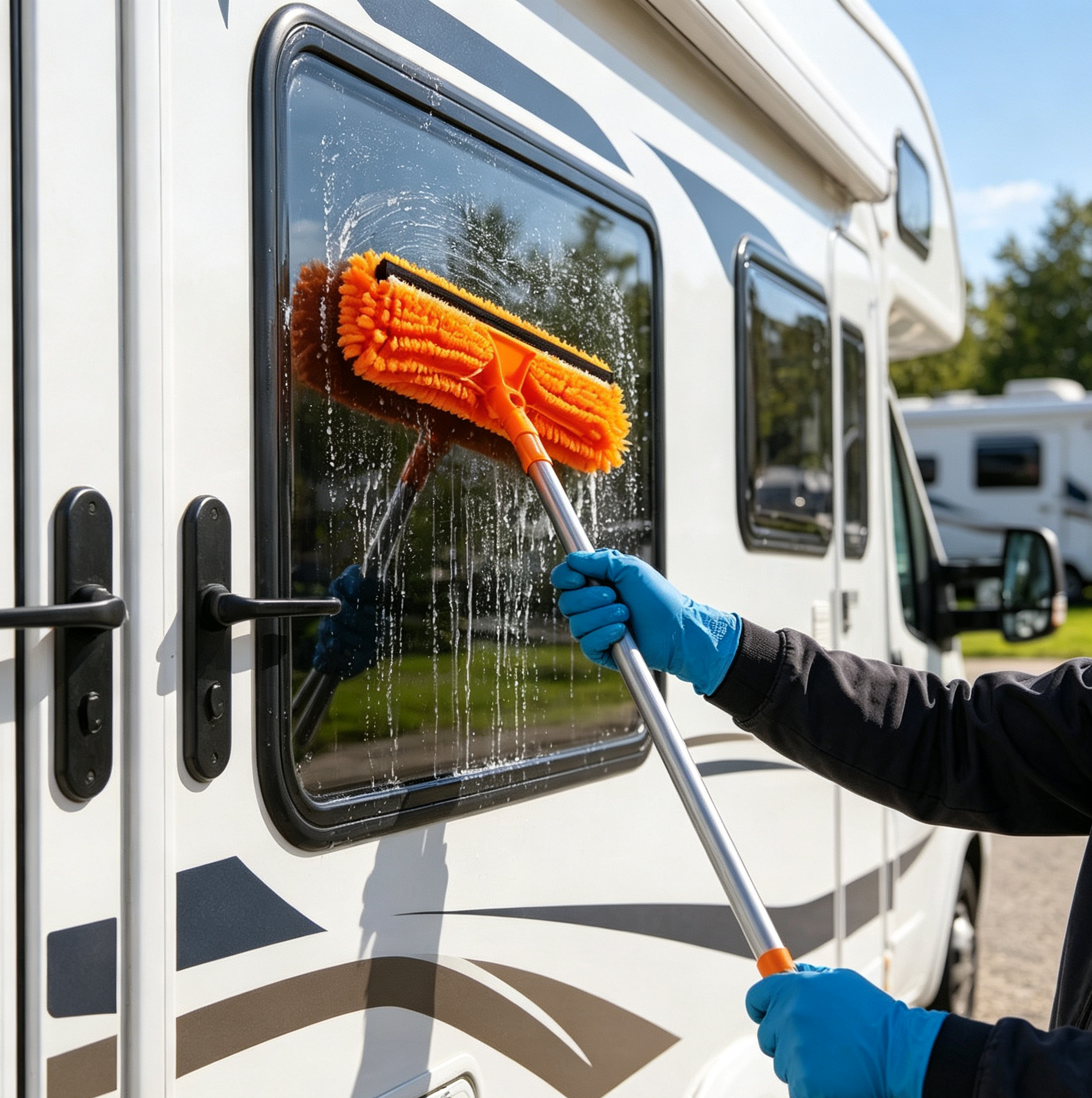
A squeegee’s working edge is the point where the product proves itself. If the edge is uneven, damaged, dirty, or poorly aligned, water can remain behind in lines.
This means sellers should show close-up images of the blade and explain actual construction details when available. If the blade is replaceable, explain maintenance. If it has a particular width, explain how that width affects use. If the handle is shaped for control, show the hand position.
A vague “premium quality” badge is less persuasive than evidence that the design supports the actual cleaning movement.
What “smart design” can mean without electronics
There are many legitimate ways for a manual cleaning tool to feel smart. A comfortable handle can help with repeated passes. A hanging loop can keep the product accessible. A compact profile can make storage easier. A replaceable blade can support longer-term use. A balanced head can help the user maintain even contact.
These features should be discussed only when they are true for the specific model. The goal is not to add buzzwords. The goal is to connect design decisions to everyday convenience.
Storage can influence whether the product gets used
A cleaning tool hidden behind boxes at the back of a closet will be used less often than one that is easy to grab. This is a small but important product truth.
If the squeegee can be hung near a utility sink, stored beside shower supplies, or placed in a slim cleaning caddy, the brand should show that scenario. It helps the shopper imagine the product as part of a realistic household routine rather than a special-purpose object used twice a year.
Why shower glass expands the use story
When the product is suitable for shower glass, this use case adds frequency. Windows may be cleaned weekly, monthly, or seasonally, but shower glass is exposed to water almost every day.
Removing water after use can reduce the amount that dries on the surface. In areas with hard water, that can be especially relevant because mineral spots form as water evaporates.
The brand must be careful not to claim that a squeegee chemically removes established mineral scale. It does not. Its practical role is to remove water before it dries, which can support maintenance between deeper cleanings.
Hard water and mineral spots: a useful education opportunity
Many shoppers confuse water spots with ordinary dirt. Mineral deposits can remain after standard glass cleaner because they are residue left behind when water evaporates.
This gives brands an opportunity to explain the difference between everyday water removal and deep treatment. A squeegee is excellent for routine water management. Existing mineral buildup may require a surface-safe descaling method appropriate to the glass and surrounding fixtures.
Educating customers about this difference reduces disappointment and strengthens trust.
Pet households are an overlooked segment
Dogs frequently press noses against sliding glass doors. Cats may touch low windows. The resulting marks are highly visible because they sit at eye level when sunlight enters the room.
For pet owners, the value of the squeegee is not seasonal. The door may need quick attention multiple times a week. A “pet nose print cleanup” scenario can make the product feel immediately relevant without exaggerating what it does.
Families with children create another high-frequency use case
Small hands leave prints on glass doors and windows. Families may also have more frequent gatherings, playdates, and daily traffic through patio areas.
A tool that makes it easier to refresh visible glass can therefore fit into a short evening or weekend routine. The key language is not “deep clean.” It is “quick refresh.”
Renters and apartment residents
Renters may not have the same maintenance responsibilities as homeowners, but they still care about how their space looks. Large balcony doors are common in apartments, and glass often dominates a small living room visually.
A compact manual tool can be attractive because it does not require installation and can move with the renter to the next home.
Why videos convert well for this product
The squeegee’s benefit happens in motion, which makes short-form video particularly useful. A ten-second demonstration can show a wet panel, one pull, and a clear result.
Longer videos can add technique: blade angle, slight overlap, edge wiping, and microfiber finishing. This turns the video into both a sales asset and a customer-education tool.
For Amazon listings, independent-store product pages, and social ads, that dual role is valuable.
A strong visual sequence for product photography
A complete image set might include:
a lifestyle hero image beside a large bright window;
a close-up of the blade on wet glass;
a wide pass across a patio door;
a before-and-after comparison;
a hand-grip image to show scale;
a storage image when the design supports hanging or compact storage;
a simple three-step diagram: wet, pull, finish.
This sequence helps the shopper understand both the product and the workflow.
The copy should sell the routine, not only the object
“Made with quality materials” is weak by itself. “Use broad, controlled passes to move water off large glass without repeatedly buffing the same area” explains a benefit.
“Smart design” is weak by itself. “Ready when you need it—no charging, no pairing, no setup” communicates what smart means in practice.
“Crystal clear” is strongest when paired with technique and a visual demonstration.
How to compare with robots without attacking them
Robotic window cleaners solve real problems. They can be useful on difficult panes and for users who want automation. The manual category does not need to pretend otherwise.
A more credible contrast is about proportionality. Use automation where automation adds value. Use a manual squeegee where speed, control, and immediate access are more important.
The “smart home” is not the home with the largest number of gadgets. It is the home where the right tool is matched to the right task.
How to compare with microfiber cloths fairly
Microfiber is not a competitor that must be dismissed either. It is actually a complementary tool. Cloths are useful for loosening dirt, wiping frames, cleaning edges, and finishing small moisture spots.
The squeegee’s strength is the broad water-removal stage. A realistic cleaning kit may include both.
This honest positioning can make the brand sound more knowledgeable and less promotional.
Seasonal marketing opportunities
Spring remains the obvious season because pollen and winter residue become visible in brighter light. Summer brings more patio traffic and outdoor entertaining. Fall creates rain marks and pre-winter maintenance opportunities. Holiday season creates demand for guest-ready interiors.
A single tool can therefore support multiple campaigns:
Spring: clear winter film and pollen.
Summer: keep patio doors ready for indoor-outdoor living.
Fall: remove rain marks before colder weather.
Holiday season: brighten visible glass before guests arrive.
Move-in or move-out: refresh windows and mirrors quickly.
Why cleaning timing matters
Direct sun can cause cleaning solution to dry too quickly, which may contribute to streaking. This is useful customer education because it shows that technique and environment matter.
Brands can recommend working on cooler glass, in shade, or at a time when the surface is not heating rapidly. That advice helps customers succeed without relying on unrealistic product claims.
Safety should be part of the brand voice
A responsible product page should state clearly that the tool is intended for safely reachable surfaces unless the specific model and instructions support extended reach.
Users should not lean out of upper-story windows or stand on unstable furniture. High exterior glass belongs to trained professionals or properly designed systems.
Including this guidance does not weaken the product. It demonstrates competence.
Durability should be explained, not assumed
Consumers often associate manual tools with long life, but durability depends on construction and care. If the blade is replaceable, that is a meaningful advantage. If the frame is made from a particular material, explain how it affects stiffness or maintenance. If the product should be stored with the blade protected, tell the customer.
A credible brand avoids “lasts forever” language and instead shows how proper care can support repeated use.
The product can support a lower-clutter mindset
Some households actively want fewer appliances. They do not want a charger, a water tank, a proprietary pad, or another item that needs a dedicated shelf.
For those customers, a compact manual tool can feel premium because it respects space and simplicity. This is especially relevant in apartments and smaller urban homes.
The emotional benefit is not just cleanliness
Clear windows change how a room feels. More light reaches surfaces. Outdoor views become sharper. A living room can feel more finished without changing any furniture.
That means the product can be connected to a lifestyle benefit: enjoying the home rather than constantly maintaining it.
The squeegee becomes a small tool that helps protect a larger design investment.
Who is most likely to respond to the product?
Strong customer segments include busy homeowners, renters, pet owners, families with young children, people with large patio doors, design-conscious consumers, DIY cleaners, apartment residents, and shoppers who prefer manual tools over additional electronics.
Each segment can receive slightly different creative while the core product remains the same.
Example positioning for Amazon and DTC
SMART: a straightforward method that reduces unnecessary complexity.
LESS EFFORT: controlled broad passes instead of repeated buffing.
CRYSTAL CLEAR: an immediate result you can see in the glass.
FAST ON LARGE GLASS: especially relevant for sliding doors, picture windows, and floor-to-ceiling panels.
DIY READY: use it whenever visible glass needs a quick refresh.
What not to claim
Do not claim one-pass perfection on every surface. Do not claim established mineral deposits will disappear without treatment. Do not imply the tool makes unsafe exterior cleaning acceptable. Do not describe materials or ergonomic features the product does not actually have.
Trust converts better than exaggeration in a category where the shopper can test the claim immediately after delivery.
Conclusion: a small tool that fits a larger 2026 trend
The direction of home cleaning in 2026 is clear. Consumers want clean, organized spaces, but they are sensitive to the time and effort required to maintain them. Home design is adding more glass. Digital media makes shoppers more informed about cleaning technique. New automated devices are proving that window cleaning is a real problem worth solving.
The smart window squeegee sits at the intersection of those trends. It offers a direct workflow for accessible glass: prepare the surface, move the water in controlled sections, finish the perimeter, and move on.
Its strongest story is not that it is futuristic. Its strongest story is that it is practical. It can reduce repeated wiping, make large glass easier to approach, support short DIY maintenance sessions, and create an immediate visual payoff.
For Amazon and independent stores, the message is therefore both simple and credible: Smart. Less Effort. Crystal Clear. Clean more glass with fewer unnecessary motions—and spend more time enjoying the view.
2026 Sources and Context



