


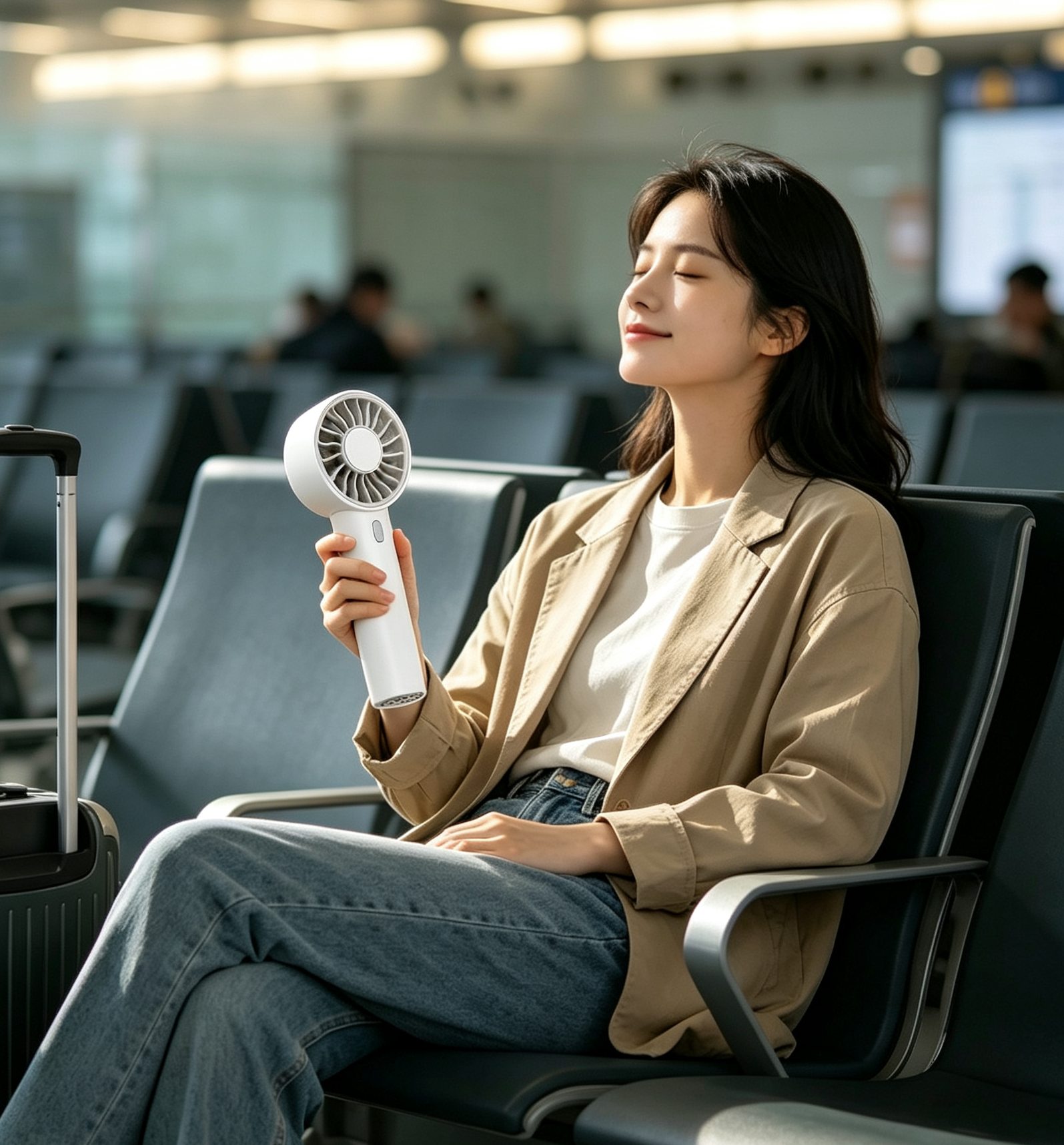
Personal Cooling Is No Longer Just a Summer Convenience
For decades, staying cool mainly meant using equipment installed in a fixed location. Air conditioners cooled homes and offices, ceiling fans stayed in one room, and desk fans occupied a permanent space on a workstation.
Modern life works differently.
People now move constantly between homes, cars, train stations, buses, airports, offices, shops, outdoor spaces, hotels, tourist attractions, campuses, entertainment venues, and leisure destinations.
During a single journey, the surrounding temperature and level of comfort can change several times.
That creates an increasingly obvious need: cooling should be able to move with the person instead of remaining tied to one place.
This is where the 2026 N29 Portable Mini Handheld Fan fits naturally.
With its compact format, portable design, and USB rechargeable operation, the N29 can be positioned as a personal airflow solution designed for a mobile lifestyle.
Its role is not to replace an air conditioner or compete with a large household fan. Its value is much simpler: to provide personal airflow when and where the user wants an extra sense of comfort.
For consumers in the United States and the United Kingdom, three usage scenarios are especially relevant: Travel. Commute. Everyday Cooling.
These are not simply advertising phrases. They reflect real habits related to mobility, travel, work, leisure, and everyday life.
In 2026, the United States experienced an exceptionally hot summer season, while the United Kingdom also recorded unusually high summer temperatures compared with its long-term historical record.
That makes personal comfort during warm weather especially easy for consumers to understand.
There is no need to invent a problem. People already know what it feels like to wait outside in hot weather, walk under strong sunshine, cross a large parking lot, stand on a railway platform, spend hours exploring a city, or queue at an airport or outdoor attraction.
The real marketing challenge is to show how a compact product such as the N29 can fit naturally into those moments.
Why the N29 Fits UK and US Consumer Priorities
The United States and the United Kingdom are very different markets in terms of geography, transport, housing, climate, and consumer behavior.
However, buyers in both markets share several important expectations when choosing small electronic devices.
The first is portability. A product should be easy to carry without becoming an additional burden.
Consumers already carry smartphones, wireless earbuds, power banks, smartwatches, charging cables, laptops, and tablets.
A new product has a better chance of becoming part of daily life when it fits naturally into that existing mobile ecosystem.
The second expectation is efficiency. Consumers do not necessarily want more devices. They want useful devices that perform a clear function without creating complicated routines.
The third expectation is versatility. A product that can be used while traveling, commuting, working in an office, spending time outdoors, and relaxing at home can offer stronger perceived value than a product used only once or twice a year.
That is exactly where the N29 should be positioned. It should not simply be presented as a smaller version of a household fan.
A stronger position is a portable personal cooling solution designed for everyday life in motion.
Exposure Point 1: Make Portability the Primary Benefit
The word portable appears everywhere in consumer electronics, but true portability means more than reducing the physical size of a product.
A genuinely portable device should reduce friction. It should be easy to carry, easy to remove from a bag, easy to use, easy to put away again, and easy to integrate into routines the user already has.
The main visual advantage of the N29 is therefore not simply that it is smaller than a traditional fan. Its real advantage is that the airflow moves with the person.
A household fan stays in a room. A ceiling fan stays on the ceiling. An air conditioner remains connected to a building. A handheld fan can travel with its user.
That difference should become central to product photography, advertising videos, marketplace listings, and retail displays.
Instead of showing the N29 only against a white background, it can be shown next to familiar everyday objects such as a smartphone, earbuds, a passport, a reusable water bottle, a work bag, a laptop, a suitcase, or a backpack.
The consumer should look at the image and immediately think: “I could easily carry that with me.”
Exposure Point 2: Travel Is One of the Strongest Opportunities
Travel is one of the most natural markets for a compact handheld fan.
Travel constantly moves people between climate-controlled environments and spaces where temperature cannot be controlled.
A traveler may leave an air-conditioned home and walk across a hot parking lot. They may wait outdoors for a taxi, rideshare, or shuttle.
They may then enter an airport, wait at check-in, stand in a security line, walk long distances between terminals, wait at the gate, and use another form of transport after landing.
At the destination, they may spend hours walking through a city or visiting outdoor attractions.
Air conditioning may exist during some parts of the journey, but it does not travel with the passenger. A handheld fan can.
That is why a stronger message is: “Take your personal airflow wherever you go.”
Airports Are an Ideal Environment for Demonstrating N29 Value
Airports are especially useful for showing the product because most travelers immediately understand the experience.
A typical airport journey may include a parking lot, a shuttle bus, a check-in line, security screening, long walks through the terminal, waiting before departure, boarding queues, baggage claim, and finding transport after arrival.
Temperature conditions can change quickly between each stage.
The N29 can therefore be presented as an accessory that accompanies the traveler throughout the journey.
A marketing video can be simple: show a traveler with a suitcase, show a queue, show the N29 coming out of a bag, and show it in use. Within seconds, the audience understands the purpose.
Exposure Point 3: Commute May Be More Commercially Valuable Than Vacation
Travel attracts attention because it is associated with vacations, leisure, and new experiences.
From a commercial perspective, however, Commute may create even more long-term value because it repeats.
A consumer may take two or three major trips a year, but they may travel to work, university, or school hundreds of times.
A modern commute is often made up of several stages: walking to a station, waiting on a platform, taking a train, transferring to a subway, walking again, and entering an office.
Each stage happens under different conditions. That makes the N29 particularly well suited to this type of mobility.
UK Commuting: When Heat Reaches Everyday Transport
The summer of 2026 demonstrated that high temperatures do not affect only beaches or holiday destinations. They can also affect working life and transportation.
During periods of high temperature, some UK rail services experienced disruption.
Of course, a portable fan cannot prevent a train delay, cool an entire rail network, or replace appropriate precautions during extreme heat.
But these situations show that the Commute scenario is real.
Heat can become part of a normal working day on a platform, inside a station, or during the walk from home to public transport.
In that environment, the N29 can become part of a familiar daily carry setup: smartphone, earbuds, water bottle, charger, travel card, and N29.
Exposure Point 4: The US Market Needs a Broader Definition of Commute
The US market requires a slightly different strategy. Many Americans travel primarily by car, so a campaign focused only on trains and subway systems would be too narrow.
A more useful definition of Commute is the journey between where you are and where you need to be.
An employee may park far from an office and cross a large parking lot in direct sun. A student may walk significant distances across a university campus.
A New York resident may use the subway. In Boston, Chicago, or Washington, some people may combine walking, bus, and rail.
Someone may wait outside for a rideshare, parents may stand outdoors while waiting for children, and professionals may move between multiple buildings or worksites.
The N29 can therefore be positioned in the United States within a much broader definition of everyday mobility.
Exposure Point 5: Everyday Cooling Turns a Seasonal Product Into an Everyday Product
One of the biggest strategic mistakes would be to market the N29 only during the hottest few weeks of summer.
The stronger opportunity is the concept of Everyday Cooling.
At home, the user may use the fan while cooking, applying makeup, reading, working from home, or relaxing.
In an office, central climate control does not always match the preferences of every employee. A personal fan provides an individual airflow option without changing the temperature of the entire building.
Outdoors, the opportunities expand even further: sporting events, theme parks, festivals, markets, picnics, guided tours, patios, waiting lines, school pickup, parks, camping, and weekend trips.
The product does not change. Only the environment changes.
One Product Across an Entire Day
An effective campaign can tell the story of the N29 across a full day.
7:30 a.m.: The N29 goes into a work bag.
8:15 a.m.: It is used during the walk from the station.
12:30 p.m.: It comes out during lunch outside.
3:00 p.m.: It is used at the desk.
6:30 p.m.: It travels to an outdoor activity.
On the weekend: It goes directly into a travel bag.
The product has not changed. The environment has changed.
Exposure Point 6: USB Rechargeability Supports the Efficiency Story
USB rechargeability is another important advantage of the N29.
Modern consumers already live with rechargeable devices such as smartphones, wireless earbuds, smartwatches, tablets, portable speakers, power banks, and cameras.
A USB rechargeable handheld fan fits naturally into this environment.
The fan can be charged alongside other devices before the next day.
A simple message can summarize the idea: Charge. Carry. Cool. Repeat.
Marketing should still remain accurate. If the manufacturer has not confirmed particular specifications, battery capacity, exact runtime, charging speed, number of speed levels, or specific airflow measurements should not be invented.

Exposure Point 7: Communicate Power Through Real Experience
The word powerful can work well in a commercial title, but it becomes less meaningful when disconnected from a real use case.
The stronger approach is to communicate performance through user experience.
Instead of saying “Extremely powerful airflow,” say “Personal airflow while you wait for your train.”
Instead of promising “Instant temperature reduction,” say “A portable breeze during a walk through the city.”
Instead of inventing technical measurements, show the fan in an office, during a trip, on a commute, or outdoors.
The N29 does not need to pretend to be an air conditioner. Its purpose is personal airflow.
Exposure Point 8: 2026 Provides a Real Context for Portable Cooling
One advantage of a 2026 campaign is that the weather context does not need to be exaggerated.
The United States experienced an exceptional summer in terms of heat. The United Kingdom also experienced unusually high summer temperatures compared with its historical record.
That does not mean every consumer needs a handheld fan every day, but it does mean that the subject of personal comfort in warm conditions is highly visible.
Exposure Point 9: Travel Activity Creates Opportunities for Retailers
The N29 can also benefit from continued travel and leisure activity.
When a consumer prepares for a trip, they begin asking what they should pack, what will make the airport more comfortable, what will help during a long day of walking, what they can recharge easily, and what they will actually use.
The N29 fits naturally into this thought process.
It can be presented alongside power banks, travel organizers, reusable bottles, chargers, travel pillows, luggage accessories, and summer products.
The objective is to place the fan inside a genuine travel ecosystem rather than present it as an isolated item.
Exposure Point 10: The N29 Is Well Suited to Social Commerce
Some products require lengthy explanations before customers understand what they do. A portable fan does not.
A short video can show the problem within seconds: a hot train platform, a sunny street, an outdoor queue, or a traveler carrying luggage. Then the N29 appears.
This format is especially suitable for TikTok, Instagram Reels, YouTube Shorts, paid social campaigns, and marketplace product videos.
Possible content angles include “What I carry on hot days,” “My small travel essential for warm weather,” “From the airport to the hotel: personal airflow that travels with me,” and “Three places I use my portable fan in one day.”
Exposure Point 11: One Product for Multiple Consumer Groups
One of the major advantages of a versatile product is that the message can be adapted to different audiences.
For frequent travelers: emphasize portability.
For commuters: emphasize everyday convenience.
For office workers: emphasize personal airflow.
For students: emphasize campus mobility and study spaces.
For theme park visitors: emphasize walking and waiting in lines.
For sports spectators: emphasize outdoor comfort.
For festival visitors: emphasize compact size.
For parents: emphasize family outings, travel, and waiting time.
For a broader lifestyle audience: emphasize Everyday Cooling.
The product stays the same. Only the story changes.
Exposure Point 12: Sell Situations, Not Specifications
This may be the most important marketing principle for the N29.
Consumers rarely wake up thinking, “Today I need to buy a product from the portable mini fan category.” Instead, they experience a situation.
“I am too warm waiting for the train.” “This airport line is uncomfortable.” “I would like more airflow at my desk.” “We are going to spend all day walking around a theme park.” “It will be hot during our trip.”
Those situations create the need.
Specifications explain what a product is. Situations explain why it matters.
Exposure Point 13: Everyday Carry Is a Strong Long-Term Position
The idea of Everyday Carry can be especially useful for the N29.
It refers to objects people regularly carry because they solve recurring needs.
Smartphone. Wallet. Keys. Earbuds. Charging cable. Water bottle. Power bank.
During warmer periods, the N29 can potentially enter this category.
Home fans are generally compared on room coverage, airflow, noise, size, and price.
A portable fan is more likely to be compared on mobility, practicality, ease of use, and availability when needed.
The N29 does not have to outperform a large fan at the job that large fan was designed to do. It has a different mission: to be available when larger cooling systems are not.
Exposure Point 14: Responsible Heat Communication Builds Trust
Because the N29 is associated with cooling, it is important to distinguish between personal comfort and safety during extreme heat.
A handheld fan can provide airflow, but it should not be presented as a replacement for air conditioning, hydration, shade, cooled indoor spaces, or official public-health and weather guidance.
That is an opportunity to improve credibility.
A responsible message might say: “Designed to provide personal airflow during travel, commuting, and everyday activities. During extreme heat, always follow official health and weather guidance.”
N29 Travel Campaign: Sell Freedom of Movement
A dedicated Travel campaign should focus on movement.
The customer should see the fan moving through an entire travel day: at home, inside the bag, at the airport, at the boarding gate, outside the hotel, during sightseeing, at an outdoor café, and then back inside the bag.
The emotional idea is freedom.
The customer does not need to know whether the next location will have perfect air conditioning. They have a personal portable option.
Possible messages include “Wherever the journey takes you, bring a breeze with you” or “Personal cooling between destinations.”
N29 Commute Campaign: Sell Repetition and Everyday Utility
A Commute campaign should feel very different from a Travel campaign.
Travel is aspirational. Commuting is practical.
The customer should recognize an ordinary Monday morning: a station, a street, a parking lot, a backpack, a laptop, a coffee, and a pair of earbuds.
The message should be clear: this product belongs in your daily routine.
A suitable line might be “From your front door to your desk, keep personal airflow within reach” or “Designed for the journey you make every day.”
Everyday Cooling Campaign: Sell Frequency of Use
An Everyday Cooling campaign should answer one important question: “How often will I actually use this product?”
The best answer is to show many different situations: while cooking, while working, during an outdoor lunch, while studying, at a sporting event, during school pickup, in a hotel, at a festival, on a weekend walk, and on public transport.
The more realistic uses consumers can imagine, the greater the perceived value becomes.
Why Efficiency Matters in the UK and US Markets
Efficiency does not mean only energy consumption.
For a small portable device, efficiency can also mean simplicity of ownership and use.
Does the customer understand the product immediately? Can it be carried easily? Does it fit habits they already have? Can it be used in several situations? Does it require many additional accessories?
A product feels efficient when it does not introduce unnecessary complexity.
The N29 supports that idea through portability, personal use, USB rechargeability, and versatility.
Extend the Sales Season Beyond Peak Summer
Another major opportunity is to extend the commercial window.
Spring travel creates demand. The first warm commuting days create demand. Outdoor events create demand. Late-summer vacations create demand. Autumn travel to warm destinations also creates demand.
International travel reduces dependence on local weather even further. A UK or US consumer traveling to a warm destination may need a portable cooling accessory even when temperatures at home have already become mild.
Retail Positioning: Avoid the Cheap Gadget Trap
The way a product is described directly influences the value consumers attach to it.
If the N29 is repeatedly presented as a cheap mini fan, customers will mainly compare price.
If it is presented instead as a portable personal cooling accessory, the comparison criteria change.
Consumers begin to consider practicality, portability, rechargeability, appearance, ease of carrying, versatility, and potential frequency of use.
That does not mean artificially turning the product into a luxury item. It means placing it in the right category.
A Clear Opportunity for Distributors and B2B Buyers
From a B2B perspective, the N29 offers several commercial advantages.
Its use is easy to understand. It can appeal to multiple consumer groups. It can be included in seasonal and travel promotions. It is easy to demonstrate in digital channels. The same product can be positioned differently depending on the sales channel.
A travel retailer can focus on airports and vacations. An office supplier can focus on personal comfort at work. A lifestyle retailer can focus on Everyday Carry. An outdoor retailer can focus on events and activities.
A marketplace seller can test Travel, Commute, and Everyday Cooling at the same time.
Authenticity Is Stronger Than Exaggeration
Modern consumers are exposed to an enormous amount of advertising.
They constantly see words such as revolutionary, ultimate, unmatched, must-have, and life-changing.
The N29 does not need that kind of exaggeration.
Hot days exist. Travel exists. Commuting exists. People spend time outdoors. And sometimes they simply want more airflow.
The N29 is portable. It can be held in the hand. It is USB rechargeable.
Those points are already enough to build a persuasive message.
The 2026 Market Context Is Already Strong Enough
The timing is especially relevant for portable cooling.
The United States experienced an exceptional summer. The United Kingdom also recorded notably high summer temperatures.
At the same time, consumers continue to travel, commute, work away from home, and participate in activities.
These realities do not mean everyone needs an N29. But they make the product's use cases very easy to understand.
Final Perspective: Travel. Commute. Everyday Cooling.
Commercially effective products often solve simple problems at the moment consumers actually feel them.
That is the opportunity behind the 2026 N29 Portable Mini Handheld Fan – Powerful USB Rechargeable Cooling for Travel, Commutes & Everyday Life.
It does not need to replace air conditioning. It does not need to cool an entire building. It does not need to promise unrealistic temperature reductions.
Its mission is much more specific: to provide personal airflow in a portable, rechargeable format designed to move through everyday life.
That may mean taking it to the airport, using it while waiting for transport, keeping it in a backpack during a city break, carrying it in a work bag, using it during the walk between the station and the office, taking it to an outdoor event, keeping it nearby at a desk, packing it for the weekend, taking it to a theme park, or using it on vacation.
The common denominator is mobility.
Travel turns the N29 into a travel companion. Commute turns it into an everyday item. Everyday Cooling gives consumers a reason to continue using it after the vacation ends.
Together, these three ideas allow the product to move beyond the simple category of mini fan. It becomes part of a broader category: portable personal comfort.
For consumers, the message is simple. You cannot always control the temperature around you. You cannot control every train platform, airport, queue, office, parking lot, or street. But you can choose what you carry.
For distributors and retailers, the opportunity is equally clear. Do not show the N29 only as a product waiting on a shelf for the hottest day of the year. Show it during the moments when the consumer is moving.
Show the airport. Show the commute. Show the office. Show the weekend. Show the city. Show the outdoor activity. Show the bag. And show the fan moving with the user.
Because portability ultimately means more than looking small in a product photograph. It means being available at the moment the consumer wants to use it.
That is the real value of the 2026 N29 Portable Mini Handheld Fan – Powerful USB Rechargeable Cooling for Travel, Commutes & Everyday Life.
One compact product. Multiple environments. Multiple audiences. Multiple reasons to carry it. And one simple idea capable of connecting the entire campaign: Travel. Commute. Everyday Cooling.
Personal airflow for a world that never stops moving.



