


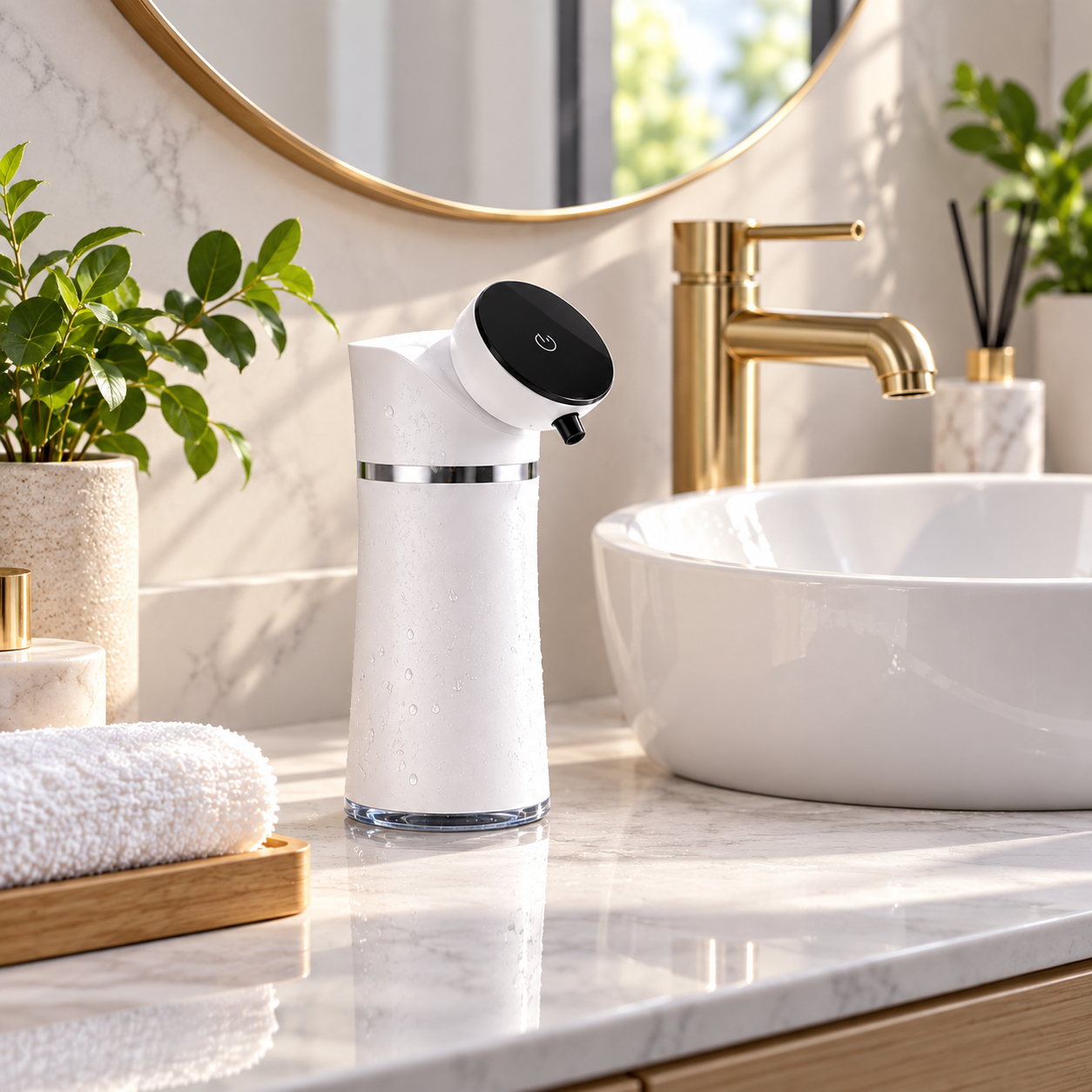
2026 SMART HYGIENE REVOLUTION
Touch-Free Cleaning. Waterproof Confidence.
In 2026, the most successful home products are not necessarily the ones with the most complicated technology. They are the ones that remove small points of friction from everyday life. In the bathroom and kitchen, that often means making routine hygiene faster, cleaner, more intuitive, and easier to maintain.
That is where an automatic liquid soap dispenser with infrared touch-free activation, an IPX5 water-resistant enclosure, an easy-to-read smart display, and a design intended for both bathroom and kitchen use can earn a strong position in the U.S. market.
The product should not be sold merely as “a soap dispenser with a sensor.” That description is too narrow. American consumers increasingly expect household products to combine hygiene, convenience, modern design, and practical durability. The stronger positioning is a smart hygiene upgrade for everyday spaces where wet hands, busy routines, and repeated use are normal.
Four features form the core story: IPX5 Water-Resistant Design, Touch-Free Infrared Dispensing, an Easy-to-Use Smart Display, and a form factor Designed for Bathroom & Kitchen. Together, these characteristics answer the five questions that matter most to U.S. consumers: Is it hygienic? Is it convenient? Will it fit a modern home? Can it handle splash-prone spaces? Is it easy enough to use every day?
1. Touch-free hygiene remains a highly intuitive consumer benefit
The first exposure point is also the easiest to understand: the dispenser releases soap without requiring the user to press a pump with soapy, wet, or dirty fingers.
The U.S. Centers for Disease Control and Prevention continues to identify handwashing with soap and clean, running water as one of the most effective everyday ways to remove germs and help reduce the spread of illness. In July 2026, CDC again emphasized the importance of hand hygiene for both healthcare professionals and the public. For ordinary households, CDC guidance continues to recommend washing with soap and water during key moments such as before preparing food, before eating, after using the toilet, after touching garbage, and after coughing, sneezing, or caring for someone who is ill.
An automatic dispenser does not make handwashing effective by itself. Users still need soap, water, proper scrubbing, rinsing, and drying. But it can remove one small contact point from the routine: the need to touch the pump before washing.
That makes the consumer message simple and credible: “Place your hand near the sensor, receive soap, wash—without pressing the dispenser.”
In the kitchen, the advantage becomes especially easy to visualize. Someone handling raw ingredients, dough, cooking oils, pet food, trash, or a messy countertop may not want to touch a pump with dirty hands. In the bathroom, touch-free operation helps keep the dispenser itself looking cleaner by reducing fingerprints and soap residue on the activation area.
The point is not to create fear around ordinary household surfaces. The point is convenience through fewer unnecessary touches.
2. Infrared dispensing turns a familiar habit into a smoother routine
“Infrared sensor” can sound technical, but the consumer benefit should be expressed in plain language: the dispenser reacts when a hand is presented in the sensing area.
That small automation matters because handwashing is a repetitive activity. A product used several times every day needs to be intuitive enough that the user does not think about it after the first day.
This is where the product fits the broader 2026 smart-home direction. The National Kitchen & Bath Association’s 2026 Kitchen Trends Report describes the kitchen as becoming increasingly intelligent, personalized, and health-conscious, with smart technology integration among the major trends expected to shape the category. NKBA’s 2026 Bath Trends Report likewise identifies growing technology integration in the bathroom, including smart fixtures and wellness-oriented features.
The significance is not that every bathroom product must become connected to Wi-Fi. In fact, the strongest smart products are often the ones that automate one useful function without making the user manage an app.
An infrared soap dispenser fits this “quiet smart” category. The technology serves a clear purpose: it eliminates the manual pumping step.
3. The strongest U.S. message is convenience, not technology for technology’s sake
American shoppers are surrounded by products labeled “smart.” Some require accounts, apps, subscriptions, voice assistants, firmware updates, or complicated pairing. A soap dispenser should not create that kind of burden.
For this category, smart should mean easy.
The ideal consumer experience is immediate: fill the reservoir, power the unit according to the product instructions, place it by the sink, and use it naturally. The smart display should provide useful information without becoming another screen demanding attention.
This is consistent with the broader 2026 kitchen and bath trend toward technology that supports daily routines. NKBA’s 2026 research describes homeowners as looking for spaces that improve well-being, simplify life, and integrate technology into the home in useful ways. That is exactly the positioning opportunity here.
The product is not valuable because it contains electronics. It is valuable because the electronics reduce one repetitive action and make the routine feel cleaner and more modern.
4. IPX5 is a serious exposure point—but it must be explained accurately
The second major selling point is water resistance. Bathrooms and kitchens are splash-prone environments. Water lands around sinks. Wet hands reach for nearby objects. Countertops are wiped down. Soap dispensers may be exposed to spray during cleaning.
An IPX5 water-resistant design gives buyers a clear technical reason to feel more confident about using an electronic dispenser near a sink.
The IP rating system is defined by IEC 60529, the international standard for degrees of protection provided by electrical enclosures. Independent testing organizations such as Intertek and UL describe the second digit of an IP code as the level of water-ingress protection. IPX5 corresponds to protection against water jets.
That distinction is important. IPX5 should not be described as “safe for underwater use” or “fully waterproof under all conditions.” Higher IP levels address temporary or continuous immersion. The more professional consumer message is: “IPX5 water-resistant construction designed to handle the splash-heavy reality of bathroom and kitchen use.”
This is a powerful example of how accuracy improves marketing. Instead of an unsupported claim like “completely waterproof,” the seller can provide a recognized technical rating and explain exactly why it matters.
5. “Waterproof confidence” should mean confidence around the sink—not permission to submerge the product
The article theme “Touch-Free Cleaning. Waterproof Confidence.” works well as a marketing idea, but the product page should distinguish between the emotional promise and the technical specification.
The emotional promise is confidence: users should not have to treat the dispenser like a fragile object every time water splashes near the sink.
The technical claim is IPX5 water resistance.
That means the practical message is about normal wet-zone use, splashing, and routine household cleaning around the unit—not dropping it into a sink full of water or placing it inside a shower stream unless the manufacturer specifically approves those conditions.
American consumers increasingly read reviews and compare specifications before purchasing electronics. A precise explanation can prevent disappointment and reduce product returns because expectations are aligned with the rating.
6. The bathroom is becoming smarter, more personalized, and more wellness-focused
Bathrooms in the U.S. are evolving from purely functional rooms into spaces designed around comfort, accessibility, wellness, storage, and technology.
NKBA’s 2026 Bath Trends Report, based on input from nearly 700 North American industry professionals, identifies smart-home integration and wellness-oriented technology as important directions in residential bath design. The organization describes technology as increasingly embedded in showers, lighting, energy systems, and other fixtures.
At the same time, homeowners are also paying attention to organization and ease of use. This creates an ideal space for a touch-free dispenser because it combines modern technology with an ordinary task.
The product should therefore be photographed and marketed as part of a contemporary bathroom ecosystem: next to a clean sink, with uncluttered surfaces, modern fixtures, neutral finishes, and a simple daily-use message.
It should not look like a laboratory device. It should look like a natural extension of the modern home.
7. Modern-home positioning works because renovation activity remains substantial
The U.S. home improvement market remains large in 2026. Houzz’s 2026 U.S. Houzz & Home Study, based on more than 20,000 users including more than 10,000 renovating U.S. homeowners, found that 54% reported renovating and half planned projects in 2026. Median renovation spending remained at $20,000, while spending among the highest-spending projects increased.
NKBA’s mid-year 2026 Kitchen & Bath Industry Outlook estimated the U.S. kitchen and bath market at about $228 billion for the year, including materials and labor.
These figures matter because a soap dispenser can be positioned as an accessible “finishing touch” within a much larger renovation economy. A homeowner may not be ready to install a fully automated smart faucet or remodel an entire vanity, but a touch-free dispenser can offer a visible smart-home upgrade at a much lower level of commitment.
This makes the product attractive for renters, homeowners, apartment dwellers, students, families, and anyone who wants a more modern sink setup without construction.
8. The kitchen may be the strongest everyday-use environment
Bathrooms are obvious, but the kitchen may deliver the most persuasive usage demonstrations.
CDC guidance identifies handwashing as especially important before, during, and after preparing food. That means soap access is part of the kitchen routine multiple times during food preparation.
Now imagine the actual sequence: a user has chicken juices, flour, oil, sauce, coffee grounds, or food scraps on their hands. With a manual pump, they may touch the top of the dispenser before washing. With an infrared dispenser, they can receive soap without touching the pump.
That is an easy-to-understand benefit, and it is highly visual for social media advertising.
The product can also support other kitchen moments: after handling pet food, after emptying the trash, after gardening, after cleaning, or before preparing a meal.
For U.S. marketing, a kitchen video can be more convincing than a technical diagram because it demonstrates the benefit in a situation everyone recognizes.
9. “Designed for Bathroom & Kitchen” expands the value of one purchase
One of the strongest practical selling points is versatility.
A product suitable for both bathroom and kitchen use gives the consumer more flexibility. It can be purchased for the guest bathroom and later moved to the kitchen. Families can use the same model in multiple rooms. Apartment residents can choose the sink where touch-free dispensing is most useful.
This helps the product move beyond a niche hygiene gadget and into the broader home-organization category.
Retail merchandising should make this flexibility visible. Instead of showing only one bathroom image, listings should include bathroom, kitchen, utility-room, and perhaps home-office break-area contexts where appropriate.
The more the consumer can imagine the dispenser fitting into daily life, the stronger the conversion opportunity.
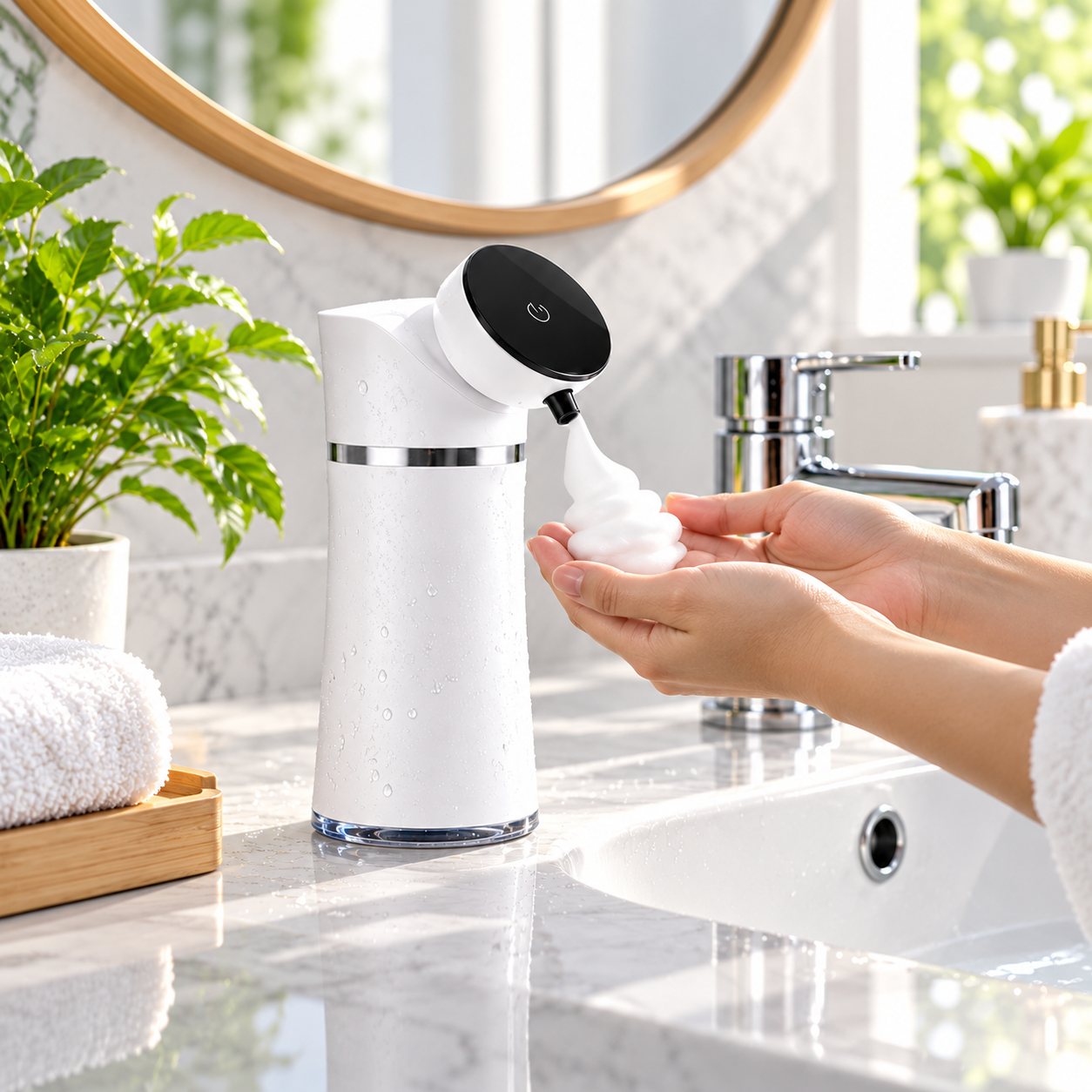
10. A smart display should solve uncertainty, not create distraction
The third core feature is the smart display. Its value depends on what information the actual product provides, but the commercial principle is straightforward: the display should make operation easier to understand.
If it shows battery or charging status, the benefit is fewer surprises. If it shows dispensing settings, the benefit is easier adjustment. If it displays other operational information, the message should focus on clarity.
Do not advertise functions the actual model does not have. Instead, show the real screen in close-up photography and explain each icon clearly.
For American consumers, “smart display” is strongest when it means “you can see what the dispenser is doing at a glance.”
This fits a larger consumer expectation: technology should reduce uncertainty. A user should not need to guess whether the unit is powered, whether a mode has changed, or why the dispenser behaves differently.
11. Touch-free operation can also help keep the product itself looking cleaner
There is another benefit that is less medical and more visual: fewer touches can mean fewer fingerprints and less residue on the control area.
Manual pumps frequently develop soap buildup around the button because users touch them with wet or soapy hands. An infrared dispenser shifts the interaction away from the top surface.
This does not mean the dispenser never needs cleaning. Any bathroom or kitchen product needs regular wiping, especially near a sink. But the touch-free interaction can support a cleaner-looking setup between cleanings.
For the U.S. home market, this is a highly relatable selling point: less pumping, less mess around the dispenser.
12. Easy daily use is the feature that determines whether smart hygiene becomes a habit
A product can have excellent specifications and still fail if it is annoying to use.
That is why “Easy Daily Use” should be one of the main headline benefits, not a secondary detail.
The ideal experience has very little learning curve. A family member, houseguest, child, or roommate should understand how to use the unit within seconds.
Product design should therefore communicate the sensor zone clearly. The smart display should be readable. Refill access should be intuitive. Charging or battery instructions should be simple. Any adjustable dispensing setting should be easy to change without entering a complex menu.
If the product succeeds at these basics, users stop thinking of it as “technology” and simply treat it as the normal way they get soap.
That is the point at which a smart product becomes genuinely useful.
13. Families are an especially strong audience for the convenience story
Households with children provide a natural use case. Kids may press a manual pump repeatedly, leave soap around the sink, or struggle with stiff pumps. A touch-free dispenser can make the interaction more consistent and engaging.
The marketing should remain realistic. The product does not teach handwashing on its own, and parents still need to help young children build good habits. But the novelty and ease of automatic dispensing can remove one physical barrier from the routine.
For family-oriented advertising, the strongest message is not fear of germs. It is “make handwashing one step easier.”
That tone aligns well with CDC guidance, which emphasizes routine handwashing at key times rather than alarmist messaging.
14. Touch-free hygiene is also relevant for cooking, cleaning, and hobby messes
Kitchen marketing should not be limited to food safety.
American households use sinks for many messy tasks: cleaning paintbrushes, gardening, pet care, DIY projects, hair coloring, crafts, baking, grilling prep, and household cleaning.
In each of these scenarios, touching a pump with messy hands can transfer residue to the dispenser. Infrared activation avoids that manual step.
This widens the product’s use story considerably. It becomes a convenience product for anyone who regularly uses both hands for messy tasks.
That is especially useful for short-form video marketing: show a messy task, show the hand entering the sensor zone, show soap dispensing without touching the unit, then show clean hands and a cleaner countertop.
15. IPX5 supports a stronger bathroom story than ordinary electronics
Electronic products near sinks naturally raise a consumer question: what happens when they get wet?
This is where the IPX5 rating should be featured prominently in product images, comparison tables, FAQs, and packaging—assuming the finished product has actually been tested and rated accordingly.
According to recognized IP testing references based on IEC 60529, IPX5 corresponds to protection against water jets. That is meaningfully stronger than a vague phrase like “splash resistant.”
At the same time, sellers should include sensible use guidance. Water resistance is not the same as immersion protection. Consumers should follow the manufacturer’s instructions for cleaning, charging, and placement.
Accurate education helps turn a technical rating into purchase confidence.
16. “Water-resistant” is a better trust-building term than an absolute waterproof claim
Many consumer products are marketed with the word “waterproof,” but an absolute claim can create unrealistic expectations.
If the verified rating is IPX5, the most defensible product wording is “IPX5 water-resistant design”. The campaign phrase “Waterproof Confidence” can remain a broad creative theme, but the specification itself should stay precise.
That matters especially in the U.S. market, where customers compare ratings and write detailed reviews. A buyer who understands what the product can and cannot handle is more likely to be satisfied.
Credibility is a conversion tool.
17. A clean, modern silhouette matters because the dispenser stays visible
A soap dispenser is not hidden in a cabinet. It remains visible on or near the sink every day.
That gives design real commercial importance. Consumers want a device that looks intentional rather than improvised.
The product should be shown with clean lines, minimal visual clutter, and a smart display that feels integrated rather than added on. The design should work with common U.S. bathroom and kitchen finishes: white, black, brushed metal, warm wood, stone, neutral tile, and modern countertops.
NKBA’s 2026 trend research repeatedly emphasizes the growing connection between function, technology, wellness, and cohesive home design. A dispenser that looks at home beside modern faucets and fixtures can participate in that larger design story.
18. The product fits a broader consumer move toward useful smart-home upgrades
At KBIS 2026, NKBA highlighted growing smart-home integration in kitchens and baths, including a new Smart Home Tech Award developed with CEDIA. The direction is clear: technology is increasingly moving into the rooms where people perform everyday routines.
But the opportunity for a soap dispenser is different from large connected appliances. It offers a low-friction entry point into smart-home convenience.
No remodeling is required. No plumbing is changed. No contractor needs to open a wall. The user can add automation directly to the countertop or sink area.
This makes the product especially attractive as a gift, apartment upgrade, dorm-room accessory, new-home finishing item, or quick kitchen-and-bath refresh.
19. Home renovation data supports the “small upgrade, visible improvement” message
Houzz’s 2026 renovation study shows that U.S. homeowners continue to invest in their homes even while renovation activity has moderated from earlier peaks. Half of surveyed homeowners planned renovation projects in 2026.
Not every project is a major remodel. Many consumers look for smaller changes that improve daily living without major cost or disruption.
A touch-free dispenser fits this behavior well. It changes a routine that happens several times a day and is visible immediately after installation.
The marketing opportunity is therefore: “A small smart-home upgrade you notice every day.”
20. Position the product around routines, not only features
The strongest product page should not begin with a wall of specifications. It should begin with familiar moments.
Hands covered in cooking ingredients. A child coming in from outside. Someone washing up after taking out the trash. A guest using the powder room. A homeowner cleaning the bathroom sink. A family preparing dinner.
Then show the technology solving those moments.
The sensor removes the pump touch. The IPX5 enclosure supports sink-side confidence. The display makes operation visible. The bathroom-and-kitchen design means the product belongs wherever the household needs it most.
Features become persuasive when the consumer can see the routine they improve.
21. Four key exposure angles for the U.S. market
Touch-Free Hygiene: “Soap without touching the pump”
Lead with the infrared sensor and demonstrate it visually. Keep the hygiene message practical rather than alarmist.
IPX5 Water Resistance: “Built for the splash zone”
Explain that IPX5 refers to protection against water jets under the IP rating framework. Clearly state that water resistance does not mean immersion-proof.
Smart Convenience: “Useful information at a glance”
Show the real display and explain only the functions the actual model provides.
Bathroom & Kitchen Versatility: “One smart design, multiple daily routines”
Use both rooms in product photography and video so consumers immediately understand the flexibility.
22. Avoid claims that weaken trust
Strong marketing does not require exaggeration.
Do not claim the dispenser “kills germs” unless there is specific validated technology supporting that claim. Do not suggest it replaces correct handwashing. Do not describe IPX5 as safe for immersion. Do not claim “hospital grade” unless there is a defined certification or test that supports the term.
The product already has enough useful benefits without these statements.
Touch-free activation is real. IPX5 water resistance is meaningful. Smart-display convenience is visible. Bathroom and kitchen versatility is easy to demonstrate.
Accuracy makes the entire product story more premium.
23. The best consumer story is “cleaner interaction, simpler routine”
The core value proposition can be reduced to one line:
“A smarter way to get soap—without touching the pump, without worrying about ordinary sink-side splashes, and without adding complexity to your day.”
That line captures why the product fits the U.S. consumer market in 2026.
It supports hygiene without pretending to be a medical device. It uses technology without demanding a complicated smart-home setup. It has a water-resistance rating that makes sense in the intended environment. And it belongs naturally in two of the busiest rooms in the home.
24. Product photography should prove the message
The best marketing assets should show the product doing real work.
Use a close-up of the infrared sensor activation. Show a hand receiving soap without touching the unit. Show droplets around the sink area to communicate the splash-prone environment. Display the smart screen clearly. Include bathroom and kitchen lifestyle images. Show refill access and charging or battery operation according to the actual model.
If the product has adjustable dispensing levels, demonstrate the difference. If the display shows power level, capture it. If the nozzle is designed to reduce dripping, show the actual performance rather than relying on a generic claim.
Every visual should answer a consumer question.
25. Reviews will focus on practical details—so sell those details first
U.S. shoppers reviewing an automatic dispenser are likely to discuss sensor responsiveness, unwanted triggering, refill convenience, battery or charging life, water exposure, soap compatibility, display clarity, and how easy the unit is to clean.
That means manufacturers and sellers should address these points before the purchase.
Provide the recommended soap viscosity if known. Explain sensor range if measured. State the reservoir capacity. Give clear charging guidance. Explain the IPX5 rating. Provide cleaning instructions. List the dimensions. Show how the lid opens.
A well-documented product creates fewer surprises and stronger long-term confidence.
26. The 2026 smart hygiene revolution is about invisible convenience
The best home technology eventually disappears into the routine.
The user does not think, “I am using infrared technology.” They hold out a hand and receive soap.
They do not think, “This enclosure has an ingress protection rating.” They simply feel more comfortable using an electronic product near the sink.
They do not think, “This display creates human-machine interface clarity.” They glance at it and understand the product status.
That is what modern convenience looks like: the technology is present, but the effort is absent.
Conclusion: Touch-free cleaning for the way American homes actually work
In 2026, U.S. households are continuing to invest in kitchens, bathrooms, wellness, and practical smart-home technology. CDC guidance continues to reinforce the importance of washing hands with soap and water during everyday routines, while kitchen and bath industry research shows that consumers increasingly want technology that supports comfort, health, organization, and convenience.
An automatic liquid soap dispenser fits directly into that intersection.
IPX5 Water-Resistant Design addresses a basic reality: bathrooms and kitchens are wet environments, and consumers want more confidence placing electronics near the sink. The rating should be communicated accurately as water resistance against water jets, not as permission for immersion.
Touch-Free Infrared Dispensing removes the need to press the pump with wet, soapy, or dirty fingers. It is particularly easy to appreciate during cooking, cleaning, bathroom routines, pet care, and family use.
An Easy-to-Use Smart Display brings clarity to the interaction and supports the modern-home expectation that technology should be understandable at a glance.
A Bathroom & Kitchen Design gives the product flexibility and expands its value beyond a single room.
Most importantly, the product does not need an exaggerated medical claim to succeed. Its advantages are already relevant to everyday American life.
The right message is straightforward: touch-free hygiene, water-resistant confidence, and smarter convenience for the places where people wash their hands every day.
That is the real 2026 Smart Hygiene Revolution—not technology that demands more attention, but technology that quietly makes one of the most familiar routines in the home cleaner, easier, and more convenient.



