


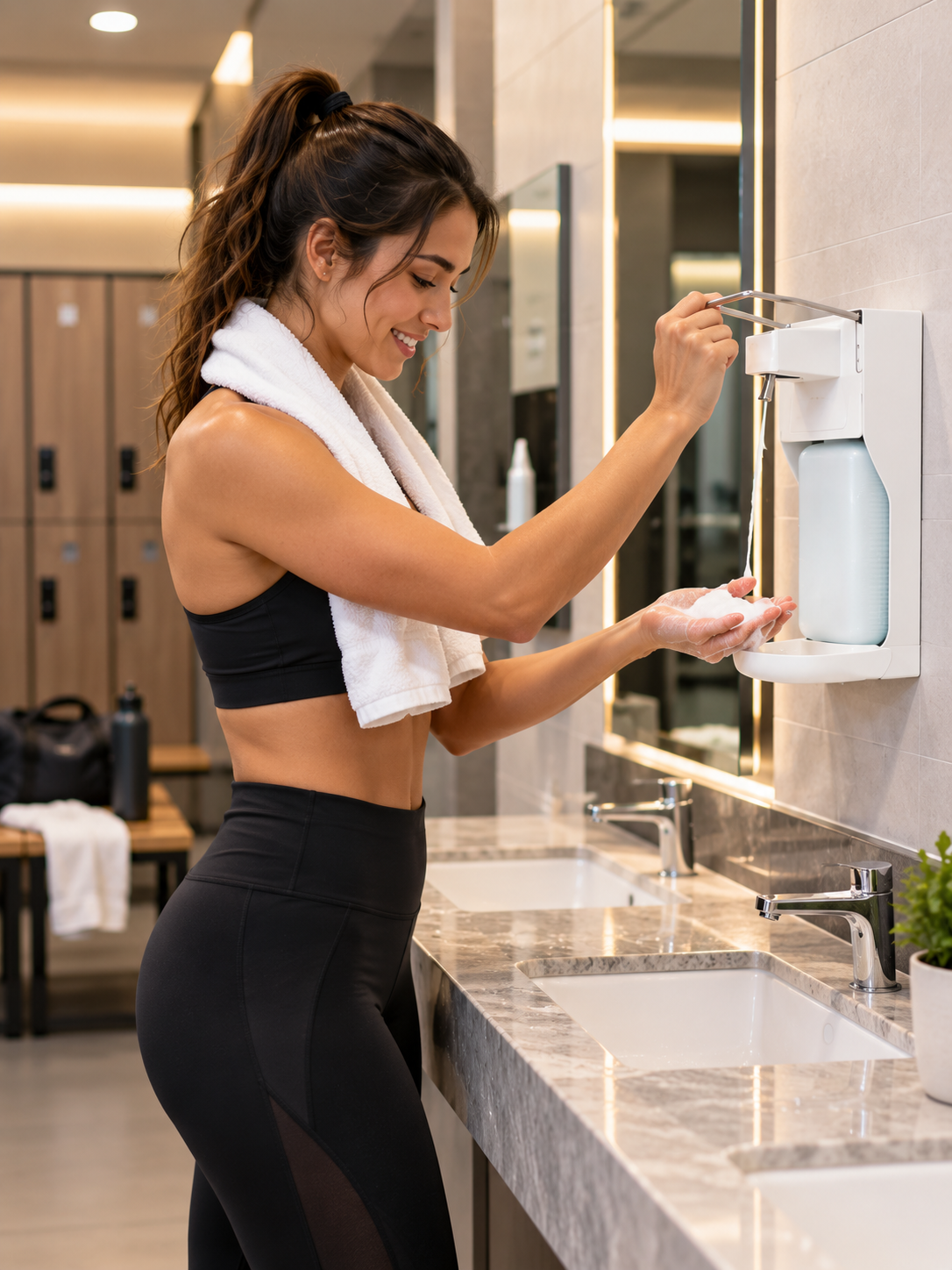
Professional Hand Hygiene, Built for High-Traffic Spaces
In 2026, hand hygiene is no longer a background facility issue. For hospitals, outpatient centers, long-term care facilities, schools, airports, public buildings, food-service environments, and other high-traffic spaces, the way soap is stored, dispensed, refilled, and accessed has become part of the broader conversation about infection prevention, staff efficiency, public confidence, and facility resilience.
The U.S. healthcare market offers a particularly clear reason to rethink basic hygiene infrastructure. In July 2026, the U.S. Centers for Disease Control and Prevention reported that, in its 2023 prevalence survey, about 1 in 38 hospitalized patients had at least one healthcare-associated infection on any given day, an improvement from about 1 in 31 in 2015. The progress is meaningful, but the underlying message is equally important: infection prevention remains an operational priority, not a completed project. The CDC also continues to emphasize hand hygiene as a core infection-control practice and has noted that healthcare providers, on average, clean their hands less than half as often as they should.
That reality puts ordinary fixtures under a new spotlight. A soap dispenser is not a medical device and should not be marketed as a substitute for infection-control protocols, staff training, environmental cleaning, or appropriate use of alcohol-based hand rub. But in a restroom, scrub-adjacent wash area, staff washroom, public lobby restroom, clinic bathroom, or other sink-based hygiene point, the dispenser is one of the pieces of physical infrastructure that determines whether soap is easy to access, whether staff have to refill too frequently, whether the fixture can tolerate demanding daily use, and whether users can minimize hand contact with the actuator.
This is where a 1000 ml wall-mounted elbow-press soap dispenser made from ABS and 304 stainless steel can earn a strong position in the 2026 U.S. market. Its value is not based on one dramatic feature. Its value comes from the way four practical design choices—elbow-press operation, large capacity, wall-mounted installation, and durable mixed-material construction—answer several real problems at once.
1. The 2026 hygiene challenge is operational, not just behavioral
Hand hygiene campaigns often focus on behavior: wash at the right moments, use the right technique, and make supplies available. The behavior matters, but compliance is also influenced by the environment around the user. If soap is empty, difficult to reach, awkward to operate, or installed in a location that interrupts workflow, even a well-written hygiene policy can lose effectiveness at the point of use.
CDC core infection-prevention guidance says that healthcare facilities should ensure that supplies necessary for hand-hygiene adherence are readily accessible in areas where patient care is delivered. The same practical principle applies beyond the bedside. Staff restrooms, public restrooms, outpatient clinics, imaging centers, urgent-care sites, rehabilitation centers, laboratories, food preparation areas, and other support spaces all depend on reliable handwashing infrastructure.
For facility managers, this changes the purchasing question. Instead of asking, “What is the lowest-cost dispenser we can mount on the wall?” the better question becomes, “Which dispenser design reduces friction across users, cleaners, maintenance teams, and procurement?”
That is a much stronger exposure point for a commercial product.
2. Elbow-press operation: a credible low-contact story
The first marketing advantage is the elbow-press mechanism. It should be described accurately. An elbow-press dispenser is not a sensor-activated touchless dispenser, so calling it fully “hands-free” may create an expectation the product does not meet. The stronger and more credible positioning is Low-Contact Operation.
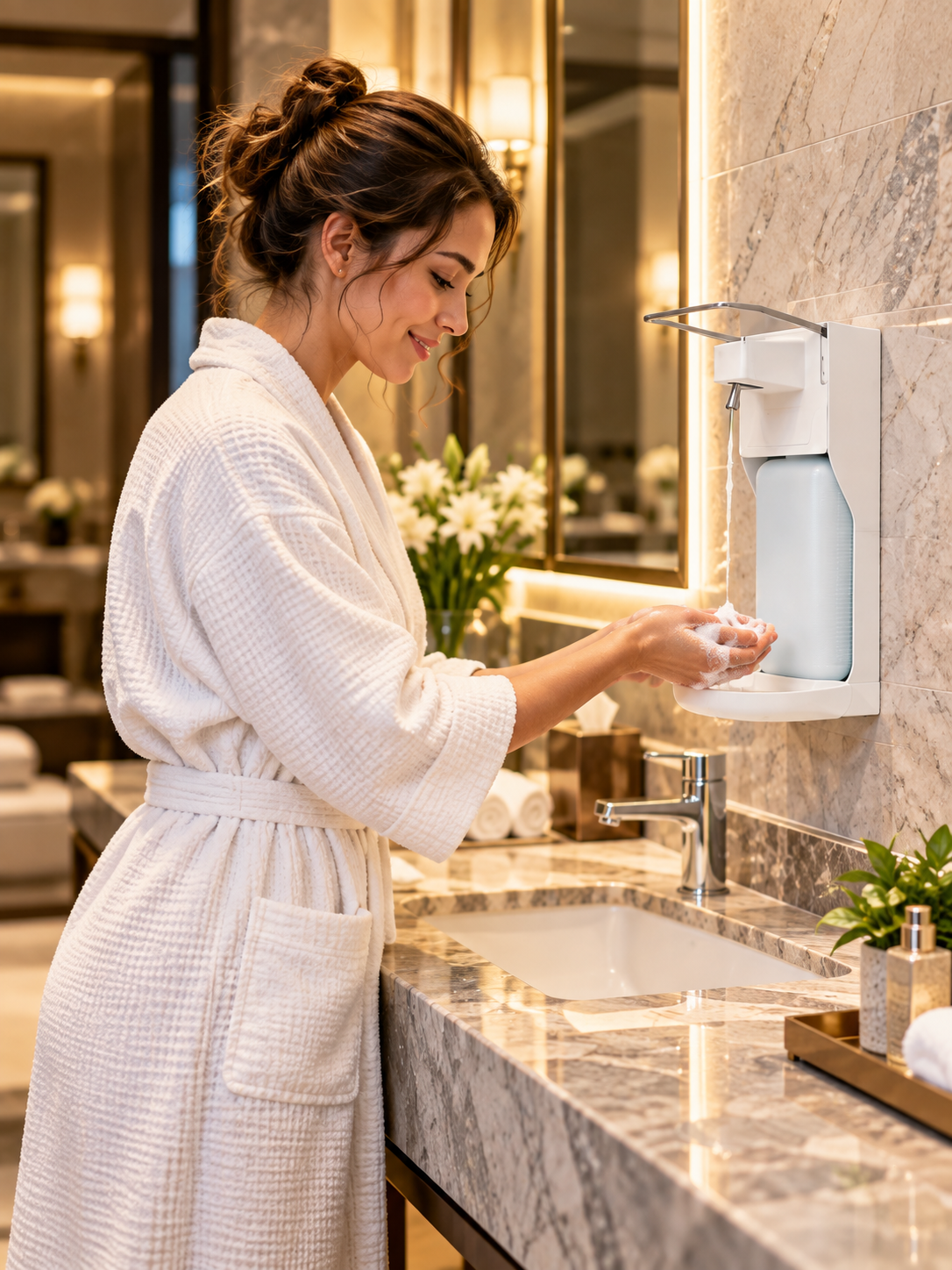
A user can press the lever with the elbow or forearm rather than using clean fingertips to push a conventional hand button. That distinction is simple, visible, and easy to demonstrate in photos, short videos, distributor listings, trade-show displays, and facility training materials.
For Healthcare & Medical settings, the appeal is intuitive. Hand hygiene is performed because hands can carry microorganisms from one surface, person, or task to another. Reducing the need to use the hand to operate a dispenser can support a cleaner workflow around handwashing. It does not eliminate the need to clean the dispenser itself, and it does not prove a specific reduction in infection rates. But it aligns with the broader infection-prevention mindset of reducing unnecessary hand contact with frequently used fixtures.
The same message works in Public Hygiene. In an airport restroom, school, stadium, municipal building, restaurant back-of-house area, factory, or office complex, users immediately understand the value of having an alternative to pressing a small button with their fingers.
This makes the product especially suitable for marketing around High-Traffic Areas. The higher the user volume, the more often the dispenser is activated. A low-contact mechanical interface provides a visible hygiene feature without requiring users to learn a complicated process.
The strongest 2026 claim is therefore not “touchless technology.” It is “simple, mechanical, low-contact dispensing designed for demanding environments.”
3. 1000 ml capacity: fewer refill interruptions where traffic is highest
The second exposure point is capacity. A 1000 ml reservoir gives the product a straightforward operational story: more soap available between refills than smaller-capacity units, depending on dose size and actual usage.
In high-traffic commercial restrooms, refill frequency is not just a janitorial detail. It affects labor planning, supply runs, the risk of an empty dispenser during peak periods, and the number of times maintenance teams need to open and service the fixture. In a hospital or medical campus, Environmental Services teams may be responsible for large numbers of washrooms and support areas. In airports, convention centers, schools, universities, arenas, and factories, the same challenge appears at a different scale.
This is where High-Traffic Areas and Durable Commercial Equipment become connected. A large-capacity dispenser only creates value if it is also practical to service and durable enough for repeated daily operation. The marketing story should therefore present 1000 ml not as an isolated specification, but as part of a facility-efficiency package.
A useful message for buyers is: “Less attention on the dispenser, more attention on the facility.”
That does not mean the unit never needs inspection. Facility teams should still establish refill schedules, clean contact surfaces, verify that the mechanism works properly, and follow the soap manufacturer’s storage and handling instructions. But a larger reservoir can create more breathing room between service events compared with smaller units under the same usage conditions.
For procurement teams, this is a stronger business argument than simply saying “large tank.” It connects capacity with staff time, uptime, and user experience.
4. Wall-mounted design: reclaiming counter space and standardizing placement
The third advantage is the wall-mounted format. Commercial restrooms often have to manage limited sink and counter space while keeping hygiene supplies visible and easy to reach. A wall-mounted dispenser removes a loose bottle from the counter, reduces clutter, and gives facility teams a repeatable installation location.
This matters in Healthcare & Medical environments because standardization can simplify maintenance. When dispensers are consistently installed, staff know where to find them, cleaning teams know where to inspect them, and facility managers can create a more uniform restroom specification across multiple floors or locations.
The wall-mounted format also supports Public Hygiene applications where loose containers may be moved, misplaced, tipped over, or create an untidy appearance. A fixed dispenser gives the wash area a more intentional commercial look.
Accessibility, however, should be treated seriously. Under the ADA Standards for Accessible Design, soap dispensers provided at accessible lavatories must be located within applicable reach ranges so that they are conveniently usable by a person at the accessible lavatory. Therefore, marketing to U.S. facility managers should not simply say “easy to install anywhere.” A more professional message is: “Wall-mounted for flexible placement; installation height and location should be selected to meet applicable accessibility and facility requirements.”
That sentence does more than reduce compliance risk. It signals that the product is being sold by a supplier that understands commercial procurement rather than consumer-only selling.
5. ABS + 304 stainless steel: durability where commercial equipment is judged every day
The fourth exposure point is material construction. ABS and 304 stainless steel give the product a useful mixed-material story. ABS is commonly used in commercial housings because it can provide a balance of rigidity, impact resistance, manufacturability, and manageable weight. 304 stainless steel is widely used in commercial and hygiene-related environments because of its corrosion resistance and clean, professional appearance.
The exact durability of any finished dispenser still depends on wall thickness, component design, assembly quality, cleaning chemicals, environment, and maintenance. For that reason, the best marketing language should avoid unsupported promises such as “indestructible,” “rust-proof forever,” or “medical-grade certified” unless the relevant testing or certification exists.
A stronger message is “built with ABS and 304 stainless steel for repeated commercial use.”
That wording supports the Durable Commercial Equipment positioning without overclaiming.
In procurement, materials also help buyers understand where the product sits in the market. A lightweight household dispenser and a commercial fixture may perform the same basic task, but the commercial buyer is evaluating the total environment: repeated operation, frequent cleaning, visual wear, user abuse, maintenance access, replacement cycles, and appearance across a facility.
The product should therefore be photographed and presented in environments that communicate durability: hospital restrooms, clinic wash areas, staff facilities, laboratories, institutional corridors, commercial washrooms, education buildings, transportation hubs, warehouses, and other demanding spaces.
6. Why the hospital market is an especially strong fit
The hospital market is attractive because hand hygiene is already deeply connected to patient safety, infection prevention, and regulatory attention. CDC’s July 2026 healthcare-associated infection update provides a timely context. The national picture has improved, but HAIs still occur, and prevention remains a priority for hospitals and public-health agencies.
At the same time, the product must be positioned with precision. A wall-mounted elbow-press soap dispenser is not a replacement for alcohol-based hand rub at the point of care. CDC guidance generally prefers alcohol-based hand rub in many clinical situations when hands are not visibly soiled, while soap and water are required or preferred in certain circumstances. A sink-side soap dispenser serves a different but essential role: making soap available where handwashing with water takes place.
This distinction creates credibility.
Rather than claiming “our dispenser prevents hospital infections,” say: “Designed to support reliable soap access in healthcare wash areas.”
Rather than claiming “hands-free infection control,” say: “Elbow-press operation supports a low-contact handwashing workflow.”
Rather than claiming “CDC compliant,” say: “Suitable for facility strategies that prioritize accessible hand-hygiene supplies; installation and product selection should follow applicable facility policies and regulations.”
For U.S. healthcare buyers, accuracy is part of persuasion. Infection-control professionals, hospital procurement teams, EVS managers, architects, and facility engineers are accustomed to evaluating claims. Precise language can make a commercial supplier appear more credible, not less ambitious.
7. High-traffic spaces are bigger than hospitals
The strongest growth opportunity may come from treating hospitals as the credibility anchor rather than the only market.
CDC guidance for community facilities recommends regular cleaning of high-touch surfaces and notes that high-traffic areas may require more frequent cleaning or disinfection. In separate respiratory-virus guidance, CDC identifies spaces such as lobbies, cafeterias, and waiting rooms as high-traffic areas that should be cleaned regularly. These recommendations reinforce a broader reality: hygiene infrastructure is increasingly evaluated across the entire building journey, not only in treatment rooms.
That opens multiple customer segments.
In urgent-care centers and outpatient clinics, the dispenser can be positioned around compact wall-mounted hygiene and practical capacity.
In nursing homes and assisted-living facilities, it can be positioned around straightforward mechanical operation, visible placement, and daily durability.
In schools and universities, the key points become Public Hygiene, high user volume, wall-mounted space saving, and manageable refill cycles.
In airports and transportation terminals, the focus shifts toward High-Traffic Areas, large capacity, fixed installation, and Durable Commercial Equipment.
In factories and warehouses, the message can emphasize workplace sanitation, robust construction, and practical operation for shared wash areas.
In restaurants, cafeterias, and food-service back-of-house spaces, the value is reliable soap availability and wall-mounted organization at designated sinks.
In public buildings, stadiums, shopping centers, and event venues, the same dispenser becomes part of a larger Public Hygiene strategy.
This multi-segment approach gives distributors and B2B buyers more reasons to stock the product. Instead of selling a narrowly defined “hospital soap dispenser,” sellers can describe it as a commercial low-contact dispenser designed for healthcare and other demanding high-traffic environments.
8. The overlooked selling point: resilience without unnecessary complexity
One of the most useful exposure angles is simplicity.
Many modern washrooms use sensor-operated dispensers. They can offer genuine touchless activation and may be appropriate in many environments. But electronic systems also introduce batteries, sensors, calibration, and additional components. An elbow-press dispenser competes differently.
Its value proposition is mechanical and understandable: press the lever with the elbow or forearm, receive soap, wash hands.
This should not be framed as “better than all automatic dispensers.” Different facilities have different requirements. The more defensible message is that a mechanical low-contact dispenser can be attractive where buyers want fewer electronic dependencies, easy-to-understand operation, and a familiar maintenance model.
That is particularly relevant for multi-site operators. A product that facility staff can quickly inspect and understand can be easier to standardize across different locations.
For a 2026 hygiene product, innovation does not have to mean adding electronics. Innovation can also mean removing friction.
10. What U.S. buyers will want to verify
Professional selling also means anticipating procurement questions.
Healthcare and institutional buyers may ask what soap formulations are compatible with the pump and reservoir. They may ask whether replacement parts are available, how the unit is opened for refilling, whether it can be locked, what mounting hardware is included, what the dispensing dose is, and how the materials respond to specific cleaning agents. They may also ask for dimensions, product weight, installation instructions, warranty terms, carton quantities, lead times, and testing documentation.
If those data are available, they should be added to the product page. If they are not available, they should not be invented.
The same principle applies to “hospital-grade” language. In the United States, sophisticated buyers may interpret “grade,” “certified,” “antimicrobial,” “ADA compliant,” or “infection reducing” as claims requiring specific evidence. If the product has not been tested or certified for a particular standard, the safer and more professional positioning is “designed for hospital, healthcare, and other high-traffic commercial environments.”
That still gives the product a strong market identity while protecting trust.
12. From Public Hygiene to facility economics
The hygiene story attracts attention. The economics can close the sale.
Facility managers rarely purchase equipment based on one specification. They think in terms of total operating burden. How often does it need attention? How easy is it to refill? How long does it last? Will users understand it? Does it fit the space? Does it look appropriate in a professional environment? Can the same model be deployed across many sites?
The 1000 ml capacity speaks to refill planning.
The wall-mounted format speaks to space control and repeatable installation.
The elbow-press mechanism speaks to low-contact operation and mechanical simplicity.
The ABS + 304 stainless steel construction speaks to Durable Commercial Equipment.
Together, they create a more complete procurement story.
This matters because the product does not need to be the most technologically complex dispenser in the building to be valuable. It needs to be dependable, understandable, appropriate for the environment, and easy to integrate into the facility’s hygiene routine.
14. The most effective exposure points for the U.S. market
For Healthcare & Medical:
Position the dispenser as a practical sink-side handwashing fixture for hospitals, clinics, long-term care facilities, medical offices, staff washrooms, and other healthcare support spaces. Emphasize reliable soap access, low-contact elbow operation, commercial materials, and professional wall-mounted installation.
For Public Hygiene:
Show the product in schools, airports, municipal buildings, offices, factories, restaurants, stadiums, and other shared facilities. Emphasize visible hygiene infrastructure, straightforward use, and fixed wall mounting.
For High-Traffic Areas:
Lead with 1000 ml capacity, durable construction, and reduced dependence on constant small-bottle replacement. Make the product relevant to facilities that experience repeated daily use.
For Durable Commercial Equipment:
Use detailed close-up images of the ABS housing, 304 stainless steel components, lever mechanism, wall mounting points, and refill access. Avoid vague “premium quality” language; show the construction.
For Hands-Free / Low-Contact Operation:
Use “low-contact” as the primary term and explain that users can operate the dispenser with an elbow or forearm. This is more accurate than describing a mechanical elbow-press product as sensor-based touchless equipment.
15. Why this product belongs in the 2026 hygiene conversation
The most important shift in facility hygiene is not a single new gadget. It is the recognition that small infrastructure decisions influence everyday routines at scale.
A hospital may have thousands of hand-hygiene moments in a day. A busy airport, school, factory, office tower, or stadium may have thousands of restroom visits. Every wash station has to work repeatedly, visibly, and predictably.
That is why a soap dispenser deserves more attention than its size suggests.
The right commercial dispenser helps ensure that soap is present, keeps the wash area organized, gives users a clear method of dispensing, and supports facility teams responsible for inspection and refilling. A 1000 ml wall-mounted elbow-press model adds specific advantages: larger capacity, low-contact mechanical activation, space-saving installation, and ABS + 304 stainless steel construction designed for commercial use.
In 2026, that combination fits the direction of the U.S. market particularly well. Healthcare organizations continue to focus on infection prevention. Public facilities continue to manage high-touch, high-traffic environments. Employers continue to provide handwashing infrastructure. Accessibility remains a real installation consideration. Facility teams continue to search for equipment that balances hygiene, durability, maintenance, and cost.
The product should therefore be sold not as a novelty, but as infrastructure.
It belongs beside the sink because that is where policy becomes practice.
It belongs on the wall because fixed, visible placement helps facilities standardize the hygiene experience.
It uses an elbow-press mechanism because low-contact operation can reduce the need for direct hand contact with the actuator.
It carries 1000 ml because busy locations benefit from more capacity between refills.
It combines ABS and 304 stainless steel because commercial buyers expect equipment that looks and feels appropriate for repeated daily use.
And it fits Healthcare & Medical, Public Hygiene, High-Traffic Areas, and other demanding environments because professional hand hygiene depends on more than awareness. It depends on whether the right supplies are available at the exact moment people need them.
Conclusion: Build hygiene into the space
The 2026 hygiene conversation is moving toward practical resilience. Facilities want solutions that are easy to understand, easier to maintain, and appropriate for repeated real-world use.
A wall-mounted 1000 ml elbow-press soap dispenser cannot replace hand-hygiene training, environmental cleaning, infection-control policies, or clinical judgment. What it can do is strengthen one essential link in the chain: dependable access to soap at the wash station, supported by a low-contact operating method and commercial-minded construction.
For hospitals and medical facilities, that makes it a practical addition to a broader hand-hygiene program.
For public buildings and other high-traffic spaces, it makes hygiene more visible, organized, and operational.
For procurement teams, it offers a clear combination of capacity, placement, durability, and simplicity.
And for distributors and facility-equipment suppliers, it offers a product story that is timely, credible, and easy to understand.
2026 HYGIENE INNOVATION is not about adding complexity for its own sake. It is about designing the basics around the way real facilities operate.
Professional hand hygiene starts with behavior. But it succeeds more consistently when the environment is built to support it.



