


Pet ownership has changed the way millions of households think about cleaning.
For people who live with dogs and cats, cleaning is rarely limited to vacuuming the floor once or twice a week. Pet hair moves. It collects on the sofa, clings to bedding, settles into rugs, appears on dark clothing just before work, travels into the car, and somehow returns shortly after the room has been cleaned.
That is why one of the most relevant cleaning ideas for pet households in 2026 is not simply more cleaning power. It is easier, faster and more accessible cleaning.
A long-handle lint roller addresses this everyday reality in a surprisingly straightforward way. Instead of turning every visible patch of pet hair into a full vacuuming or laundry session, it provides a quick way to remove loose fur from the surfaces where people actually notice it most.
The opportunity is significant because the number of households living with pets remains enormous across both North America and Europe.
In July 2026, the American Pet Products Association reported that approximately 71 million U.S. households owned a dog, with dog ownership reaching 53% of U.S. households in its underlying 2025 survey. APPA also noted that consumers were becoming more intentional about spending and bringing more routine pet care activities into the home.
The picture is similar across the Atlantic. UK Pet Food's 2026 survey, conducted by Kantar, estimated that 62% of UK households own a pet, representing around 18 million homes. The organization estimated approximately 15.5 million pet dogs and 13.1 million cats in the country.
Across the European Union, FEDIAF currently reports approximately 140 million pet-owning households, or about 49% of households.
Those numbers matter for a simple reason: pet hair management is not a niche household problem.
It is an everyday cleaning category.
And that creates a strong opening for a tool that combines three things consumers immediately understand:
Convenience. Multi-surface cleaning. Pet-hair removal.
Pet Hair Is Not a Once-a-Week Problem
A pet can spend only a few minutes on a sofa and leave visible hair behind. A cat may sleep on the same bed every afternoon. A dog can ride in the car and leave fur on the rear seat. A clean black sweater can attract hairs simply because its owner sat in a favorite pet chair.
The problem is not necessarily that each individual mess is large.
The problem is repetition.
Pet hair appears in small amounts, in different places, throughout the day.
That changes the economics of cleaning.
A powerful vacuum cleaner may be ideal for deep cleaning the floor, but many owners do not want to bring out a large appliance every time they see several hairs on a cushion.
A washing machine is essential for genuinely dirty bedding, but washing an entire blanket simply because loose fur has accumulated on the surface can be excessive.
A small handheld lint roller works well on clothing, but repeatedly bending over a bed, rug or large sectional sofa with a short handle can make a simple task unnecessarily inconvenient.
This is exactly where a long-handle adhesive lint roller can establish its purpose.
It sits between the large cleaning appliance and the tiny emergency clothing roller.
It is designed for the moments when the homeowner thinks:
“I want this hair gone now, but I do not want to start a complete cleaning session.”
That is the product's first and perhaps strongest exposure point.
Exposure Point No. 1: Convenience Is Becoming a Product Benefit in Its Own Right
Convenience used to sound like an additional feature.
In 2026, it increasingly functions as part of the product's core value.
Mintel described convenience in April 2026 as a major consumer value exchange, increasingly defined by the reduction of friction, effort and mental load. Its research reported that more than 60% of U.S. consumers were willing to pay more for things that make life easier, while 42% prioritized convenience over price in the research cited by Mintel.
That insight is particularly relevant to household cleaning.
Pet owners do not necessarily need another complicated appliance. Many already own vacuums, robot vacuums, mops, washing machines, brushes and grooming tools.
The missing link is often immediacy.
Imagine several ordinary situations.
You are dressed for work and notice cat hair on your trousers.
Guests are arriving in fifteen minutes and there is dog hair on the sofa.
Your pet has been sleeping on the duvet.
A patch of fur has accumulated on the carpet beside the pet bed.
Your dog has just returned from a trip in the car and the seat is covered with loose hairs.
None of these situations necessarily justifies deep cleaning the entire space.
They require a targeted response.
A long-handle lint roller turns pet-hair removal into a low-preparation task. Pick it up, roll the problem area, refresh the adhesive surface when necessary, and put the tool away.
That simplicity is the selling point.
The consumer is not purchasing adhesive alone.
The consumer is purchasing fewer steps between noticing the problem and fixing it.
The Best Cleaning Tool Is Often the One People Actually Reach For
This sounds obvious, but it has major implications for product design and marketing.
Households frequently own tools that are technically capable of completing a task but are inconvenient enough that they are not used for small jobs.
A vacuum cleaner can collect pet hair.
But does someone want to get the vacuum, attach the correct accessory, plug it in or check the battery, clean one sofa cushion and then store everything again?
Sometimes yes.
Often no.
A washing machine can clean a blanket.
But does a blanket need to enter a full wash-and-dry cycle every time a pet leaves loose hair on its surface?
Probably not.
Convenience products become valuable when they eliminate disproportionate effort.
For this reason, the long-handle lint roller should not be marketed as a replacement for every cleaning method.
That would weaken the message.
It should be presented as the tool that handles the frequent jobs between deeper cleaning sessions.
That is a far more credible promise.
Exposure Point No. 2: The Long Handle Solves a Different Problem From an Ordinary Lint Roller
Traditional lint rollers are strongly associated with clothing.
They are excellent examples of simple products that solve an obvious problem. A person notices lint or hair on a jacket, rolls it several times, and moves on.
But pet owners do not only find hair on jackets.
They find it on beds.
Sofas.
Armchairs.
Rugs.
Carpets.
Pet beds.
Upholstered benches.
Fabric dining chairs.
Stairs.
Car seats.
Blankets.
Cushions.
These larger and lower surfaces change the physical experience of cleaning.
A short lint roller may require the user to bend over repeatedly, kneel beside furniture, crawl across part of a bed, or stretch across a large sofa.
A longer handle increases reach.
That sounds like a small design modification, but it changes the product category.
Instead of being only a garment-care accessory, the lint roller becomes a household cleaning tool.
That is a much broader commercial position.
The ideal message is therefore not simply:
“A bigger lint roller.”
It is:
“A faster way to remove pet hair from the surfaces throughout your home.”
Less Bending, More Reach, Faster Coverage
Consumers understand benefits more easily than specifications.
A product description might say the handle is a certain number of centimeters long. That information is useful, but length alone does not explain why anyone should care.
Show the consequence.
A long handle can help the user reach farther across a bed.
It can make it easier to roll across a large sofa.
It can allow users to clean visible hair from parts of a rug while remaining standing.
It can make it easier to reach along the back of upholstery or other awkward fabric surfaces.
It may reduce the number of times a person needs to reposition themselves during the job.
Those are practical benefits consumers can visualize immediately.
For marketing, demonstration therefore matters more than technical language.
Show the roller being used.
Show the arm movement.
Show the reach.
Show a large sofa cushion being covered.
Show a bedspread being refreshed.
Show a patch of fur on a rug disappearing after several passes.
The customer should understand the purpose of the long handle before reading the detailed product description.
Exposure Point No. 3: Multi-Surface Cleaning Reflects How Pet Hair Really Moves Through a Home
Pet hair does not respect product categories.
A strand of fur does not know whether it has landed on clothing, bedding, upholstery or carpet.
Consumers experience one problem—pet hair—but retailers often divide cleaning into separate categories.
Laundry.
Floor care.
Furniture cleaning.
Garment care.
Automotive cleaning.
Pet accessories.
A multi-surface lint roller has the opportunity to connect several of these environments with one simple use case.
That is commercially important.
The customer does not have to think:
“What category does this mess belong to?”
They simply reach for the same familiar tool.
Clothes
Clothing may be the most instantly understandable use case.
Dark trousers, coats, suits, knitwear, dresses and uniforms can make light-colored pet hair especially visible.
For many people, this creates an annoying ritual before leaving home.
They dress.
They notice hair.
They brush at it with a hand.
Some hairs disappear.
Others become more visible.
A lint roller solves the problem in a way the consumer already understands.
The long-handle format can still accommodate clothing while expanding the tool's role throughout the home.
Sofas and Armchairs
Furniture is where the value of a larger cleaning format becomes more obvious.
Dogs and cats frequently return to the same sitting or sleeping areas.
That creates concentrated zones of fur.
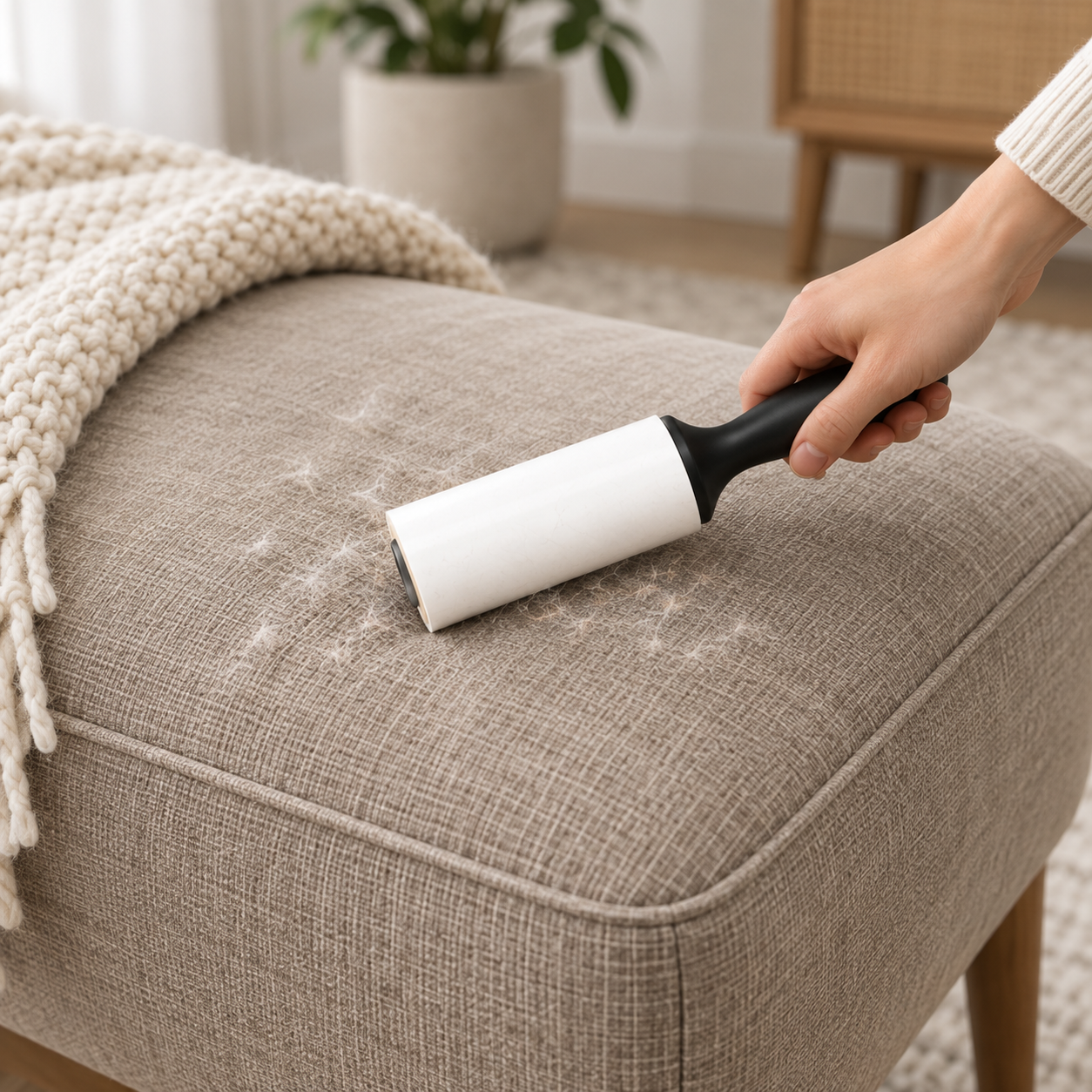
Instead of vacuuming the entire sofa every day, a lint roller can be used for quick surface maintenance in the locations where hair is most visible.
Before guests arrive, this becomes especially useful.
The user is not conducting a deep upholstery cleaning.
They are restoring the appearance of the room quickly.
That distinction is important.
Consumers frequently buy products not only to clean but to make the home feel ready.
Beds and Bedding
Many households allow dogs or cats onto beds.
Even households that do not intentionally invite them there may discover that pets have their own ideas.
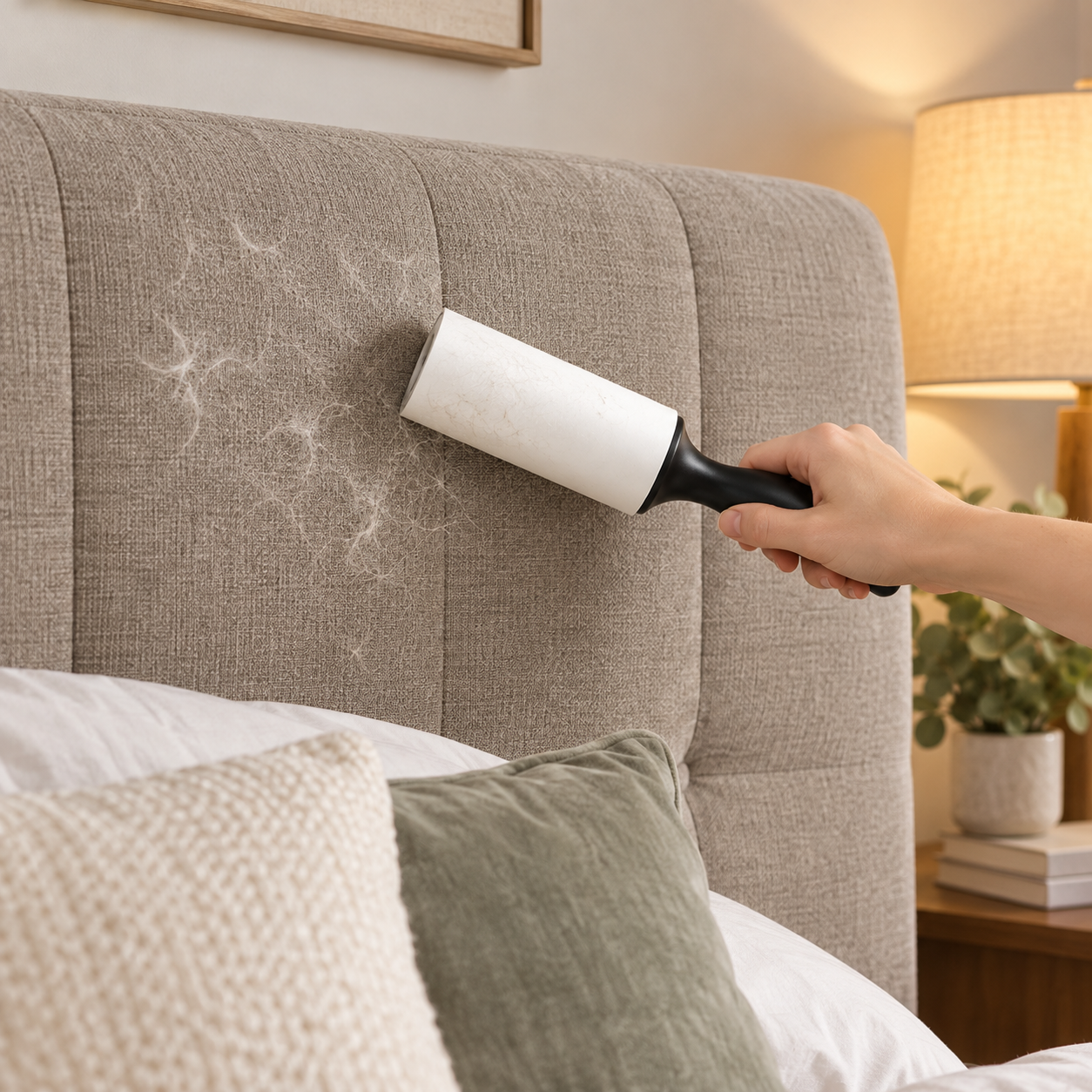
The result is familiar: visible hairs on sheets, duvet covers, quilts and throws.
Laundry remains essential when bedding genuinely needs washing.
However, loose surface hair does not always mean the entire bed needs to be stripped immediately.
A lint roller offers an intermediate option.
It can refresh the visible surface today while the household keeps its normal laundry schedule.
That is convenience translated into a concrete household benefit.
Rugs and Carpets
Carpet requires realistic expectations.
Deeply embedded fur may need a strong vacuum, specialist attachment or more intensive treatment.
An adhesive roller should not be promoted as a universal replacement for proper carpet cleaning.
Its opportunity lies in surface hair and targeted areas.
Perhaps the dog always sleeps beside the sofa.
Perhaps the cat has a favorite sunny patch near a window.
Perhaps hair gathers around a pet bed.
Those high-contact zones can become visibly furry long before the entire carpet needs cleaning.
A long-handled roller allows homeowners to target the visible accumulation without treating the entire room.
Car Interiors
Pet ownership does not stop at the front door.
Dogs travel to parks, veterinary appointments, grooming visits, holidays and family gatherings.
Cats may travel to veterinarians or when families move.
Fabric vehicle seats can quickly become another pet-hair surface.
A portable lint roller can therefore extend beyond the home into the car.
For families who regularly travel with animals, this is an important secondary selling point.
Pet Beds and Blankets
Pet beds may contain significantly more loose hair than many other household surfaces because animals spend extended periods resting there.
A lint roller can provide frequent surface maintenance between washing cycles.
Again, the product is strongest when positioned as part of a cleaning system rather than an alternative to washing.
Remove loose surface hair regularly.
Wash removable covers according to their instructions.
Vacuum surrounding areas when needed.
The roller fills the quick-maintenance gap.
Exposure Point No. 4: Pet Hair Cleaning Is a Routine, Not a Rescue Operation
One of the most useful developments in pet-care coverage in 2026 is the emphasis on consistency.
In September 2026, Good Housekeeping published advice from board-certified veterinary dermatologist Dr. Rose Miller about managing dog shedding. Miller explained that shedding varies with factors including season and breed and recommended consistent grooming, while household tools such as suitable vacuums, washable covers and other fur-removal tools can help control hair around the home. She also noted that unusually increased hair loss or bald patches should be discussed with a veterinarian.
That advice supports a more realistic way to market a pet-hair roller.
The objective is not to promise that the house will never contain pet hair again.
That would be impossible in many homes.
The objective is control.
Groom the pet.
Remove loose fur from frequently used surfaces.
Vacuum when necessary.
Wash appropriate textiles on schedule.
Repeat.
A long-handle lint roller becomes valuable because it makes one part of that cycle easier to repeat.
And repeated tasks are exactly where convenience produces the greatest long-term value.
Saving ten minutes once may not change someone's life.
Saving several minutes every time a repetitive chore appears can dramatically improve the experience of maintaining a pet-friendly home.
Pet Ownership Is Becoming More Integrated Into Daily Life
The rise in pet ownership is not simply about more animals.
It is also about where pets fit into everyday routines.
UK Pet Food's March 2026 report found that the United Kingdom had approximately 15.5 million dogs, three million more than five years earlier. Dog ownership had increased from 33% of households in 2021 to 41% in 2026, with particularly high ownership among younger adults.
That matters to cleaning brands because pets are increasingly integrated into spaces originally designed around human routines.
Dogs sit on sofas.
Cats sleep on beds.
Pets travel in cars.
Owners work from home beside them.
People photograph them indoors.
They visit friends and family.
Pet-friendly living means the dividing line between “pet space” and “human space” is often disappearing.
Cleaning products therefore need to work where this shared life actually happens.
A pet-hair tool designed only for one corner of the house misses the opportunity.
A multi-surface product acknowledges reality.
The Sofa Is No Longer Just Furniture
Consider the modern sofa.
It may function as a place to watch television, work on a laptop, entertain guests, take an afternoon nap and spend time with a dog or cat.
A pet may sit on the same cushion every day.
That cushion becomes one of the home's highest-frequency fur zones.
This is why sofa cleaning is such a strong demonstration scenario for a long-handle lint roller.
The before-and-after effect can be visible.
The problem is relatable.
The task is frequent.
And the consumer already understands why a full vacuuming session may feel excessive when the goal is simply to remove visible fur from two cushions.
In marketing terms, that makes the sofa more than a supported surface.
It becomes a communication platform.
A product video showing a roller moving across a fur-covered sofa can communicate the product's purpose in seconds.
Exposure Point No. 5: Immediate Visible Results Are Powerful
Pet-hair cleaning has one major marketing advantage compared with many household chores:
The result can be visually obvious.
Loose hair is often visible before cleaning.
It is often visible on the adhesive surface afterward.
And the cleaned fabric can visibly look better.
That creates a natural demonstration loop:
Problem → action → collected hair → cleaner-looking surface.
For online retail, short video and social commerce, this matters enormously.
Consumers cannot touch the product through a screen.
They therefore need proof they can understand visually.
A close-up of the adhesive roll alone tells them very little.
A demonstration across a sofa, bed or dark fabric communicates much more.
The best content should show realistic amounts of pet hair rather than artificially overwhelming piles.
Credibility sells.
A consumer with a Labrador, German Shepherd, Husky, Corgi or long-haired cat already knows what fur looks like in a real home.
They do not need exaggerated staging.
They need to see whether the tool appears convenient enough to become part of their routine.
A Cleaning Product Can Sell Time, Not Just Cleanliness
This is where the 2026 convenience trend becomes especially valuable.
Mintel's research argues that convenience increasingly reduces not only physical work but also mental friction—the number of decisions and steps involved in completing an ordinary task.
A long-handle lint roller can communicate precisely this kind of value.
There is very little planning.
No detergent choice.
No water temperature.
No charging routine if the product is completely manual.
No cleaning program.
No complicated attachment selection.
No need to decide whether ten hairs justify operating a large appliance.
See fur.
Roll fur.
Continue with the day.
That simplicity is not technological innovation.
But for repetitive household chores, technological complexity is not always the goal.
Sometimes the most useful innovation is fewer steps.
Exposure Point No. 6: It Complements Expensive Appliances Rather Than Competing With Them
Many pet households already own a vacuum marketed for animal hair.
Others may have robot vacuums running automatically.
That does not make the lint roller unnecessary.
In fact, it can strengthen the case for it.
Different cleaning tools solve different scales of problems.
A robot vacuum may help maintain floors.
An upright or cordless vacuum handles broader floor cleaning.
An upholstery attachment reaches deeper into furniture.
A washing machine cleans removable textiles.
Pet grooming reduces loose fur before it reaches the environment.
A lint roller handles immediate surface removal.
The positioning should therefore be:
“Use the right tool for the right moment.”
This avoids the credibility problem created by claiming that a small manual product can replace a high-powered vacuum cleaner.
It also allows the lint roller to enter households that already spend heavily on cleaning equipment.
The customer does not need to believe their existing tools are inadequate.
They only need to recognize that those tools are sometimes too much work for a small job.
The “Between Cleans” Position Is Extremely Strong
Professional cleaning is scheduled.
Vacuuming is often scheduled.
Laundry is scheduled.
Pet hair is not.
It appears whenever the pet sheds.
This creates a useful category:
between-clean maintenance.
The couch was vacuumed on Sunday.
By Tuesday, there is hair again.
The bedspread was washed yesterday.
The cat sleeps on it this afternoon.
The carpet was cleaned this morning.
The dog lies down in the same spot that evening.
Consumers become frustrated when a freshly cleaned home seems to lose its appearance immediately.
A lint roller does not prevent shedding.
It gives the homeowner a quick recovery mechanism.
That psychological benefit matters.
The user does not have to choose between tolerating visible hair for six more days and repeating a full cleaning job.
There is a middle option.
Exposure Point No. 7: A Manual Product Can Be an Advantage
The market often associates improvement with electronics.
More sensors.
More motors.
More settings.
More automation.
Those features can be valuable, but they also introduce charging, maintenance, storage and cost.
A manual adhesive roller offers a different value proposition.
It can be immediately understandable.
There is no learning curve.
There is no battery to monitor.
There is no software.
It can be stored near the location where it is most frequently needed.
For consumers who already feel surrounded by devices, simplicity itself can become attractive.
This positioning is particularly useful when the product is shown next to real-world moments rather than presented as a technical gadget.
Keep one near the wardrobe.
Keep one in the utility room.
Keep one near the living room.
Use it before guests arrive.
Use it before work.
Use it after the dog leaves the sofa.
That is a lifestyle story, not a technology story.
Why Long-Handle Design Is Especially Relevant to Larger Surfaces
Small handheld lint rollers are optimized for targeted garment cleaning.
A long-handle roller changes the scale.
Think about the number of movements required to cover a queen- or king-size bed with a six-inch handheld roller.
Now imagine reaching across the same surface with a longer handle.
The adhesive mechanism may be familiar, but the working radius changes.
The same applies to a sectional sofa.
A long handle makes it easier to cover a seat from front to back without repeatedly moving around the furniture.
On a rug, it can allow spot cleaning while standing.
This is why product imagery should not focus only on the roller head.
Show the full handle.
Show scale.
Show someone using the product beside common furniture.
Customers need to understand that this is not merely another pocket-size garment roller.
It belongs in household cleaning.
A Strong Product Story Starts With the Problem, Not the Product
Weak marketing starts with specifications:
“Long handle.”
“Sticky roller.”
“Wide cleaning head.”
“Easy storage.”
Strong marketing starts with situations:
“Your dog was on the sofa five minutes before guests arrive.”
“You are wearing black and your cat is orange.”
“The duvet was clean until your pet decided it was the perfect place for a nap.”
“The carpet only has hair around the pet bed, and you do not want to vacuum the whole room.”
“The rear car seat needs a quick refresh after a trip with your dog.”
Now the product features have meaning.
The long handle helps because the sofa is large.
The adhesive surface matters because the hair is loose.
The multi-surface use matters because the problem moves from room to room.
Convenience matters because the customer is already busy.
This is the difference between describing a tool and selling a solution.
10 Real-Life Moments That Can Drive Product Exposure
1. The Five-Minute Guest Cleanup
A friend sends a message: “We're nearby. Can we stop in?”
The home is generally clean, but the dog has been sleeping on the sofa.
Instead of vacuuming the entire living room, the owner rolls the seating area and cushions.
This is an ideal convenience scenario.
2. The Black-Clothing Problem
Pet hair becomes especially visible on contrasting fabrics.
The owner is ready to leave for work, notices fur and needs a solution immediately.
There is no time for laundry.
A lint roller makes intuitive sense.
3. The Morning Bed Refresh
A cat spends the night or early morning on the duvet.
The bedding does not need washing every day, but visible loose hair is undesirable.
Several passes provide a quick surface refresh.
4. The Favorite Rug Spot
A dog rests in the same location every evening.
Hair accumulates there faster than on the rest of the floor.
A multi-surface roller can target that specific zone between vacuuming sessions.
5. The Car After a Weekend Trip
The dog has been on the rear seat for several hours.
Before colleagues or family use the car, the owner wants to remove obvious fur.
A manual tool is easy to use without taking a household vacuum outside.
6. The Pet Bed Between Washes
The pet bed cover is washable but does not need to enter the machine every day.
Removing loose surface fur can help keep it looking tidier between scheduled washes.
7. The Home Office Chair
Working from home has blurred another boundary.
Cats sit on desk chairs.
Dogs lean against their owners.
Pet hair collects on fabric office furniture.
The roller becomes part of workplace presentation as well as household cleaning.
8. The Rental or Apartment Lifestyle
Many urban pet owners live in apartments where storage matters.
They may not want multiple bulky tools for every cleaning problem.
A slim manual tool that can work across several fabric surfaces has a clear space-efficiency story.
9. Seasonal Shedding
Veterinary guidance notes that some dogs shed more heavily during seasonal transitions, while certain breeds shed throughout the year.
During heavier shedding periods, the value of quick maintenance becomes even more visible.
10. Everyday Appearance Maintenance
Sometimes there is no event.
No guests.
No emergency.
The owner simply prefers a sofa without visible fur.
That ordinary desire may be the biggest market of all.
Europe and North America Share the Same Basic Problem
Cultural preferences differ across countries, but pet hair behaves exactly the same way.
That makes the product naturally adaptable across Western markets.
In the United States, APPA's 2026 dog research shows the enormous scale of dog ownership and a consumer environment where owners are becoming more intentional about how they spend on everyday pet routines.
In Britain, 62% of households were estimated to own a pet in 2026, with particularly strong dog ownership among younger adults.
Across the EU, FEDIAF's current headline data puts the number of pet-owning households at roughly 140 million.
Different countries may require different advertising tones.
U.S. marketing can be very direct:
“Pet hair on the sofa? Roll it away before guests arrive.”
British communication may emphasize practicality:
“A simple way to keep upholstery, bedding and clothes looking tidy between cleans.”
French or Italian positioning may place more emphasis on maintaining an attractive home while living comfortably with animals.
German consumers may respond better to clear functional explanation—surfaces, reach, cleaning purpose and replacement method.
But the underlying need remains consistent:
People love living with their pets.
They would simply prefer less visible hair on everything they own.
What Consumers Should Look for in a Long-Handle Lint Roller
Not every product should be evaluated only by price.
For an everyday cleaning tool, usability determines whether it becomes part of the routine.
Handle Stability
A long handle only adds value if it feels sufficiently stable during ordinary use.
If a handle flexes excessively or feels loose, the extra reach becomes frustrating.
Customers should be able to apply normal rolling pressure comfortably.
Comfortable Grip
Pet hair removal can involve repeated back-and-forth movement.
A grip that feels secure makes extended use more pleasant.
Effective Working Width
A broader roller may cover furniture or bedding more efficiently.
However, excessively large dimensions can reduce control on smaller surfaces.
The ideal design should balance coverage and maneuverability.
Easy Adhesive Refresh
An adhesive roller is only convenient if the user can quickly expose a fresh working surface or change the relevant consumable.
Complicated replacement undermines the convenience proposition.
Replacement Availability
If the design uses replaceable rolls or adhesive sheets, consumers should know where replacements can be purchased.
The product is part of a routine, so ongoing usability matters.
Storage
A long-handle product should still be easy to store.
Hanging capability, compact profile or other simple storage solutions can become meaningful advantages in apartments and smaller homes.
Surface Guidance
Manufacturers should clearly explain which surfaces are appropriate.
Very delicate fabrics may require testing in an inconspicuous area first.
Clear instructions strengthen trust and reduce misuse.
What the Product Should Not Promise
Persuasive marketing does not require exaggeration.
In fact, exaggerated claims are particularly dangerous in a category where consumers can test the product immediately.
A lint roller should not promise to eliminate shedding.
Animals will continue to shed.
It should not imply that routine grooming is unnecessary.
Veterinary advice emphasizes the importance of consistent grooming for managing shedding.
It should not claim to replace deep carpet cleaning.
Embedded hair may require vacuuming or specialist tools.
It should not promise medical or allergy benefits unless those claims have appropriate evidence and regulatory support.
The more credible promise is also the easier one to understand:
Quickly pick up visible loose pet hair from suitable household surfaces.
That is enough.
A product that reliably solves a small, repetitive problem can be more useful than one that promises to solve everything.
Convenience Plus Effectiveness Is the Winning Combination
Convenience alone is not sufficient.
If a product is easy to use but does not perform its primary task well, consumers will abandon it.
Mintel's 2026 household-cleaning outlook explicitly highlights the importance of pairing convenience with effective, low-effort cleaning rather than treating ease as a substitute for performance.
For a long-handle lint roller, this creates a clear design and marketing priority.
The product must feel easy.
But the user must also see hair being collected.
That visible confirmation reinforces trust.
The ideal customer experience is almost immediate:
They identify pet hair.
They make several passes.
They look at the roller.
The hair is there.
They look at the sofa.
It looks cleaner.
The job feels finished.
This is one reason simple pet-hair tools can generate satisfying demonstration content.
The mechanism is easy to understand.
The result requires little explanation.
The Product Fits a Broader Shift Toward Low-Effort Cleaning
Mintel's 2026 research on the future of household cleaners describes the market as moving toward lower-effort routines and greater convenience.
A manual lint roller might appear almost too simple to belong in a discussion about the future of cleaning.
But simplicity is exactly the point.
Innovation is not always adding technology.
Sometimes innovation means redesigning an established tool so it fits more situations.
The original lint roller solves clothing lint.
The long-handle version expands the same familiar cleaning principle to furniture, beds, rugs and other larger surfaces.
That reduces the gap between “I see pet hair” and “I have removed it.”
For busy households, that is meaningful innovation.
Turning Pet Hair Removal Into a 60-Second Habit
One of the best ways to communicate the product is to stop presenting cleaning as a major project.
Show micro-routines.
Before sitting down in the evening, roll the pet's favorite corner of the sofa.
Before getting dressed for work, check the coat.
After making the bed, roll the area where the cat was sleeping.
After bringing the dog home in the car, refresh the rear seat.
Before visitors arrive, make one pass through the living room.
These small routines create a cleaner-looking environment without demanding a separate block of cleaning time.
This is especially persuasive for consumers who already feel that household chores consume too much of their day.
They are not being asked to clean more.
They are being offered a faster way to manage the mess that is already happening.
Pet-Friendly Does Not Have to Mean Fur Everywhere
Marketing pet cleaning products should avoid presenting animals as a nuisance.
People do not want a product that seems to tell them their pet is a problem.
They want a product that allows them to enjoy the pet without accepting every side effect.
That distinction changes the tone dramatically.
Instead of:
“Stop your pet from ruining your furniture.”
Use:
“Keep the sofa ready for both your pet and your guests.”
Instead of:
“Fight endless animal hair.”
Use:
“Make everyday fur cleanup quicker.”
Instead of suggesting that pets and clean homes are incompatible, position the product as the bridge between them.
A home can contain a dog, a cat, comfortable fabric furniture and people wearing dark clothing.
It simply needs a realistic maintenance routine.
The Emotional Benefit: A Home That Feels Ready
Cleaning products often sell functional outcomes.
But consumers experience emotional outcomes too.
A sofa without visible fur feels ready for guests.
A coat without cat hair feels ready for the office.
Fresh-looking bedding feels ready for sleep.
A cleaner car seat feels ready for passengers.
Those moments create a sense of control.
This is where product communication can move beyond “sticky roller removes hair.”
The deeper proposition is:
Your pet can be part of everyday life without every surface looking like a pet bed.
That is relevant to modern pet households because pets increasingly participate in ordinary family spaces.
The product does not change that relationship.
It makes the relationship easier to maintain.
A Smarter Cleaning System for Pet Owners
Step 1: Manage Loose Hair at the Source
Regular grooming appropriate to the animal's coat can help manage shedding.
If shedding suddenly becomes excessive or is accompanied by bald areas or skin problems, veterinary advice is appropriate.
Step 2: Use Quick Tools for Daily Surface Hair
This is where the long-handle lint roller fits.
Use it on suitable clothing, sofas, beds, rugs, upholstery and other surfaces where loose hair is visible.
Step 3: Vacuum for Broader and Deeper Cleaning
Floors, deep carpet fibers and larger areas still benefit from appropriate vacuuming equipment.
Step 4: Wash Washable Textiles on Their Normal Schedule
Blankets, removable furniture covers, pet bedding and other washable items need periodic laundering according to care instructions.
Step 5: Repeat Small Maintenance Before Hair Builds Up
Regular quick cleaning often feels easier than allowing large quantities of fur to accumulate.
The roller's role is not to dominate this system.
Its strength is that it makes Step 2 extremely simple.
Why This Matters in 2026
The market conditions around the product are unusually favorable.
Pet ownership is widespread across North America and Europe. APPA reports tens of millions of U.S. dog-owning households, UK Pet Food reports pets in a majority of British households, and FEDIAF reports roughly 140 million pet-owning households across the EU.
At the same time, consumer research increasingly emphasizes convenience, lower-effort household routines and products that reduce everyday friction.
Pet hair sits directly at the intersection of those trends.
It is recurring.
It is visible.
It appears on multiple surfaces.
It is annoying enough to solve but usually not serious enough to justify an intensive cleaning process every time.
That creates the ideal environment for a simple, accessible tool.
The Strongest Exposure Points for Retail and Online Marketing
For businesses selling a long-handle lint roller, the product story can be summarized through several highly visual benefits.
Convenience: remove visible fur without starting a full cleaning session.
Multi-Surface Use: demonstrate clothing, sofa cushions, bedding, rugs and car upholstery rather than showing only one surface.
Pet Hair Focus: make the problem obvious from the first image. This is not merely a general dust roller; it belongs in the daily routine of dog and cat households.
Extended Reach: show why the handle matters by demonstrating use across a bed, sofa and floor-level rug.
Quick Touch-Ups: position the product between vacuuming and laundry rather than against them.
Visible Results: let customers see the collected fur.
Everyday Readiness: connect the product to moments such as leaving for work, preparing for guests and refreshing furniture.
Simple Manual Operation: highlight the absence of complicated setup.
Pet-Friendly Lifestyle: present the product as a way to share more of the home with pets while keeping common spaces tidy.
These are stronger selling points than abstract technical language because each one answers the consumer's most important question:
“What problem will this solve for me?”
Better Product Advertising: Show One Person Solving Five Problems
A highly effective video does not need elaborate production.
Begin with someone wearing dark trousers covered in cat hair.
Roll.
Move to the sofa.
Roll.
Move to the bed.
Roll.
Move to the rug beside a pet bed.
Roll.
Move to the rear car seat.
Roll.
End with the roller holding the collected hair.
The message is instantly clear:
One familiar cleaning action. Multiple everyday surfaces.
That is “multi-surface” communication without needing to explain the phrase.
A second video can focus entirely on the long handle.
Show a traditional short roller requiring the person to bend repeatedly.
Then show the longer design covering the same sofa or bed with greater reach.
Again, the visual communicates the reason for the product.
The Consumer Does Not Want Another Chore
This may be the most important insight of all.
Nobody buys a lint roller because they want to spend more time cleaning.
They buy it because they want cleaning to disappear into the background of everyday life.
The ideal product experience is therefore almost forgettable.
The user notices hair.
They remove it.
The problem is gone.
They return to what they were doing.
That is convenience at its best.
No complicated ritual.
No exaggerated promise.
No new lifestyle to learn.
Just a familiar problem solved with less friction.
Conclusion: A Simple Tool for a Very Modern Pet Household
The long-handle lint roller succeeds because it does not attempt to change the reality of pet ownership.
Dogs shed.
Cats shed.
Hair reaches the sofa, bed, clothes, carpet and car.
Deep cleaning will still be necessary.
Pets will still need grooming.
Blankets will still need washing.
Vacuum cleaners will still have an important role.
But not every strand of fur needs a deep-cleaning response.
That is the opportunity.
In 2026, when millions of American, British and European households are sharing more of their everyday living space with pets, the most relevant cleaning products are often those that make recurring chores easier rather than more complicated. Current consumer research is pointing in the same direction: convenience, reduced effort and products that integrate smoothly into daily routines are becoming increasingly important.
A long-handle lint roller translates those trends into an extremely understandable solution.
Pet hair on your clothes?
Roll it away before leaving home.
Hair on the sofa?
Refresh it before guests arrive.
Fur on the bed?
Clean the visible surface without immediately starting another laundry cycle.
Hair around your pet's favorite place on the rug?
Target that area between vacuuming sessions.
Pet hair in the car?
Handle the surface cleanup before the next passenger gets in.
That is the product's real strength.
Not complexity.
Not unrealistic promises.
Convenience. Reach. Multi-surface usefulness. Fast, visible pet-hair removal.
For the modern pet household, those benefits turn a familiar lint roller into something much more useful: an everyday cleaning tool that helps people spend less time dealing with fur and more time enjoying the animals that put it there.



