


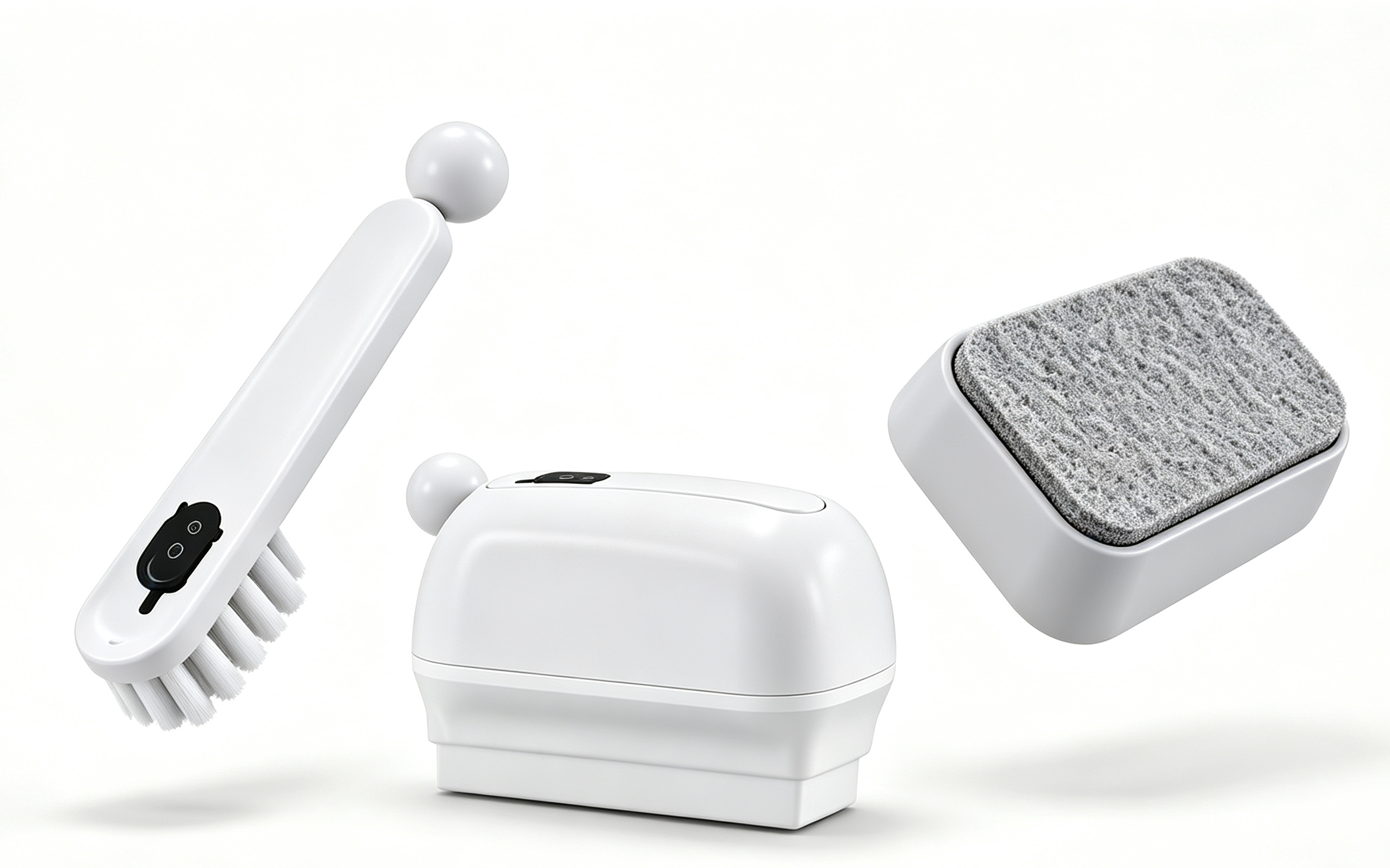
In 2026, the modern kitchen is expected to do more than look clean. It is where food is prepared, dishes are washed, groceries are unpacked, children grab snacks, pets may pass through, and family routines happen several times a day. That means kitchen cleaning has become less about a once-a-week deep clean and more about fast, repeatable maintenance.
For U.S. and European households, one of the strongest product ideas in this environment is not simply “more cleaning power.” It is fewer tools, fewer steps, and faster transitions between tasks. That is exactly where a well-designed 3-in-1 kitchen cleaning brush can earn attention.
The phrase “3-in-1” should not be treated as a decorative badge. It becomes persuasive only when the three functions correspond to real kitchen jobs and are clearly supported by the actual product design. Depending on the model, those functions may involve broad scrubbing, detail work, narrow-gap cleaning, scraping, edge cleaning, or another combination. A trustworthy listing should describe only what the specific product really does.
The larger story, however, is universal: one tool can reduce the need to switch between several brushes, sponges, and small cleaning gadgets during a single kitchen-cleaning session. For a time-conscious consumer, that can make everyday care feel Faster, Easier, and Smarter.
Why kitchen cleaning is a stronger 2026 purchase category than it looks
The American Cleaning Institute’s 2026 National Cleaning Week research found that 78% of Americans say they clean as much as or more than their parents or caregivers did. Sixty-one percent still turn to friends and family for cleaning advice, while 39% now rely more heavily on digital tools such as search, social media, or AI.
That combination matters for e-commerce. Consumers are still maintaining traditional cleaning habits, but they are increasingly researching better ways to do them. A kitchen brush is no longer evaluated only by price. Shoppers compare design, versatility, storage, cleanability, material compatibility, durability, and whether the tool genuinely reduces hassle.
ACI’s 2026 Spring Cleaning Survey also found that 72% of respondents consider coming home to a clean, organized space more relaxing than a massage. That emotional value of cleanliness helps explain why small tools that simplify maintenance can have an outsized role in everyday life.
The kitchen is different from the rest of the house
A kitchen combines grease, moisture, food residue, heat, crumbs, raw ingredients, cooked foods, and high-touch surfaces. It is not just another room.
FDA and USDA food-safety guidance consistently emphasizes cleaning hands, utensils, cutting boards, counters, sinks, and food-contact surfaces. The core principle is simple: cleanliness helps reduce the transfer of foodborne pathogens around the kitchen.
That does not mean a 3-in-1 brush should be marketed as a medical or disinfecting device. It should not. A brush physically removes soil; sanitizing or disinfecting, when needed, is a separate process that depends on approved products and proper instructions.
This distinction is important because it gives the product a credible role: mechanical cleaning first. Removing stuck food, grease, crumbs, residue, and debris makes the next hygiene step more effective.
Exposure Point #1: one tool, multiple routine jobs
The first and most obvious selling point is consolidation.
Many kitchens accumulate a surprising number of small cleaning tools: one brush for the sink, another for bottles or narrow spaces, a sponge for the stovetop, a scraper for dried residue, a detail brush for seams, and disposable towels for quick jobs.
A true 3-in-1 design can reduce this clutter if its functions replace several of those steps. The strongest marketing does not say “does everything.” It says something more believable: handles three common cleaning jobs without making you stop and switch tools.
That is especially relevant in apartments, smaller kitchens, RVs, student housing, and homes where counter and cabinet space is limited.
Exposure Point #2: Faster means fewer tool changes
Time savings in cleaning do not always come from moving your hand faster. They often come from eliminating interruptions.
Imagine cleaning around the sink after dinner. A wide surface has food residue. The faucet base has a tight seam. A dried spot needs focused agitation. If each job requires a different tool, the user repeatedly puts one item down, searches for another, rinses it, switches grips, and restarts.
A 3-in-1 brush can reduce those transitions. That is the real meaning of Faster: less stopping, less searching, less switching.
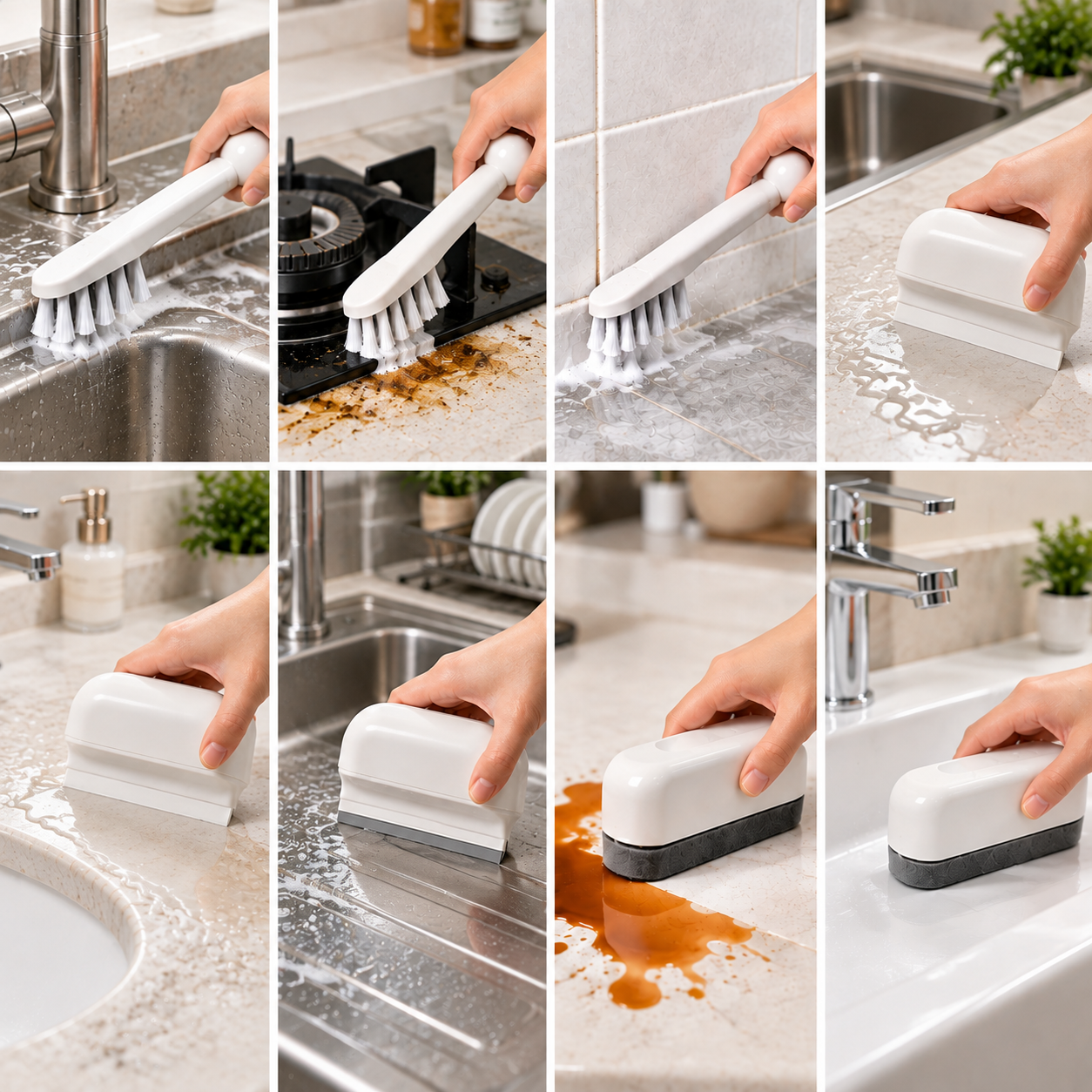
For Amazon and direct-to-consumer pages, this is easy to demonstrate in video. Show three different cleaning zones in one sequence without leaving the frame to grab another tool.
Exposure Point #3: Easier means a clearer cleaning routine
“Easier” should not imply that difficult grease disappears without effort. Instead, it can mean that the cleaning process becomes simpler to understand.
A practical routine might be:
Remove loose food debris.
Apply an appropriate cleaner or warm soapy water.
Use the suitable function of the 3-in-1 brush for the surface.
Rinse or wipe away loosened soil.
Dry the area where appropriate.
Clean and dry the brush before storage.
This sequence is easy to remember and can be adapted to many household kitchens.
Exposure Point #4: Smarter kitchen care is about matching the tool to the mess
Smart cleaning does not require electronics. It requires using the right mechanical action for the soil and surface.
A flat greasy area may need broad contact. A seam may need a narrow working edge. A stubborn spot may need concentrated scrubbing. If the product genuinely provides three different working modes, the design can help the user match effort to the task.
The e-commerce message becomes: one handle, three practical approaches.
Why brushes deserve attention in the sponge-heavy kitchen
Kitchen sponges are extremely common, but they are not always ideal for every job. USDA notes that sponges can be potential sources of bacteria and are difficult to clean completely, which is why frequent replacement is recommended.
Scientific research comparing dishwashing sponges and brushes has also found lower bacterial levels in used brushes than in sponges under studied conditions, with Salmonella dying more rapidly in brushes that were allowed to dry. The researchers concluded that brushes may be more hygienic than sponges, while still emphasizing the importance of cleaning or replacing contaminated tools.
This does not mean every brush is automatically hygienic. A brush left wet, packed with food residue, or stored in a closed damp container can still become dirty. The credible benefit is that many brush designs can rinse more openly and dry more readily than thick porous sponges.
Drying is an underrated product feature
A cleaning tool should not only clean the kitchen; it should also be easy to clean itself.
This creates an important exposure point for a 3-in-1 brush: rinse, dry, store.
If the actual product has an open structure, hanging hole, standing base, removable head, or another feature that helps drying, that should be shown prominently. If it does not, the brand should not invent those features—but it should still provide realistic care instructions.
After use, food particles should be rinsed away. The tool should be allowed to dry rather than being sealed wet in a drawer.
Food safety makes regular kitchen cleaning more meaningful
FDA guidance reminds consumers that foodborne pathogens can spread through cutting boards, utensils, sponges, countertops, and other kitchen surfaces. USDA similarly emphasizes cleaning surfaces that contact raw meat, poultry, fish, and eggs before moving on to other food-preparation tasks.
A 3-in-1 brush should therefore be positioned as part of a sensible cleaning system, not as a substitute for handwashing, safe food handling, or sanitizing when required.
Good marketing can say: remove the visible soil thoroughly, then follow the appropriate food-safety guidance for the surface.
The sink is the most natural hero scene
If there is one place where a multi-function kitchen brush makes immediate sense, it is the sink zone.
The sink combines curved surfaces, drains, faucet bases, edges, splashes, soap residue, food particles, and high-touch areas. It visually demonstrates why one brush shape may not solve every problem.
For product photography, the sink allows the brand to show several tasks without changing location. A broad surface can demonstrate general scrubbing; a narrow or detail function can demonstrate seams or edges; a third feature can address another compatible task.
Again, the exact use should match the actual product.
Stovetop cleaning creates a different kind of challenge
Cooking areas accumulate oil film, sauce splashes, dried starch, and crumbs. Smooth glass or induction surfaces need different treatment from cast-iron grates or textured metal.
This is where material compatibility must be clear. A stiff brush suitable for a durable grate may not be appropriate for a delicate coated surface.
A credible product page should include a surface-compatibility chart instead of claiming “safe for everything.”
Countertops: broad areas where speed matters
Countertops are high-use surfaces and often need several small cleanups a day. Crumbs, coffee drips, flour, sauce, and oil can accumulate quickly.
If the 3-in-1 brush is intended for countertop use, the benefit is speed: loosen stuck residue, work around edges, rinse or wipe clean, and move on.
But food-contact surfaces require appropriate rinsing and cleaning practices. The brush itself must also be kept clean.
Cutting boards and textured surfaces
Grooves and knife marks can trap food. FDA and USDA both emphasize cleaning cutting boards after use and replacing boards that become excessively worn or difficult to clean.
If the brush is designed for cutting boards, its bristles may help work into textured areas, but the listing should not imply that brushing can make a deeply damaged board safe forever.
Sometimes the correct answer is replacement.
Cookware: performance must follow the manufacturer’s surface guidance
Pots, pans, baking trays, and lids are highly attractive marketing scenes, but cookware coatings vary widely.
A cleaning brush that works well on stainless steel may be too aggressive for certain nonstick coatings. Consumers should be instructed to follow cookware-care guidance and test uncertain surfaces.
Responsible brands win long-term trust by defining what the tool is and is not intended to clean.
The edge-and-seam problem
One reason multi-function cleaning tools sell well is that dirt rarely stays in the center of a surface. Grease collects around rims. Crumbs fall into seams. Food splashes dry around knobs and edges.
A 3-in-1 brush becomes more compelling if one of its real functions is designed for these overlooked areas.
Recent home-cleaning coverage has highlighted how hidden edges around cooktops can collect grease and debris even when the visible surface looks clean. That is exactly the kind of problem that detail-oriented product content should show.
Why “one product solves multiple problems” resonates in the U.S.
American shoppers are accustomed to multi-use tools in kitchens, garages, home offices, and personal care. The appeal is partly economic and partly psychological: fewer items to choose from, fewer items to store, and less decision fatigue.
The strongest 3-in-1 claim therefore combines convenience with organization: three useful functions without three separate tools taking up space.
Small kitchens make tool consolidation even more valuable
Urban apartments, condos, dorms, tiny homes, and RVs have limited storage. A drawer filled with specialized brushes is not attractive.
A compact 3-in-1 tool can be positioned as a space-saving kitchen-care solution, provided the actual size supports that claim.
Show the product in a realistic drawer, cleaning caddy, or hanging position instead of only against a white studio background.
Busy families need “reset cleaning” more than deep cleaning
After breakfast, there may be crumbs and spills. After dinner, grease and food residue. After meal prep, cutting boards and sink edges.
Most households cannot deep-clean the kitchen three times a day. What they need is a quick reset.
The 3-in-1 brush fits this behavior: clean the obvious mess, rinse the tool, dry it, and return the kitchen to a usable state.
Meal-prep households create repeated cleaning cycles
People who batch-cook or prepare several meals at once use more cutting boards, containers, pans, and sink space in a short period.
For these consumers, switching between cleaning tools creates friction. A multi-function brush can be positioned around continuous workflow: prep, clean, switch task, clean again.
Families with children
Children increase the frequency of kitchen spills, crumbs, sticky spots, and snack preparation.
A versatile cleaning tool can help adults deal with those small messes without turning every incident into a full cleaning session.
Cleaning products and chemicals, however, should be stored safely and out of children’s reach. ACI’s 2026 research on the “decanting” trend warns that transferring cleaning products into decorative containers can create unnecessary risks by separating them from original labels and safety information.
Pet households
Pet bowls, feeding mats, and surrounding floors may require dedicated cleaning tools. Food-safety guidance recommends avoiding cross-use of cleaning tools between pet items and human food-preparation surfaces.
A 3-in-1 kitchen brush should therefore not be marketed as one tool for absolutely everything. Multi-function does not mean cross-contamination is irrelevant.
In some homes, separate color-coded brushes may be the smarter solution for different zones.
Three-in-one should reduce clutter, not increase hygiene risk
This is an important nuance. Combining functions is useful when those functions belong to compatible cleaning tasks.
It is not useful to use the same dirty brush on raw-meat residue and then immediately on a ready-to-eat food area without proper cleaning and sanitizing.
The product page should teach users to rinse and clean the brush between jobs and to follow safe kitchen zoning practices.
The brush itself needs a cleaning routine
A dirty cleaning tool is not a good cleaning tool.
After use:
Remove trapped food particles.
Rinse thoroughly with appropriate water and detergent.
Clean or sanitize according to the product’s material and instructions.
Allow it to dry fully.
Replace the brush when bristles or working edges become excessively worn.
If the product is dishwasher-safe, that can be an important feature—but it should be claimed only if confirmed by the manufacturer.
Durability is a practical e-commerce benefit
Consumers who buy a multi-function tool expect it to replace several simpler items. That makes durability especially important.
Show actual materials, connection points, bristle design, and moving parts if any. Explain how the tool should be stored to prevent deformation.
Do not simply say “built to last.” Show why.
Grip and hand comfort matter during repeated scrubbing
A brush can be used for several minutes at a time, especially after cooking a large meal. A handle that is too thin, slippery, or awkward can make the job more tiring.
If the product has a real ergonomic shape or textured grip, photograph it in a wet-hand context and explain the benefit.
Again, avoid claiming ergonomic performance without design evidence.
Color and design can support a cleaner-looking kitchen
A cleaning tool does not need to be ugly. Many shoppers now leave frequently used tools visible near the sink.
A clean, modern design can help the product feel like part of the kitchen rather than clutter. This is especially relevant for direct-to-consumer brands where aesthetics matter.
But appearance should not compromise cleanability. Decorative grooves that trap residue would work against the product’s purpose.
Storage is part of the product experience
A tool that is easy to store is more likely to be used.
If the product has a hanging loop, standing base, wall-mount option, or compact folding structure, demonstrate it. If it does not, show a realistic caddy or drawer solution.
“Smarter kitchen care” includes what happens after the cleaning is finished.
How to create a high-converting Amazon image sequence
Image 1: clean hero image with the full 3-in-1 tool visible.
Image 2: all three real functions clearly labeled.
Image 3: one continuous kitchen-cleaning workflow showing fewer tool changes.
Image 4: close-up of bristles or working edges contacting real soil.
Image 5: size and grip in an adult hand.
Image 6: rinse-and-dry care instructions.
Image 7: surface compatibility and caution chart.
Video should prove the 3-in-1 claim
The best product video is not a montage of claims. It is a demonstration.
Show Task One. Without leaving the frame, switch to Function Two. Then Function Three. Time the sequence honestly.
That is how “Faster, Easier, Smarter” becomes visible.
What to avoid in product claims
A credible brand should avoid saying:
“Kills 99.9% of bacteria” unless independently tested and legally supportable.
“Safe on all surfaces” unless validated.
“Never needs replacement.”
“Removes any grease instantly.”
“Replaces every kitchen cleaning tool.”
Better claims are specific and demonstrable.
Seasonal marketing: spring cleaning
Spring is a natural moment to deep-clean sinks, cabinet edges, appliance seams, and storage areas. The product can be positioned as a “kitchen reset” tool that handles several detailed jobs in one session.
Summer cooking and grilling season
Summer can mean more entertaining, grilling, outdoor meals, and frequent food prep. More cooking creates more cleanup.
Campaign language can focus on quicker resets between meals and gatherings.
Back-to-school routines
When school schedules return, kitchens often become busier with breakfasts, lunch prep, snacks, and weeknight dinners.
A multi-function tool fits the need for faster evening cleanup.
Holiday cooking
Holiday kitchens create the perfect stress test: more pans, more spills, more guests, more cleanup.
The 3-in-1 brush can be marketed as a practical prep-and-reset companion, not as a miracle solution.
New apartment and housewarming positioning
A compact multifunctional cleaning tool also works as a practical “first kitchen” product for renters, students, newlyweds, and new homeowners.
It is small, easy to understand, and relevant to almost every kitchen.
The value story for independent stores
Direct-to-consumer sites have more space than marketplace listings to teach the customer. Use that space to explain why each of the three functions exists, which surfaces are compatible, how to clean the brush, and how the product fits into food-safe kitchen routines.
Educational content can turn a simple brush into a credible home-care system.
The five strongest exposure points for 2026
FASTER: fewer tool changes during a single cleaning session.
EASIER: one handle and a clear sequence for several routine tasks.
SMARTER: match different cleaning actions to different types of kitchen soil.
LESS CLUTTER: three useful functions without three separate tools.
EASIER TO MAINTAIN: a brush-based tool can often be rinsed and dried more openly than a thick sponge, depending on design.
Conclusion: the best 3-in-1 story is practical, not exaggerated
The 2026 kitchen-cleaning consumer does not need another gadget simply because it has more features. The product must reduce friction.
Current U.S. cleaning research shows that Americans still place a high value on cleanliness while increasingly turning to digital sources for advice. FDA and USDA guidance reinforce the importance of regularly cleaning utensils, surfaces, sinks, and food-contact areas. Research on brushes and sponges provides additional context for why cleanable, quick-drying brush tools can be attractive in kitchen hygiene.
That creates a strong place for a genuine 3-in-1 kitchen cleaning brush. Its value is not that it “does everything.” Its value is that it can handle three compatible cleaning jobs without forcing the user to stop, search, switch, and restart.
For Amazon and independent stores, the most credible message is straightforward: Faster cleanup. Easier routines. Smarter tool consolidation. One practical brush, multiple everyday jobs, and less time spent managing the tools instead of cleaning the kitchen.



