


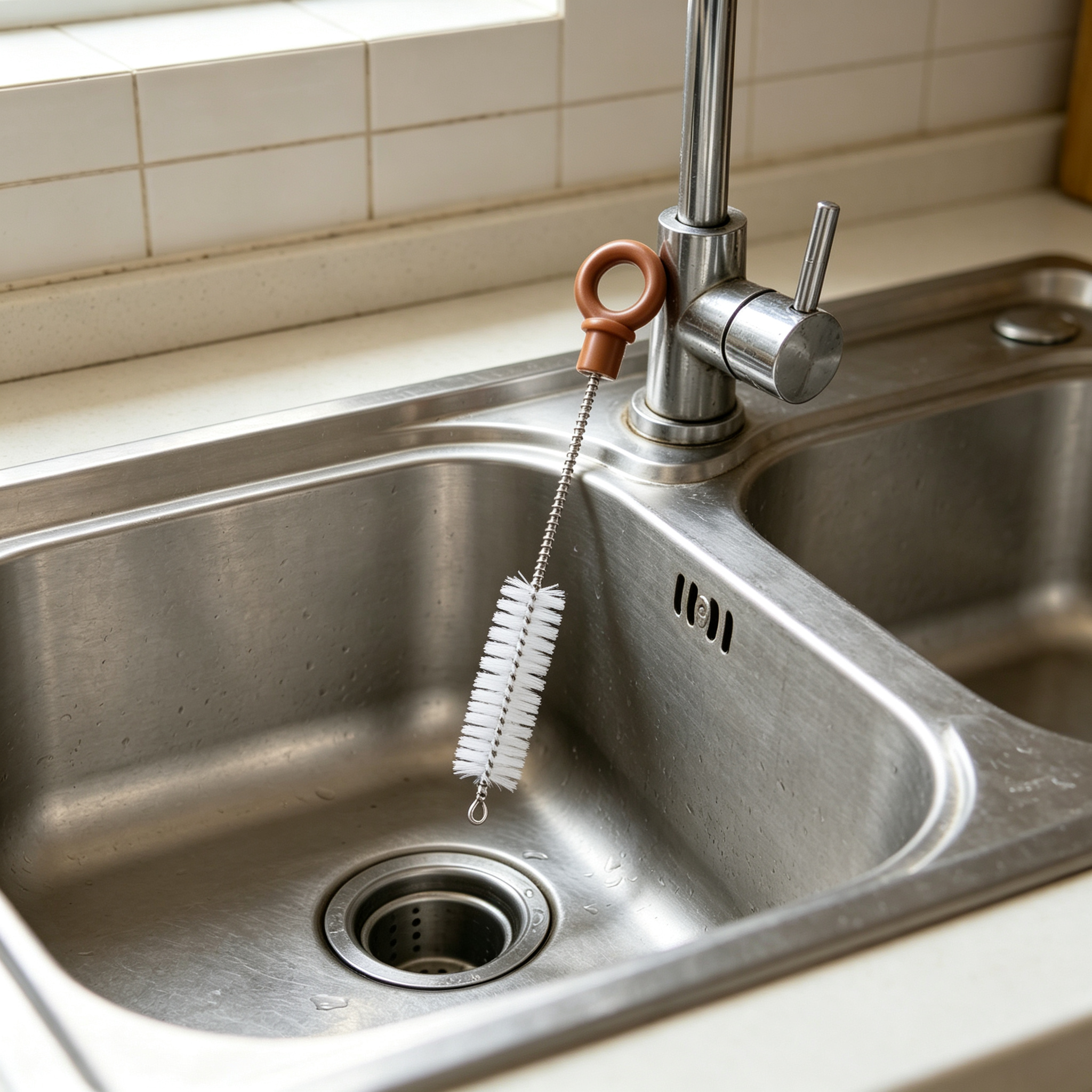
The next meaningful kitchen upgrade may not be another appliance.
It may be a better brush.
That sounds almost too simple in a market filled with smart refrigerators, espresso systems, air fryers, touchless faucets, and app-connected appliances. Yet one of the clearest lessons from the U.S. housewares market in 2026 is that consumers are not interested in innovation simply because it looks new.
They increasingly want products that remove friction from ordinary life.
For a 2-in-1 cup cleaning brush, that distinction matters.
If the product is marketed simply as “a cup brush,” it immediately enters a crowded, price-sensitive category. The customer sees bristles, a handle, perhaps a secondary cleaning component, and begins comparing prices.
But if the same product is positioned as a tool that reduces the number of utensils needed around the sink, makes awkward drinkware easier to maintain, and simplifies a task people repeat every day, its value changes.
It becomes less about the brush itself and more about what the brush gives back: fewer cleaning steps, less switching between tools, less clutter around the sink, and a more efficient daily routine.
That is why the strongest positioning for 2026 is not simply “better cleaning.” It is Faster, Smarter, Everyday Cleaning.
American consumers are looking for less friction at home
The idea that convenience matters to U.S. consumers is not speculation.
At The Inspired Home Show 2026 in Chicago, the International Housewares Association presented new consumer lifestyle research showing how Americans evaluate products for the home.
The research found that Millennials—who represent an estimated 35% to 40% of home and housewares spending—have convenient cleaning tools high on their shopping lists. Gen X consumers were similarly described as valuing products that make cleaning easier and more convenient. Across generations, quality and trust were the two leading elements shaping perceptions of value, while durability and reliable performance were among the most important characteristics associated with product quality.
This creates an important opportunity.
A successful kitchen tool does not necessarily need to perform a technologically complex task.
It needs to make a familiar task noticeably easier.
Cup cleaning is exactly that kind of task.
Coffee mugs, insulated tumblers, smoothie cups, reusable bottles, travel cups, narrow glasses, lids, rims, grooves, and small components have become ordinary parts of American kitchens.
Cleaning them, however, is not always as straightforward as washing a dinner plate.
Hands may not comfortably reach the bottom.
A sponge may clean the upper wall but struggle with a deep base.
A standard bottle brush may reach inside but feel excessive for a coffee mug.
Small lid details may require an entirely different cleaning tool.
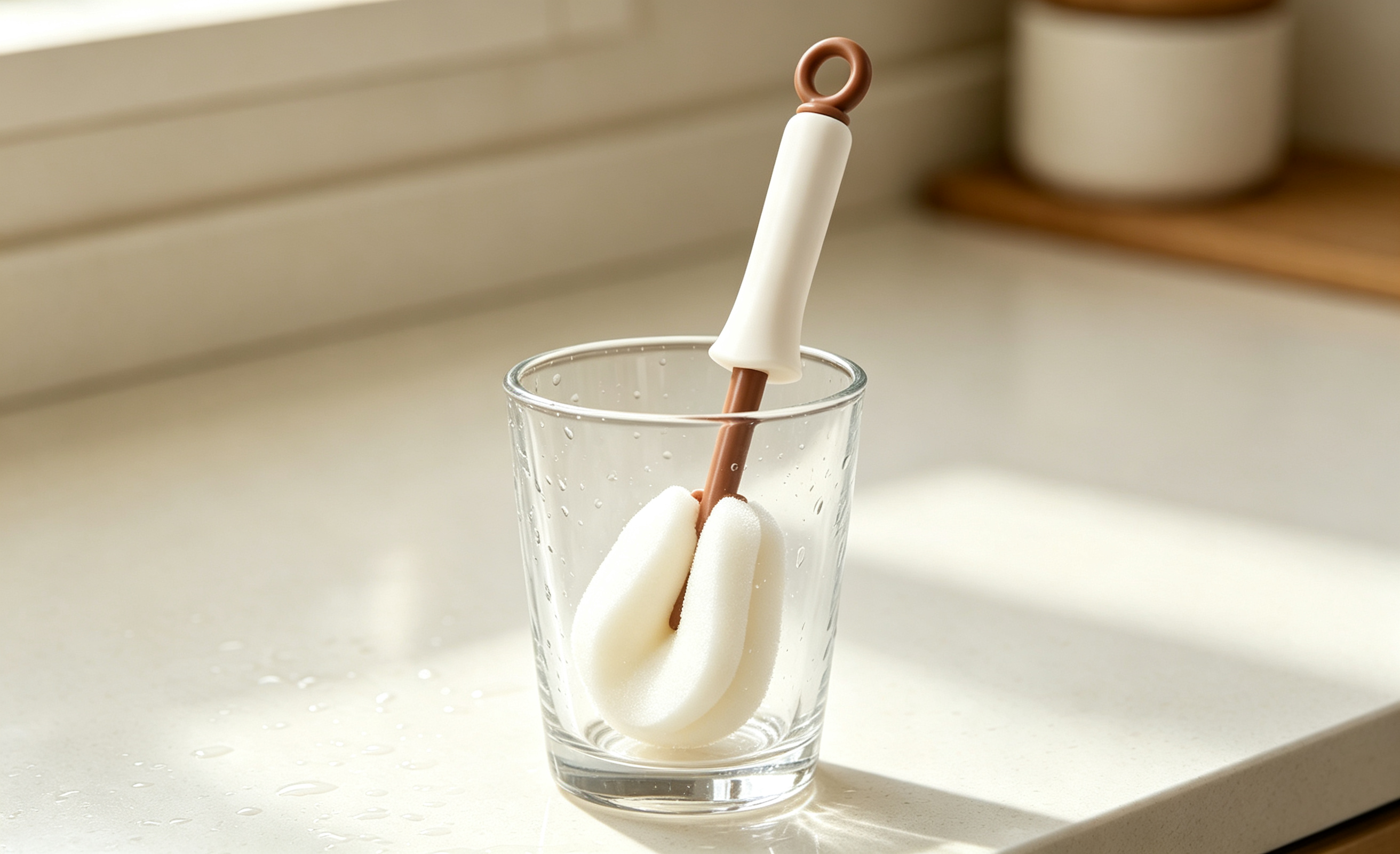
A well-designed 2-in-1 brush can address this friction by combining complementary cleaning functions in one compact product.
That multifunctionality is not a gimmick when it genuinely reduces the number of steps involved.
It is the product.
The first exposure point: sell time, not bristles
Traditional cleaning-tool marketing often focuses on physical specifications: dense bristles, comfortable handle, strong material, good grip.
Those details matter.
But they are not necessarily what motivates a customer to stop scrolling.
The more compelling question is: What becomes easier because I own this?
For the American market, one strong answer is time.
Not dramatic amounts of time.
No responsible brand should claim that a brush will save “hours every week” unless it has evidence.
The more credible value is the elimination of small inefficiencies.
Instead of reaching for one brush for the cup, another small brush for the rim or lid, and perhaps a sponge for exterior areas, a genuine two-function product can keep more of the cleaning process in one hand.
A few seconds saved on one cup sounds insignificant.
But convenience products rarely succeed because they save a spectacular amount of time once.
They succeed because they remove the same irritation repeatedly.
Coffee today.
Protein shaker tonight.
Travel tumbler tomorrow morning.
Children's drinkware after dinner.
Reusable bottles on the weekend.
Daily repetition turns small efficiency gains into noticeable convenience.
That is why the first major exposure message should not be: “2-in-1 cup cleaning brush.”
It should be closer to: “One tool. Fewer steps. A quicker sink routine.”
The first phrase describes the product.
The second explains why the consumer should care.
The U.S. housewares industry is already telling us that cleaning remains a strong category
The latest International Housewares Association data reinforces the size of the opportunity.
In its August 2026 MarketOutlook release, IHA reported that cleaning tools had the highest purchase intent among the housewares categories it studied, with 67% of surveyed U.S. adults saying they were very or somewhat likely to purchase cleaning tools during the coming year. The survey was conducted by Morning Consult among 2,201 adults in the first quarter of 2026.
That does not mean 67% of Americans want a cup brush.
It would be misleading to turn category-level purchase intent into a product-specific claim.
What it does indicate is that cleaning tools remain an active consumer category rather than an afterthought.
The challenge is differentiation.
And differentiation is especially important because cleaning tools have historically been treated as commodities.
IHA's previous 2025 MarketOutlook found that 70% of respondents intended to buy cleaning tools, yet 40% said they would not pay more for them despite product innovation.
That finding contains both the problem and the opportunity.
Consumers buy cleaning tools.
But they may resist premium pricing unless the improvement is obvious.
A manufacturer therefore cannot simply add a second function, increase the price, and expect the market to understand the value automatically.
The consumer needs to see the problem being solved.
The second exposure point: show the two functions in seconds
A 2-in-1 product has one major marketing advantage: it is naturally demonstrable.
This matters enormously in online retail.
According to IHA's 2026 State of the Industry data, 60% of home and housewares purchases in 2025 occurred online, versus 40% in stores.
When a consumer cannot physically pick up the product before buying, visual communication has to do more work.
For a 2-in-1 cup brush, the ideal product video should not begin with branding.
It should begin with the problem.
A tall cup with residue at the bottom.
A lid or narrow detail that is inconvenient to reach.
Then the product solves both tasks.
No complicated explanation.
No dramatic claims.
The viewer should understand the value before the video reaches ten seconds.
That is one of the strongest exposure opportunities available to this category.
A regular cleaning brush is difficult to demonstrate in a surprising way.
A genuinely multifunctional brush creates its own before-and-after story.
First function.
Second function.
One handle.
Done.
That visual structure is naturally suited to Amazon listings, retailer product pages, TikTok, Instagram Reels, YouTube Shorts, and paid social advertising.
Multifunctionality matters because American kitchens are fighting clutter
There is another reason a 2-in-1 format makes sense.
Kitchen space is valuable.
The 2025 U.S. Houzz Kitchen Trends Study found that homeowners undergoing kitchen renovations were investing heavily in specialty storage. Among those adding or replacing cabinets, 67% incorporated pullout waste or recycling storage, 59% added tray organization, 39% chose cutlery organizers, and 35% added specialized utensil storage.
The 2026 Houzz study continued to show functionality as a major renovation driver. The percentage of renovating homeowners citing kitchen deterioration or dysfunction as a reason for remodeling rose to 38%, while 41% cited dissatisfaction with the kitchen's old style.
These figures are not about dish brushes.
But they illuminate a broader consumer mindset.
Americans are spending real money to make kitchens work better.
That means product designers should be cautious about adding more single-purpose objects to the countertop or sink area.
One brush for mugs.
One for bottles.
One for lids.
One for narrow grooves.
One sponge for general cleanup.
Individually, each is inexpensive.
Collectively, they create clutter.
A two-function tool can address that problem by consolidating jobs.
This creates the third major exposure point: multifunctionality as space efficiency.
The product does not merely perform two tasks.
It potentially replaces two tools.
That is a much stronger reason to buy.
“Smarter” does not have to mean electronic
The word “smart” has been overused in the home industry.
Consumers are surrounded by products described as smart because they contain sensors, Bluetooth, apps, screens, or automated settings.
But smart design can also be mechanical.
Sometimes the smartest product is the one that solves two ordinary problems without requiring a battery.
For a cup cleaning brush, Smarter should mean: a handle shaped for control, a main cleaning section suited to common cup interiors, a secondary function that addresses areas the primary brush cannot reach efficiently, easy rinsing, simple storage, and a form that avoids unnecessary complexity.
That type of intelligence is highly relevant in 2026.
The International Housewares Association's consumer research shows that Americans increasingly define value through quality, trust, performance, and durability—not merely low purchase price. In the 2026 Value Equation Index, 64% identified quality as important, while durability and reliable performance were the leading characteristics consumers associated with quality.
That suggests an important lesson for manufacturers:
Do not make a 2-in-1 product complicated simply to justify the phrase “2-in-1.”
The second function needs to solve a real problem.
If it does, simplicity becomes a strength.
The third exposure point: own the reusable drinkware routine
One of the most promising marketing contexts for this type of brush is reusable drinkware.
American kitchens and workplaces now contain a wide variety of cups that are used repeatedly throughout the day: coffee tumblers, insulated cups, water bottles, protein shakers, smoothie cups, commuter mugs, children's cups, and reusable beverage containers.
These products are often taller, narrower, or more structurally complex than traditional open glasses.
That creates a cleaning-tool opportunity.
Instead of marketing the brush around the generic phrase “dish washing,” position it around the modern drinkware routine.
Morning coffee.
Gym bottle.
Office tumbler.
Smoothie cup.
Evening tea.
The brush becomes part of the consumer's daily hydration and beverage ecosystem.
This gives the product a much more contemporary identity.
A traditional dish brush belongs in the sink.
A modern 2-in-1 drinkware brush belongs in a lifestyle.
Everyday Cleaning is where the real value lives
Many household products are marketed around occasional deep cleaning.
That is not the strongest story here.
A cup brush is valuable precisely because it is used repeatedly.
It is an Everyday Cleaning product.
That changes how the brand should communicate.
Instead of dramatic images of heavily stained drinkware, show realistic situations: coffee residue after breakfast, a smoothie cup after a workout, a reusable tumbler after commuting, a child's cup after lunch, a narrow glass at the end of dinner.
The message becomes: “This is the tool you reach for without thinking.”
That is powerful because frequently used products can earn loyalty differently from occasional-use tools.
If the handle feels right every day, consumers notice.
If the brush rinses easily every day, consumers notice.
If the second function repeatedly eliminates the need to find another tool, consumers notice.
Convenience is rarely one spectacular moment.
It is the absence of repeated annoyance.
The cleaning market is also connected to organization and emotional comfort
The American Cleaning Institute's 2026 national survey provides useful context.
Among 1,000 nationally representative U.S. adults, 80% said they engage in spring cleaning at least annually. Fifty-seven percent said decluttering or organization motivates them to begin spring cleaning, while 72% said coming home to a clean, organized space is more relaxing than receiving a massage.
Again, this data does not prove that consumers want a specific cup brush.
But it reinforces a broader point: cleaning is not merely about removing dirt. It is also connected to order.
A sink surrounded by brushes, sponges, narrow cleaners, straw tools, and miscellaneous accessories can feel visually disorganized even when everything is technically clean.
This creates another exposure opportunity.
The 2-in-1 design can be presented as part of a cleaner sink setup.
One compact tool doing multiple jobs.
Less visual clutter.
Simpler storage.
Fewer things to replace.
The fourth exposure point: convenience without disposable thinking
Convenience has sometimes been associated with disposable products.
That does not have to be the case.
The 2026 IHA MarketOutlook found that convenience continues to influence cleaning purchases strongly enough that 40% of respondents said they planned to buy cleaning tools that use disposable cloths.
For a reusable brush manufacturer, this is useful information.
It shows how powerful convenience can be.
The goal is therefore not to lecture consumers for wanting easy solutions.
The goal is to make reusable tools sufficiently convenient that they compete on the same emotional territory.
Easy to grab.
Easy to use.
Easy to rinse.
Easy to store.
Two jobs in one.
A reusable product wins when the user does not feel that choosing reuse requires accepting more friction.
Design the product around the hand, not just the cup
The product's shape is another potential exposure point.
Manufacturers often concentrate almost entirely on the cleaning head.
But the consumer interacts first with the handle.
How thick is it?
Does it become slippery with soapy hands?
Is there enough leverage when cleaning the bottom of a tall tumbler?
Can the second cleaning function be accessed without awkwardly touching the wet main brush?
Can the user switch functions quickly?
Does the product feel balanced?
These details determine whether the 2-in-1 concept actually creates Faster cleaning or simply adds another feature.
A feature is not useful because it exists.
It is useful because it reduces effort.
Product photography should prove reach
A cup brush has another challenge: much of its work happens where the consumer cannot see it.
Inside the cup.
At the bottom.
Around narrow edges.
In grooves.
Good photography therefore needs to make invisible performance visible.
A transparent glass can demonstrate contact with interior walls.
A tall tumbler can demonstrate reach.
A side-by-side image can show how the secondary cleaning component addresses a smaller detail.
A dimension graphic can make handle length easy to understand.
A close-up should show bristle density or cleaning material without exaggerating what it can do.
A video is even better because movement communicates flexibility and control.
The fifth exposure point: stop competing as a generic “cleaning brush”
Generic naming creates generic value.
“Cup Brush.” “Bottle Brush.” “Kitchen Brush.”
These terms are useful for search, but weak as positioning.
The consumer sees a commodity.
Instead, the marketing hierarchy should begin with the outcome:
“Two cleaning functions in one kitchen tool.”
“Made for everyday drinkware.”
“From deep cup interiors to small details.”
“One tool for your daily coffee, tumbler, and bottle routine.”
The category term still belongs in the title and product description for clarity and search visibility.
But it should not carry the entire sales story.
This is especially important because U.S. consumers increasingly research housewares before buying.
IHA's 2026 consumer research found that 80% of consumers considered ratings and reviews very or extremely important, rising to 88% among Millennials.
That means the product must give customers something specific to talk about.
“The brush works” is a weak review.
“I stopped using three separate brushes” is a strong review.
“It reaches my tumbler and the small cleaner handles the lid” is a strong review.
“It takes up less space by the sink” is a strong review.
Product design should create reviewable benefits.
Why value matters more in 2026
American consumers remain price-conscious.
YouGov reported in March 2026 that 53% of U.S. adults had set a budget for the year, up from 46% in 2025, reflecting continued sensitivity to everyday household costs.
This makes value communication even more important.
A more expensive brush cannot rely on “premium” language alone.
Consumers need a concrete reason to spend more.
For a 2-in-1 brush, that reason may be consolidation.
If one well-designed tool genuinely replaces two separate products, the price comparison changes.
Instead of asking: “Why does this brush cost more?” the consumer can ask: “How many tools does this replace, and how often will I use it?”
This is the right value conversation for 2026.
Not luxury.
Utility.
The product should work for Millennials without excluding everyone else
IHA's 2026 research offers another useful clue.
Millennials and Gen X together account for roughly 60% to 70% of U.S. home and housewares spending, according to the Association's consumer lifestyle research.
Millennials were described as highly interested in convenient cleaning tools, while Gen X consumers showed particular interest in products that make cleaning easier as they age.
This creates a broad positioning opportunity.
For younger households, show busy mornings, coffee routines, reusable tumblers, compact kitchens, and multifunctionality.
For families, emphasize reducing the number of tools needed to clean varied drinkware.
For older consumers, emphasize grip, reach, control, and reduced fiddling with multiple small accessories.
One product.
Different reasons to value it.
The sixth exposure point: apartment kitchens and limited storage
Not every U.S. consumer has a large kitchen.
For people living in apartments, condos, dorms, shared housing, or smaller homes, space is a genuine resource.
That makes “2-in-1” more meaningful.
A multifunction tool should not merely offer extra features.
It should reduce storage demand.
This is where packaging and merchandising can become powerful.
Show one product next to the two conventional tools it can replace.
The consumer immediately understands the footprint advantage.
The strongest slogan may not be about cleaning performance at all.
It might simply be: “Two jobs. One spot by the sink.”
Retail packaging needs to explain the product without assistance
Because housewares purchases increasingly take place online, digital presentation is essential.
But physical retail still matters.
Forty percent of U.S. home and housewares purchases in 2025 were still made in stores.
A shopper standing in a store may give the package only a few seconds.
The front should therefore communicate three things immediately: what it cleans, what makes it 2-in-1, and what inconvenience it removes.
A diagram is often better than a paragraph.
“Main brush: cup interiors.”
“Detail cleaner: rims, lids or narrow areas,” if that accurately reflects the real product design.
No unnecessary language.
No vague claims.
The back can explain materials, care instructions, dimensions, and compatible use cases.
The front should answer one question: “Why is this better than the brush beside it?”
Do not invent hygiene claims the product cannot prove
Cleaning products often become vulnerable to exaggerated marketing.
Terms such as “antibacterial,” “germ-killing,” “sanitizing,” or “99.9% bacteria removal” should never be added simply because the product is intended for kitchen cleaning.
Those are evidence-dependent claims.
A manual cup brush can be valuable without making medical or microbiological promises.
The credible benefits are already strong: better reach, two complementary functions, fewer tools, simplified routines, comfortable handling, and easier access to drinkware details.
Those are consumer benefits.
They can be demonstrated visually.
The seventh exposure point: turn routine into content
The product is also naturally suited to short-form social content because the cleaning task is visually satisfying.
A stained coffee cup becomes clean.
A narrow tumbler goes from difficult to easy.
A small detail gets cleaned with the second function.
A cluttered sink setup becomes simpler.
This gives the manufacturer several repeatable content formats: “one tool vs. two tools,” “morning coffee cleanup,” “tumbler cleaning in seconds,” “small kitchen sink organization,” and “things your sponge cannot easily reach.”
The key is authenticity.
The cleaning challenge shown in the video should be realistic.
The result should not be manipulated.
And time-saving claims should match what the demonstration actually proves.
Smarter product architecture can create repeat sales
A well-designed 2-in-1 brush also creates opportunities beyond the first purchase.
If the brush head wears over time while the handle remains functional, a replaceable-head architecture may create a useful consumable ecosystem.
If the product actually supports that design, it can deliver several advantages: lower replacement cost for the consumer, less need to discard the entire tool, repeat sales for the manufacturer, and a reason for the customer to remain within the same brand.
The important point is not to add replaceability simply because it sounds sustainable.
The connection must remain strong.
Replacement must be intuitive.
Spare parts must actually be available.
A theoretically replaceable head that disappears from the market after six months creates frustration rather than loyalty.
The strongest B2B markets may not be obvious
The 2-in-1 cup brush can also move beyond the residential kitchen.
Potential professional audiences include office kitchens, coffee stations, coworking spaces, hospitality operators, cafés cleaning reusable preparation vessels, corporate pantries, short-term rental operators, and professional organizers.
The B2B conversation is slightly different.
A household buyer may care about saving drawer space.
A property manager may care about standardizing one tool across multiple units.
An office manager may prefer fewer loose cleaning accessories around a shared sink.
A hospitality buyer may care about storage, durability, replacement parts, packaging, and consistent supply.
This means manufacturers should not use one product page for every buyer.
Residential positioning can focus on convenience.
B2B material can focus on simplification and operational consistency.
From “cleaning brush” to “daily kitchen efficiency tool”
This is ultimately the biggest repositioning opportunity.
The cleaning category often talks about dirt.
But consumers frequently buy convenience.
They buy the five-minute meal.
The coffee maker that remembers a setting.
The organizer that ends drawer chaos.
The appliance that combines multiple cooking functions.
The container that stacks better.
The tool that eliminates an annoying step.
A 2-in-1 cup cleaning brush belongs in the same psychological category.
It solves a smaller problem.
But it uses the same value equation.
Less friction.
Fewer steps.
More control.
Better use of space.
That is why “cup cleaning brush” is technically correct but strategically incomplete.
The more meaningful message is: Faster routines. Smarter tools. Better Everyday Cleaning.
What manufacturers should prove before using those words
Strong positioning must still be earned.
If a brand wants to call the product faster, it should demonstrate where steps are reduced.
If it wants to call it multifunctional, both functions need to be genuinely useful.
If it wants to emphasize durability, construction and testing should support that message.
If it wants to market easy cleaning, the brush itself should rinse without trapping excessive residue.
If it promises compact storage, dimensions should support that claim.
Every marketing claim should be connected to a physical design decision.
2026 is not about adding more products to the kitchen
One of the most interesting contradictions in the modern kitchen market is that consumers continue buying new products while simultaneously wanting less clutter.
That means the winning products increasingly need to justify the space they occupy.
A single-purpose gadget used twice a year has a difficult argument.
A compact tool used every day has a much better one.
A compact tool that performs two useful functions is stronger still.
This is where the 2-in-1 cup cleaning brush can find its place.
Not as another gadget.
As consolidation.
Not more kitchen stuff.
Less cleaning friction.
The future of simple tools is better thinking
The U.S. housewares market in 2026 provides a useful lesson for manufacturers everywhere.
Consumers still buy cleaning tools.
They still care about price.
But the definition of value is broader.
Quality matters.
Trust matters.
Durability matters.
Reliable performance matters.
Convenience matters.
Reviews matter.
And for several of the country's largest consumer generations, products that make cleaning easier have clear appeal.
A 2-in-1 cup cleaning brush does not need artificial intelligence, an app, a charging cable, or ten different attachments to participate in that trend.
It needs to remove friction from a real task.
Clean the main drinking surface effectively.
Handle the smaller detail that normally requires another tool.
Feel comfortable in the hand.
Rinse easily.
Store simply.
And be ready again tomorrow.
The smartest upgrade may be the simplest one
When people hear “2026 kitchen upgrade,” they may imagine an expensive remodel.
Houzz's latest U.S. research certainly shows that homeowners continue investing heavily in kitchen functionality, with dysfunction itself becoming a stronger reason to renovate.
But better kitchens are not created only through countertops, cabinetry, and appliances.
They are also created through dozens of small interactions.
Opening a drawer.
Making coffee.
Packing a lunch.
Rinsing a tumbler.
Cleaning after dinner.
Putting everything away.
The products that improve these repeated moments can create disproportionate value because consumers experience the improvement again and again.
That is the real opportunity for the 2-in-1 cup cleaning brush.
Do not sell another piece of plastic that happens to have bristles.
Sell a better routine.
One tool instead of several.
One motion instead of unnecessary switching.
One compact solution beside the sink.
Make the benefit instantly visible.
Make the second function genuinely useful.
Make the construction good enough to earn trust.
And position the product where American consumers increasingly place value: convenience, quality, multifunctionality, and everyday performance.
Because the most persuasive kitchen innovation is not always the one that does something revolutionary.
Sometimes, it is the one that makes a task we already perform every day noticeably easier.
That is how a simple brush becomes a 2026 kitchen upgrade.
And that is how Faster + Smarter + Everyday Cleaning becomes more than a slogan—it becomes a practical reason to choose one product over another.



