


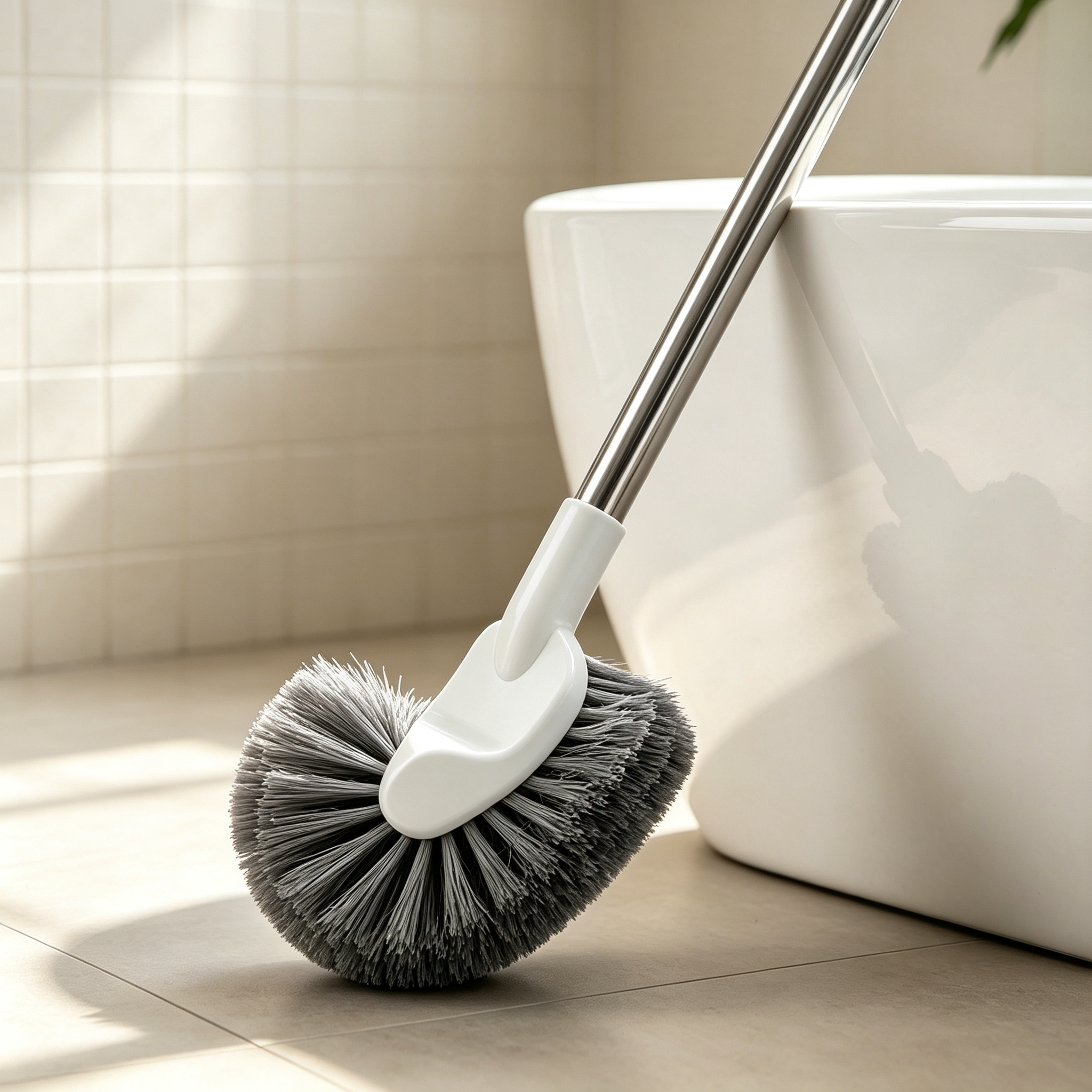
A toilet brush is probably one of the least celebrated products in a bathroom. Yet it performs one of the most necessary jobs.
For decades, consumers treated toilet brushes as disposable cleaning accessories: inexpensive plastic handles, basic holders, limited attention to appearance, and an expectation that the entire product would eventually be replaced.
That mindset is changing.
As bathrooms become more carefully designed, as consumers pay greater attention to cleanliness, and as hotels and property managers compete on the details of the guest experience, even a simple cleaning tool is being reconsidered.
The opportunity is no longer just to sell another toilet brush. The opportunity is to offer a better bathroom-cleaning experience—one built around Stainless Steel, stronger ergonomics, better maintainability, and a more professional visual language.
And that matters because modern bathroom expectations are moving in three directions at the same time: people want spaces that are cleaner, products that last longer, and accessories that do not undermine the design of the room.
A well-designed long-handle toilet brush sits directly at the intersection of those expectations.
The Bathroom Has Become More Than a Utility Space
Modern bathrooms are increasingly treated as part of the overall living experience.
Design publications and renovation research have documented the continuing transformation of bathrooms into spaces focused on comfort, accessibility, wellness and long-term usability. Architectural Digest's 2025 bathroom-trend coverage highlighted wellness, elevated materials, unobtrusive technology and easier-to-maintain layouts as significant themes in contemporary bathroom design. Houzz's 2025 U.S. Bathroom Trends Study found that 68% of surveyed renovating homeowners were considering special needs in their bathroom projects, illustrating how functionality and long-term usability are becoming central design concerns.
This shift creates an interesting problem.
A homeowner may invest in refined tiles, carefully selected faucets, frameless glass, modern lighting and coordinated storage—only to place a visibly cheap plastic toilet brush next to the toilet.
Functionally, the tool may work. Visually, however, it can feel disconnected from everything else in the room.
That disconnect is a product opportunity.
A toilet-cleaning tool can be designed to perform its basic task while also fitting naturally into a contemporary bathroom. A brushed or polished metal appearance can feel deliberate rather than disposable. A restrained holder can look like part of the room rather than an object that needs to be hidden.
This is the first major exposure point for the product: Turn an overlooked cleaning tool into an intentional bathroom accessory.
That positioning immediately moves the conversation away from price alone and toward quality, design and long-term value.
Hygiene Is Becoming a System, Not a Single Cleaning Action
The global conversation around cleanliness has also matured.
In October 2025, WHO and UNICEF released their first global guidelines on hand hygiene in community settings, covering homes, public spaces and institutions. In September 2026, WHO published additional guidance explaining why these recommendations matter and emphasizing three requirements for effective hygiene systems: appropriate materials, clear information, and a physical and social environment that makes good practices easy to maintain.
Those guidelines are primarily about hand cleaning—not toilet brushes—and it would be misleading to claim that a particular brush prevents infectious disease.
The more relevant lesson for bathroom-product manufacturers is broader.
Good Hygiene depends on systems that make cleaning easier to perform consistently.
Bathrooms need surfaces that can be maintained. Cleaning tools need to be accessible. Users need products that are comfortable enough to use regularly. Hotels need routines that employees can execute efficiently. Property managers need equipment that can withstand repeated service.
A better toilet brush therefore should not be marketed with exaggerated health claims. It should be positioned as a better tool within the cleaning process.
That distinction matters. Credible marketing builds trust.
Why Material Choice Changes the Product Story
A long-handle toilet brush operates in one of the most demanding environments in the home.
It is repeatedly exposed to moisture. It may encounter cleaning solutions. It is handled frequently. It is stored close to water. Its appearance can deteriorate quickly if the materials and finishes are poorly selected.
Material therefore becomes more than a specification. It becomes part of the value proposition.
Industry information from worldstainless explains that stainless steel derives much of its corrosion resistance from a naturally forming chromium-rich passive surface layer that can regenerate in the presence of oxygen. Industry technical guidance also identifies cleanability, mechanical strength and long service life as reasons stainless steels are widely used in hygiene-critical applications.
That does not mean every steel product is automatically immune to corrosion. Grade selection, manufacturing quality, surface finish, exposure to chlorides and cleaning practices all matter.
That nuance is actually useful for serious manufacturers.
Instead of simply saying “metal is better,” brands can communicate specific material choices, manufacturing standards and maintenance recommendations.
A well-made Stainless Steel handle communicates strength before the customer even uses the product. It feels different in the hand. It looks different beside the toilet. And it gives manufacturers a more credible basis for moving the product away from the disposable end of the category.
Durability Is Becoming Part of the Value Equation
Low purchase price and low total cost are not the same thing.
A cheap cleaning tool that bends, cracks, discolors or needs frequent replacement may ultimately deliver less value than a product designed to remain serviceable for longer.
This matters particularly for commercial buyers.
Consider a hotel group, serviced-apartment operator or professional cleaning company managing hundreds of bathrooms.
Replacing one broken brush is insignificant. Repeated across hundreds of rooms and multiple replacement cycles, however, the process creates purchasing costs, labor, inventory handling and waste.
That is where a Durable product can create a stronger commercial argument.
Instead of competing exclusively on unit price, suppliers can discuss service life, maintenance, consistency and replacement frequency.
For residential customers, the same argument can be translated more simply: buy an accessory that feels like part of the bathroom rather than something temporary.
This is the second major exposure point: Shift the purchasing conversation from “How cheap is it?” to “How long will it continue doing its job well?”
That question opens a much more valuable market.
The Long Handle Is Not a Cosmetic Feature
One of the strongest functional selling points of this category is surprisingly straightforward: distance.
A longer handle allows the user to reach deeper parts of a toilet bowl without bringing the hand unnecessarily close to the cleaning area.
It can also reduce the degree of bending required during routine cleaning.
This may sound like a small improvement, but small ergonomic improvements become meaningful when a task is repeated hundreds or thousands of times.
For a homeowner, that can mean a more comfortable routine. For housekeeping professionals, it can contribute to a more efficient workflow. For older users or people designing homes for longer-term accessibility, the ergonomic logic becomes even more relevant.
Current U.S. bathroom-renovation data supports the wider trend toward future-oriented usability. Houzz reported that 68% of homeowners in its 2025 bathroom study considered special needs in renovation projects, while many were planning for requirements that might emerge years later.
A toilet brush obviously does not solve accessibility on its own. But the trend tells manufacturers something important: customers are increasingly paying attention to how products are actually used, not merely how they look.
Handle length, grip comfort, balance, weight and storage accessibility deserve to be treated as selling points rather than engineering details.
The Hidden Opportunity: Make Cleaning Tools Less Embarrassing to Display
Traditional cleaning tools are often designed around one assumption: they should be hidden.
That assumption limits product value.
If manufacturers improve the appearance of the holder, handle and overall proportions, the product becomes suitable for visible placement.
That matters in smaller bathrooms where storage is limited. It matters in guest bathrooms. And it matters enormously in hospitality environments where every visible object contributes to the impression of the room.
A modern toilet brush should not need to pretend it is something else. It simply needs to look considered.
Minimal profiles, carefully controlled proportions, neutral finishes and visually clean storage systems can change how customers perceive the category.
The objective is not luxury for the sake of luxury. It is visual coherence.
A bathroom where even the cleaning accessories appear intentional communicates attention to detail. And attention to detail is increasingly valuable.
Hospitality Makes the Business Case Even Stronger
Hotels provide one of the clearest examples of why bathroom details matter.
Recent travel research reported by Hospitality Net based on Vrbo data found that exceptional cleanliness was considered one of the strongest quality signals for a vacation property by 78% of surveyed travelers. The same research reported that 67% identified the absence of unpleasant odors and 66% identified spotless bathroom surfaces as important markers of cleanliness. It also found that 81% would pay more for a vacation rental with stronger trust signals.
That does not mean travelers are booking hotels because of toilet brushes. It means the bathroom is part of the trust equation.
Housekeeping tools contribute indirectly to the operational ability to deliver the result guests actually notice: a clean, well-maintained room.
The hotel industry is also operating in an environment of increasing guest expectations. Shiji's Q2 2026 Guest Experience Benchmark reported a global review index of 87.3%, with room quality and service remaining major drivers of guest perception.
In such an environment, operational consistency matters.
A poorly made cleaning tool that fails during housekeeping is a minor procurement problem. Multiplied across a large property portfolio, it becomes an avoidable operational problem.
This creates the third exposure point: Market the product not only as a household accessory, but as an operational tool for hospitality and property management.
The conversation then becomes larger than the bathroom shelf. It becomes about housekeeping efficiency, purchasing consistency and guest experience.
The Best Product Story Combines Appearance and Performance
Many household-product categories fall into one of two traps.
Some products are engineered primarily for performance but look industrial. Others are styled beautifully but offer little practical improvement.
The strongest bathroom products bridge that gap.
A long-handle toilet brush can communicate premium quality visually while still solving practical problems.
The holder should support tidy storage. The handle should feel stable. The cleaning head should be suitable for reaching the relevant bowl surfaces. The complete system should be simple to maintain. The form should complement modern fixtures.
None of these characteristics is revolutionary by itself. Their value comes from integration.
That integration is precisely what allows a manufacturer to reposition an ordinary object.
Four Audiences, Four Different Reasons to Buy
The same product can generate very different value depending on the buyer.
For homeowners, the strongest message is often a combination of cleanliness, appearance and convenience. They want something effective that does not make a renovated bathroom look cheaper.
For hospitality operators, consistency becomes more important. The product needs to support repetitive use and fit the property's visual standards.
For property managers and serviced-apartment operators, replacement frequency and ease of procurement become meaningful.
For cleaning-service companies, ergonomics and reliability may matter more than decorative styling.
This means marketing should not rely on one generic message.
A product page aimed at homeowners might lead with bathroom aesthetics. A LinkedIn campaign aimed at hotel procurement managers should focus on lifecycle value and operational reliability. A distributor presentation might emphasize material specification, packaging efficiency and suitability across residential and commercial channels.
One product can therefore support several routes to market—provided the messaging reflects the buyer's actual problem.
What Should Be Shown in Product Photography?
For this category, photography is not decoration. It is evidence.
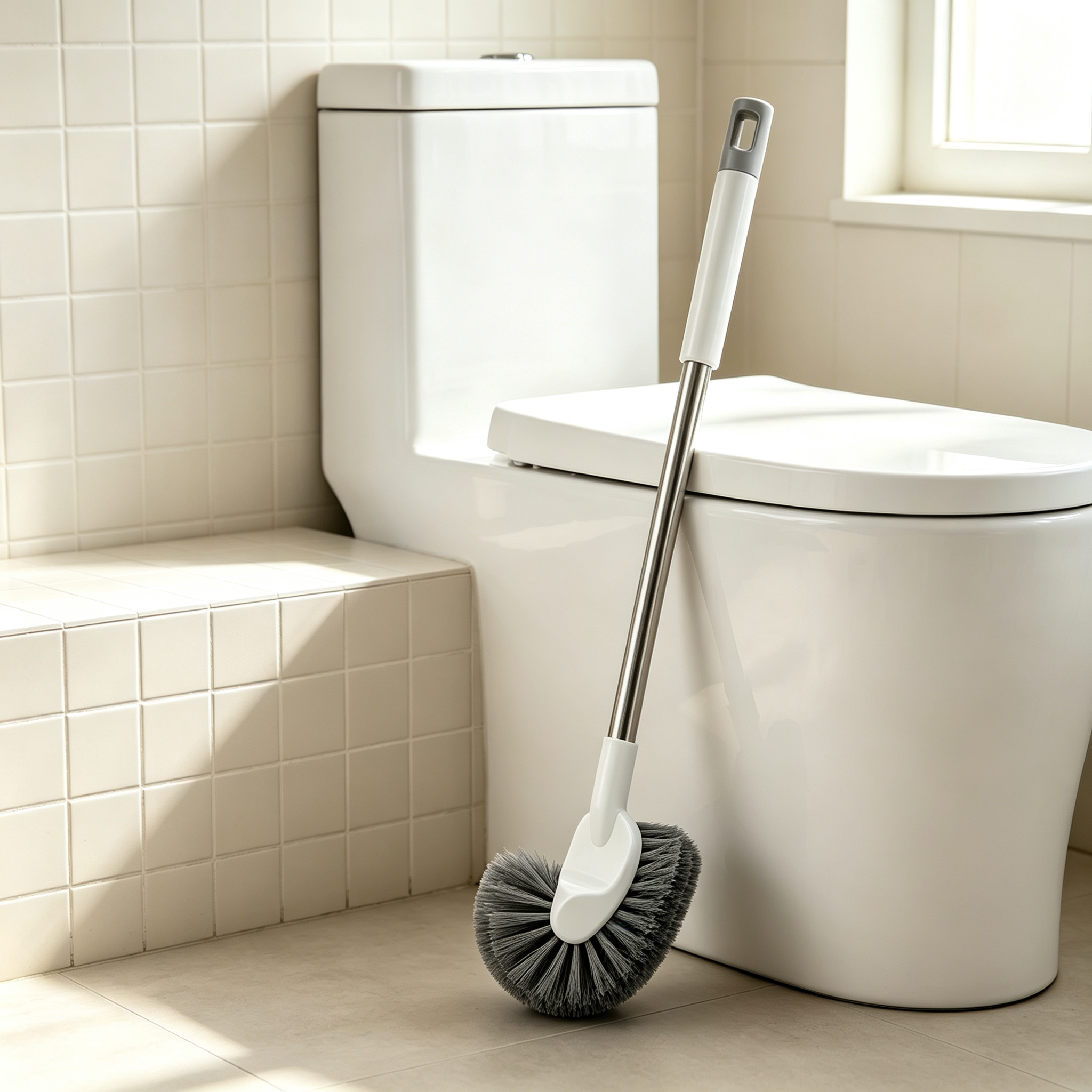
The first image should establish that the product belongs in a contemporary bathroom. The second should demonstrate scale and handle length. The third should show the material finish closely enough that a buyer can understand the construction.
Another image should show the brush stored naturally beside the toilet, because customers need to visualize what the product looks like when it is not being used.
For B2B buyers, detail photographs of joints, handle construction, holder geometry and packaging can be more persuasive than lifestyle images alone.
Video is even more useful.
A short demonstration can show how far the brush reaches beneath the toilet rim, how the handle behaves under pressure, how the product is returned to the holder, and how easily exposed surfaces can be wiped clean.
The goal is to convert invisible engineering decisions into visible proof.
Avoid One of the Biggest Mistakes in Hygiene Marketing
Cleaning-product marketing often becomes less credible when brands make claims that go beyond the evidence.
Words such as “antibacterial,” “sterile,” “germ-free” and “eliminates bacteria” carry specific implications.
Unless a product has been appropriately tested and the claims comply with the relevant market's regulatory requirements, those terms can create unnecessary risk.
A stainless-steel handle, for example, should not automatically be described as antimicrobial.
Technical guidance on hygienic applications specifically notes that stainless steel does not inherently provide an active antimicrobial effect; its advantage lies instead in properties such as cleanability, durability and suitability for sanitization.
That is a powerful distinction.
Trustworthy positioning would emphasize cleanable surfaces, thoughtful separation between hand and bowl, moisture-resistant material selection, long-handle ergonomics, reliable construction and easy maintenance.
These are meaningful benefits. There is no need to exaggerate them.
Maintenance Should Be Part of the Product Experience
There is another overlooked marketing opportunity: teach customers how to care for the product.
Stainless steels are corrosion-resistant, not magically maintenance-free.
Industry guidance notes that appropriate cleaning remains important and that certain environmental conditions—including chloride exposure—can affect corrosion behavior.
A responsible manufacturer can therefore provide clear care instructions.
That simple step does several things simultaneously. It reduces misuse. It increases the customer's perception of professionalism. It may extend the attractive life of the product. And it gives the brand an opportunity to educate rather than merely advertise.
For premium household products, education is increasingly part of the value proposition.
Sustainability Is Stronger When It Is Measurable
Sustainability has become a common marketing phrase, but vague claims have limited persuasive value.
For a toilet brush, the most credible sustainability discussion begins with longevity.
If a stronger product remains functional for longer and avoids repeated full-product replacement, there is a clear resource-efficiency argument.
But brands should distinguish between reasonable lifecycle logic and quantified environmental claims.
If a manufacturer wants to claim that a product reduces waste by a particular percentage, cuts carbon emissions or lasts a specific number of times longer than a competing product, those claims need evidence.
Without comparative testing, the safer and more convincing message is straightforward: design the product for longer use, provide clear maintenance guidance, and offer replaceable components where the design genuinely supports them.
That approach connects sustainability to engineering. It also creates a more credible premium proposition.
The Real Differentiator Is Not the Brush—It Is the Experience
When customers compare toilet brushes online, many products initially appear similar.
That creates a commoditization problem.
Competing only through photographs, price and generic phrases such as “high quality” makes differentiation difficult.
A stronger brand story focuses on the complete experience.
How does the handle feel? How easily can users reach difficult areas? Does the product look appropriate in a renovated bathroom? How does it behave after repeated exposure to moisture? Is the holder stable? Can the exterior be cleaned easily? Does the supplier explain the material clearly? Is the packaging suitable for retail or e-commerce? Can a hotel or distributor order consistently?
These questions transform the product from an object into a system of value.
Five Exposure Points That Can Drive Attention
For a long-handle bathroom toilet brush, the most commercially useful exposure strategy can be summarized around five themes.
First, modern bathroom aesthetics: position the brush as a product that belongs beside contemporary fixtures rather than as an accessory that needs to be hidden.
Second, long-handle ergonomics: demonstrate reach and user distance visually instead of relying only on technical dimensions.
Third, material credibility: explain why carefully selected metal construction can support corrosion resistance, cleanability and a premium feel.
Fourth, commercial reliability: show hotel, apartment, office and property-management buyers how product consistency can support routine housekeeping operations.
Fifth, lifecycle value: communicate the economics of longer service instead of relying solely on low initial price.
These exposure points work because they address five different buyer questions: Will it look good? Will it be easier to use? Is the material trustworthy? Can I rely on it operationally? Is it worth the money?
Why “Premium” Should Mean Better, Not Simply More Expensive
Consumers are increasingly skeptical of products that use premium styling to justify a higher price without delivering better functionality.
Therefore, the objective should not be to create a toilet brush that merely appears expensive.
The objective should be to create a better tool.
Material selection must support the environment in which it is used. The handle must provide meaningful reach. Connections must remain stable. The holder must work in real bathrooms. The surface finish must tolerate realistic maintenance. Packaging must protect the product during transport.
If those fundamentals are correct, premium positioning becomes a consequence of product quality rather than a marketing invention.
That is how an ordinary category becomes interesting.
A Better Product for the New Bathroom Standard
Bathrooms are undergoing a quiet transformation.
Consumers are looking beyond basic function and thinking more carefully about wellness, accessibility, design coherence and long-term usability.
Hospitality operators are operating in a world where cleanliness is inseparable from guest trust.
Public-health organizations continue to emphasize the importance of making good hygiene practices easy to maintain in homes and community environments.
And manufacturers are under pressure to create products that deliver stronger value without depending on disposability.
Within that context, the humble toilet brush deserves more attention than it usually receives.
A carefully engineered long-handle model can reduce uncomfortable reaching, support routine cleaning, improve the appearance of the bathroom and offer a stronger lifecycle proposition than poorly constructed alternatives.
The opportunity is especially compelling when Hygiene is treated as a practical routine rather than a marketing slogan, when Durable construction is demonstrated rather than merely claimed, and when Stainless Steel is specified and maintained with an understanding of what the material can—and cannot—do.
Ultimately, better bathrooms are not created only through expensive renovations.
They are created through hundreds of small decisions.
The faucet. The lighting. The storage. The towels. The cleaning routine. Even the toilet brush.
When every object is selected with greater attention to function, longevity and user experience, an ordinary bathroom becomes a better-managed space.
And that is the real opportunity for manufacturers, distributors and buyers:
Do not sell another disposable cleaning accessory. Create a cleaning tool people are comfortable using, comfortable displaying and confident keeping.
That is how a simple bathroom product becomes a meaningful upgrade.



