


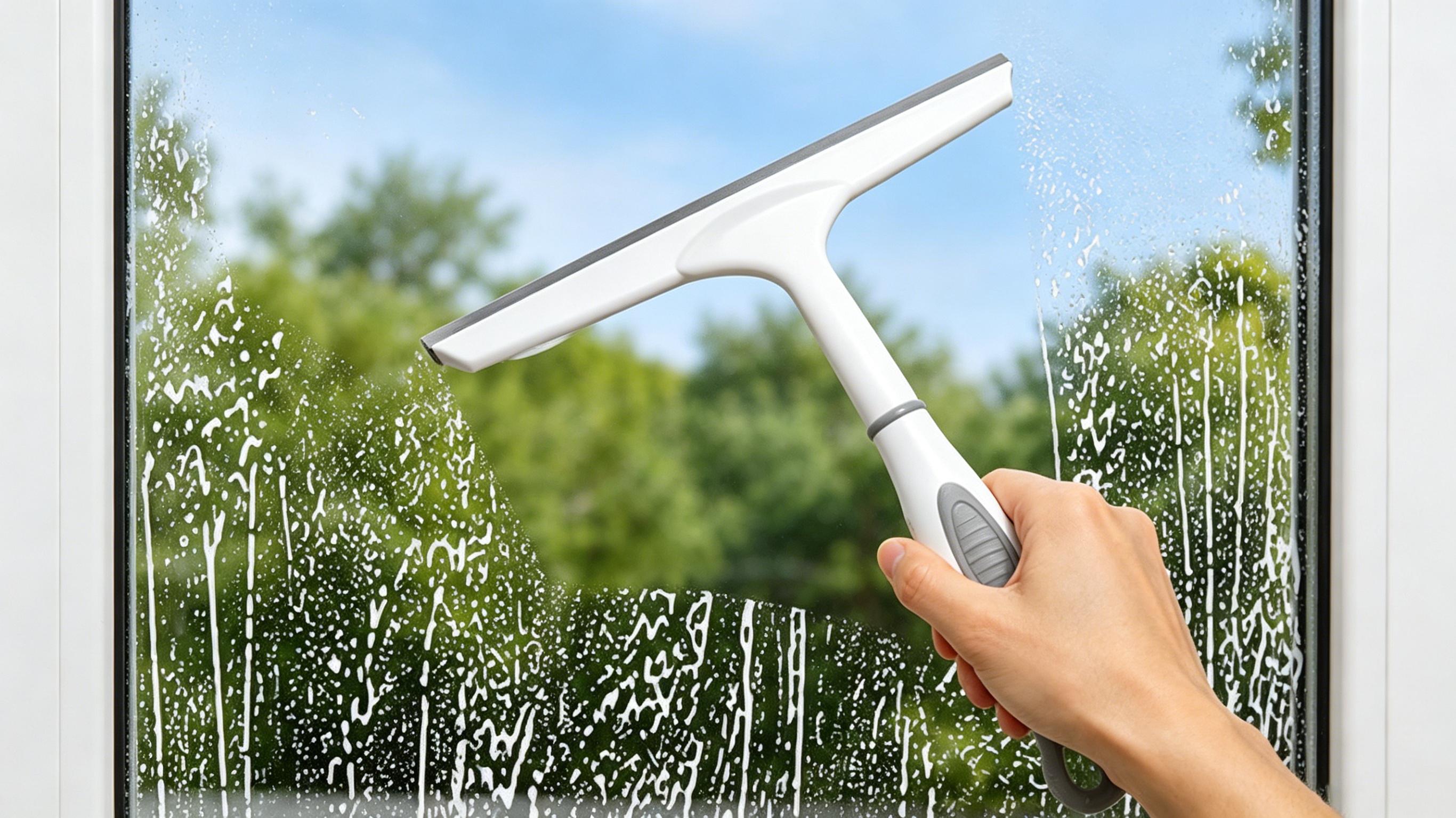
In 2026, the most interesting opportunities in home cleaning are not always the biggest or most complicated machines. They are often simple tools that solve a frequent, visible problem in less time. The glass squeegee is a strong example. It is inexpensive to use, easy to understand, compact to store, and immediately useful on shower glass, bathroom mirrors, windows, tiles, and other smooth surfaces. For distributors, retailers, private-label brands, cleaning companies, hotels, property managers, and e-commerce sellers, that combination makes the category increasingly relevant.
The commercial logic is being reinforced by broader changes in the home-care market. Consumers are under time pressure, but they still want homes that look clean, dry quickly, and feel well maintained. Bathrooms are becoming larger, more personalized, and more wellness-oriented. Glass remains an important visual material because it helps spaces feel open and bright, but transparent surfaces also expose water spots, soap residue, fingerprints, and streaks immediately. At the same time, windows remain one of the most visible cleaning tasks in any home, hotel, office, or rental property. A practical glass squeegee therefore sits at the intersection of three durable needs: faster cleaning, visible results, and moisture control.
1. The 2026 Home-Care Market Is Rewarding Simple, Low-Effort Solutions
One reason the glass squeegee category deserves attention is that current consumer research is emphasizing convenience rather than complexity. Euromonitor International’s July 2026 report, Top Five Trends in Home Care, identifies convenience and efficiency as major drivers of category growth. The report says consumers increasingly value products that fit busy schedules, reduce effort, shorten routines, and provide dependable results under normal household conditions. That is almost a direct description of what a well-designed shower squeegee or window squeegee is supposed to do.
Mintel reaches a similar conclusion. Its 2026 research on the future of household cleaners describes the market as moving toward low-effort routines, health-conscious choices, and aesthetically pleasing solutions. Mintel also highlights the importance of faster, more seamless cleaning and products that reduce steps. This matters because a glass squeegee does not require a learning curve, batteries, charging, software, or a complicated maintenance routine. The user sprays or rinses the surface when needed, pulls the blade across the glass, removes the remaining water, and can see the result immediately.
NielsenIQ adds an important spending signal. In its Consumer Outlook: Guide to 2026, NIQ reported that household-care dollar spending per U.S. household was up 3% across its measured omnishopper data. Consumers remain cautious, but household care is still part of the protected day-to-day budget. This does not mean every cleaning product will grow automatically. It means products must show clear value. A practical bathroom cleaning tool that solves a repeated problem has a better story than a novelty item that is used once and forgotten.
2. Bathrooms Are Becoming Larger, More Open, and More Glass-Intensive
The bathroom is one of the strongest use cases because design trends are increasing the importance of showers and visually clean surfaces. The National Kitchen & Bath Association (NKBA), one of the most influential trade organizations in the North American kitchen and bath industry, released its 2026 Bath Trends Report based on responses from 688 industry professionals. The report found that 72% of respondents expected the overall bathroom footprint to increase, while 55% said a larger shower was more important than having a bathtub. NKBA also identified wellness, personalization, accessibility, and practical upkeep as central design themes.
That matters for cleaning-tool demand. A larger shower means more wall area, more enclosure surface, more tile, and often more glass. A beautiful walk-in shower can look premium when dry and spotless, but the same enclosure quickly shows mineral deposits and soap film after repeated use. The larger and more transparent the surface, the more visible the maintenance problem becomes. This creates a natural role for the shower squeegee as an everyday prevention tool rather than an occasional deep-clean accessory.
Houzz provides another useful real-world signal. The 2025 U.S. Houzz Bathroom Trends Study surveyed 1,737 homeowners with recent or planned bathroom renovation projects. It reported that wet rooms had increased to 16% of renovated bathrooms, or roughly one in six projects. Houzz also found continued investment in major bathroom renovations and strong interest in wellness and accessibility. The direction is clear: the bathroom is becoming a more carefully designed daily environment, not merely a utility room.
3. Moisture Control Gives the Product a Practical Reason to Stay Within Reach
The strongest products are not only visually useful; they connect to a real maintenance need. The U.S. Environmental Protection Agency (EPA) repeatedly emphasizes moisture control as the key to reducing mold problems indoors. Its guidance on mold and moisture notes that bathrooms are frequently damp environments and recommends ventilation, frequent cleaning, and drying of wet surfaces. The EPA also advises acting quickly when condensation appears on windows and other surfaces.
The U.S. Centers for Disease Control and Prevention (CDC) similarly states that mold grows where moisture is present and recommends addressing the moisture problem as part of cleanup and prevention. A glass squeegee is not a substitute for ventilation, proper waterproofing, leak repair, or appropriate cleaning products, and it should never be marketed as a medical device or as a guaranteed mold-prevention solution. Its value is simpler and more defensible: it physically removes a large portion of residual water from smooth surfaces after showering or washing.
That distinction is important. Good product marketing should explain exactly what the tool does. When users pull a shower squeegee over glass or tile, they reduce standing droplets and help the surface dry faster. In areas with hard water, removing droplets before they evaporate can also reduce the amount of visible mineral spotting left behind. On windows, the same principle helps remove wash water efficiently and supports streak-free cleaning when the blade, angle, and technique are correct.
4. A Glass Squeegee Turns “Deep Cleaning” Into a 30-Second Maintenance Habit
Many consumers delay bathroom cleaning because buildup makes the task feel larger than it is. Water spots accumulate, soap residue dries, and the user eventually needs stronger chemicals and more scrubbing. The advantage of a shower squeegee is behavioral: it moves part of the work from an occasional recovery task into a very short maintenance step.
This aligns with Mintel’s 2026 U.S. Household Routine Consumer Report, which says tighter schedules are reshaping cleaning expectations and that consumers want products that make routines simpler and faster. The report specifically points toward shorter routines, fewer steps, and faster results. A well-positioned glass squeegee fits that pattern because the task is visible, finite, and easy to complete immediately after use.
For the consumer, the message should be concrete: use the squeegee while the surface is already wet. Start at the top, pull in controlled strokes, and direct the water toward the drain or lower edge. Wipe the blade if needed. The result is not “a perfectly sanitized bathroom” and should not be advertised that way. The result is less residual water, fewer visible droplets, a clearer glass surface, and less dried residue to attack later.
5. Window Cleaning Expands the Use Case Beyond the Bathroom
The same product family can address windows, mirrors, glass doors, balcony panels, car glass in appropriate designs, and other smooth surfaces. That broader use case increases purchase justification. A customer may first buy a shower squeegee for the bathroom and then discover that a window squeegee is useful for weekly glass cleaning or seasonal deep cleaning.
For window care, blade quality and balance matter because streak-free cleaning depends on consistent contact across the glass. An uneven edge can leave lines. A handle that twists too easily can reduce control. A blade that is too rigid may not adapt well to slight surface variation, while one that is too soft may chatter or leave water behind. Product development should therefore focus on the relationship between blade material, edge geometry, handle angle, weight distribution, and intended surface size.
A wide window squeegee may improve productivity on large panes, but it can feel awkward inside a narrow shower or on small mirrors. A compact shower squeegee is easier to maneuver in corners but requires more passes on a large window. This is why a product line often performs better than a single universal size. Retailers can offer a compact bathroom model, a medium multi-purpose glass cleaning tool, and a wider window cleaning tool. The customer then chooses based on the dominant task rather than accepting a compromise.
6. What Buyers Should Look for in a Better Squeegee
Not all squeegees deliver the same experience. The first factor is the blade. The edge should make even contact with the surface and remove water without requiring excessive pressure. If the blade skips, curls, or develops an uneven edge too quickly, the customer will interpret the problem as poor product quality even if the rest of the tool looks attractive.
The second factor is ergonomics. A handle should allow a natural wrist position and reliable control with wet hands. Texture, thickness, angle, and total weight all affect the experience. A product may look minimal in a product photo but become uncomfortable after repeated passes. For private-label development, the handle should be evaluated through actual cleaning tests, not only CAD drawings or packaging mockups.
The third factor is storage. In a bathroom, the shower squeegee should be easy to hang, stand, or mount without creating clutter. A hanging hole, hook-compatible end, wall holder, or other storage concept can convert the tool from something kept under the sink into something used after every shower. Because regular use is the main value proposition, storage design is part of performance, not merely an accessory.
The fourth factor is surface compatibility. A well-designed glass squeegee should work smoothly on common non-porous surfaces intended by the manufacturer, but buyers should define the target application carefully. Shower glass, mirrors, glazed tile, standard windows, and large commercial panes impose different demands. Packaging should state the recommended surfaces clearly and avoid claims that have not been tested.
The fifth factor is cleanability and durability. A bathroom cleaning tool lives in a wet environment. Crevices that trap dirt can create an unpleasant ownership experience. Components should be easy to rinse and dry. If a model uses multiple materials or replaceable parts, the connection points should be designed for repeated use. For commercial cleaning clients, durability testing can be especially important because the usage frequency may be far higher than in a household.
7. Why the Category Works for Retail, E-Commerce, and Private Label
The glass squeegee has several business advantages. It is visually intuitive, compact, easy to bundle, and suitable for multiple price tiers. A basic model can compete on value, while a more refined model can compete on design, comfort, storage, material feel, packaging, or a coordinated bathroom aesthetic. NielsenIQ’s 2026 analysis of premiumization in U.S. fast-moving consumer goods also shows a broader split in which premium and value propositions can both gain while undifferentiated mainstream products are squeezed. The lesson for squeegee brands is to choose a clear position.
For a value-focused retailer, the proposition might be a reliable blade, straightforward handle, simple packaging, and strong cost efficiency. For a premium bath brand, the same category can be redesigned around visual simplicity, a refined handle profile, coordinated colors, an integrated holder, gift-ready packaging, and a stronger unboxing experience. The function is still water removal, but the presentation is aligned to a different customer expectation.
E-commerce sellers gain another advantage: the product is easy to explain through before-and-after imagery. A listing can show shower glass, a mirror, a window, and the storage solution. Short-form video can demonstrate streak-free cleaning. Comparison charts can separate size, blade width, handle style, and recommended applications. Bundles can pair the glass cleaning tool with microfiber cloths or other non-chemical accessories, subject to the seller’s assortment strategy.
8. OEM Customization: Build Your Brand Without Reinventing the Product
Our company supports OEM programs for customers who already know the target market and want a faster path to a branded product. An OEM squeegee project typically starts with an existing or proven structural platform and then adapts the visible and commercial elements around the buyer’s requirements.
Branding is the most obvious layer. Depending on the selected model and production method, a buyer may request logo placement, color coordination, retail packaging, barcode and labeling layouts, instruction cards, or multi-language packaging. The important point is consistency. A window squeegee sold under a premium home brand should look like it belongs to that brand from the first product image to the final package opened by the consumer.
OEM customization can also help channel differentiation. A supermarket program may need compact packaging and a sharp price point. A hotel-supply distributor may prefer neutral colors and carton efficiency. An e-commerce brand may want packaging optimized for parcel shipping and product photography. A bathroom-accessory brand may prioritize a coordinated holder and a finish that matches the rest of its collection.
9. ODM Development: Create a More Defensible Product Proposition
For buyers who want stronger differentiation, our company also supports ODM development. ODM is valuable when the customer does not simply want a logo on an existing glass squeegee but wants to rethink the product around a specific market problem, price band, user group, or retail channel.
The development process should begin with the use case. Is the priority shower maintenance in premium homes? Fast window cleaning for professional cleaners? A compact tool for small apartments? A coordinated bathroom accessory for a design-led retail collection? Each brief leads to different design decisions. A product for hotels may emphasize repeated daily use and operational simplicity. A product for direct-to-consumer retail may emphasize appearance, tactile quality, packaging, and content-friendly features.
From there, the design can address blade dimensions, handle geometry, component structure, storage concept, material options, colors, packaging, and branding. Prototypes or samples can be evaluated for grip comfort, wiping consistency, balance, storage convenience, assembly, and appearance. The point of ODM is not to make the product complicated. It is to make each design decision support a clear target customer.
10. Who Should Be Buying This Category in 2026?
Household retailers are an obvious group because the glass squeegee can sit in bathroom, cleaning, hardware, or seasonal window-care assortments. Home-improvement retailers can merchandise it near shower hardware, glass treatments, tile-care products, and renovation accessories. E-commerce sellers can build keyword-rich listings around shower squeegee, window squeegee, bathroom cleaning tool, glass cleaning tool, and streak-free cleaning.
Hospitality buyers also have a strong use case. Hotels and serviced apartments must maintain showers, mirrors, and glass surfaces at a consistent visual standard. A practical window cleaning tool or shower squeegee can support housekeeping workflows, especially where glass is extensive. Property-management companies and short-term rental operators face a similar challenge because visible water spots and streaks can influence guest impressions even when a space is otherwise clean.
Professional cleaning companies may prefer tools optimized for repeated use and quick handling. Bathroom and sanitaryware brands may treat the squeegee as an accessory that protects the appearance of the main product. Promotional and corporate-gift buyers can use custom colors and logos when the product fits a home, property, hospitality, or lifestyle campaign. Distributors can target all of these verticals with different packaging and assortment strategies.
11. Why a Manual Tool Still Matters in an Age of Automation
Cleaning automation is expanding, but that does not eliminate the need for simple hand tools. ISSA, the international cleaning industry association, has documented rapid growth in autonomous floor-cleaning equipment. Yet even in professional environments, automation works best when the tool matches the task. Robots are effective where routes, floors, and operations justify them. A vertical shower panel, mirror edge, narrow window, or quick post-shower wipe is a different problem.
For these small, frequent tasks, manual tools can be faster because there is almost no setup. The user does not need to charge, fill, connect, map, program, or maintain an electronic system. A shower squeegee can be picked up and used in seconds. That makes it especially relevant for “micro-cleaning” moments: the short maintenance actions that prevent a surface from becoming a larger cleaning project.
12. A Strong 2026 Product Strategy: Sell the Outcome, Then Customize the Tool
The market case for the glass squeegee is strongest when brands avoid exaggerated claims and focus on outcomes consumers can verify. The product removes surface water. It helps glass look clearer between deep cleans. It can reduce visible spotting by removing droplets before they dry. It makes window washing faster when used with proper technique. It supports a short maintenance habit after showering. These are concrete benefits.
The broader 2026 evidence strengthens that proposition. Euromonitor is highlighting efficiency and convenience in home care. Mintel is emphasizing low-effort cleaning and shorter routines. NielsenIQ is showing continued household-care spending and a market that rewards clearer value propositions. NKBA is documenting larger showers and more wellness-focused bathrooms. Houzz is showing the rise of wet rooms and continued bathroom investment. EPA and CDC guidance reinforce the importance of controlling moisture and drying wet environments. Together, these signals create a credible commercial context for a category built around removing water from glass and other smooth surfaces.
That is where our OEM and ODM capabilities become valuable. We can work with customers to develop a glass squeegee program around the intended market position, including branding, color direction, packaging, size selection, storage concepts, and product structure based on the agreed project scope. The goal is not simply to put a logo on a cleaning tool. The goal is to create a product that fits the customer’s channel, target price, design language, and real cleaning scenario.
In a crowded home-care market, simple products can still create strong business when they solve visible problems repeatedly. The glass squeegee does exactly that. Bathrooms are receiving more investment. Showers are getting larger. Consumers want cleaning routines that take less time. Glass continues to demand frequent visual maintenance. Window and bathroom care remain recurring tasks. For brands looking for a practical, demonstrable, customizable cleaning product in 2026, the category deserves serious attention.



