


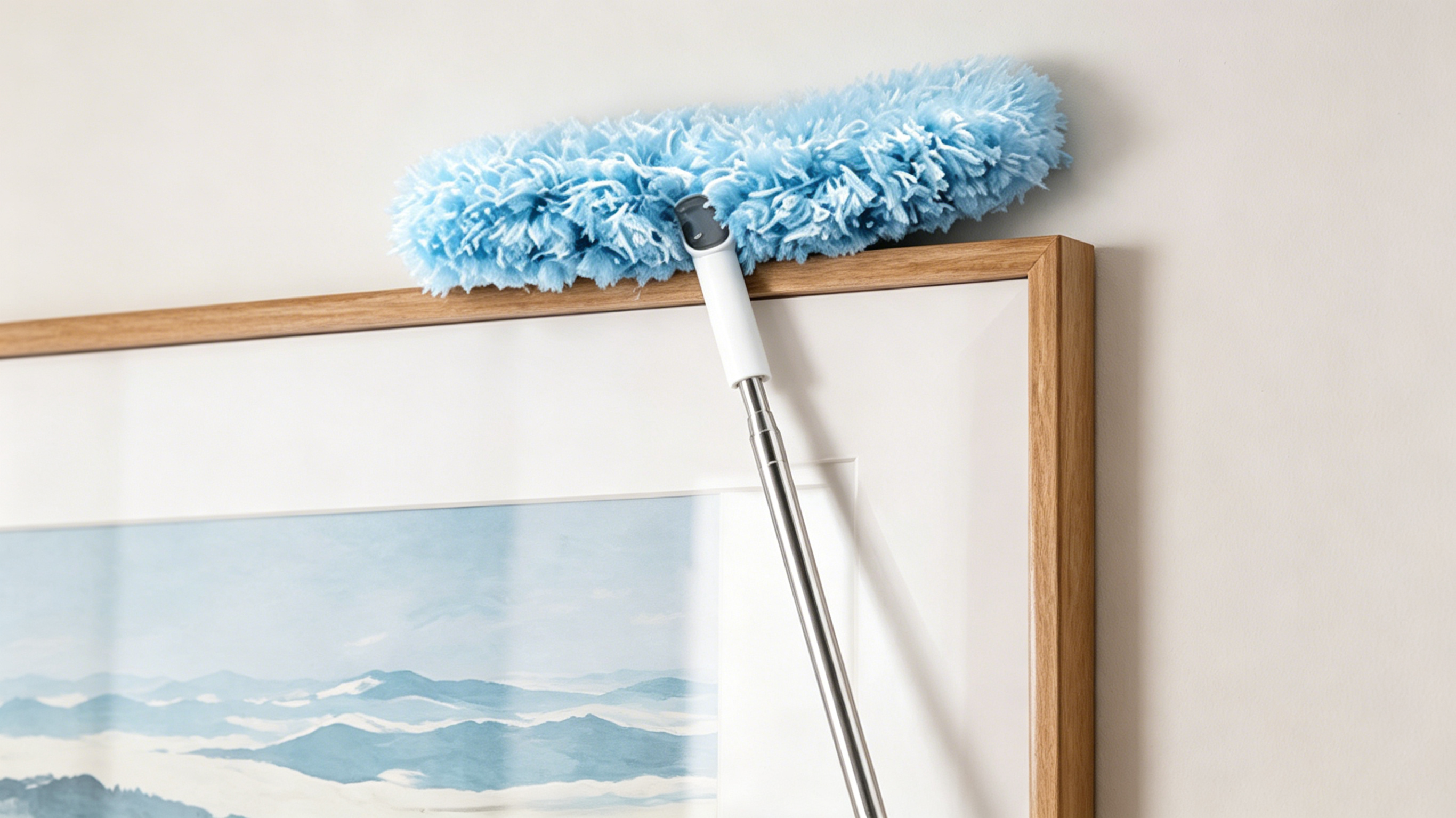
In 2026, the strongest cross-border cleaning-tool opportunities are not always the most complicated products. A simple product can become highly competitive when it solves several everyday problems with one clear structure. The long-handle duster is a good example. With the right head profile, adjustable pole, flexible core and replaceable cleaning surface, one tool can address ceiling-edge dust, curtain rods, air-conditioner housings, cabinet tops, wardrobes, high shelves, lighting surrounds, narrow spaces behind appliances and low gaps under furniture.
For importers, distributors, marketplace sellers, hotel suppliers and Private Label brands, this versatility matters because every additional practical scenario makes the SKU easier to explain and easier to merchandise. A shopper can understand the value in seconds: shorten it for storage, extend it for higher surfaces, bend the head for horizontal tops, flatten it for narrow gaps, remove the head for cleaning or replacement. That is a much stronger sales story than simply saying “extra-long duster.”
Our company develops cleaning tools for international buyers and supports OEM, ODM and Private Label. We can customize microfiber, chenille, head width and thickness, fiber length and density, bendable-core stiffness, aluminum or stainless-steel poles, PP connectors, TPR grips, telescopic sections, locking systems, replaceable heads, colors, logos, retail packaging, buyer-provided barcodes, multilingual labels, BOM, Golden Sample, QC standards and Master Carton configuration.
There is no authoritative global database that reports the exact 2026 sales growth of “long-handle dusters” as an individual product. We therefore do not invent a market-share percentage. Instead, this article uses current evidence from the U.S. Census Bureau, U.S. Bureau of Labor Statistics, Eurostat, the UK Health and Safety Executive and UN Trade and Development to explain the commercial environment in which a multi-scenario long-reach cleaning tool can become an attractive sourcing item.
1. Why the 2026 market favors cleaning tools with visible, demonstrable functions
1.1 E-commerce gives a clear advantage to products that can be demonstrated quickly
The U.S. Census Bureau reported on August 18, 2026 that seasonally adjusted U.S. retail e-commerce sales reached approximately US$340.2 billion in the second quarter of 2026. That was 12.2% higher than the second quarter of 2025, while e-commerce represented 17.1% of total retail sales.
This figure is not a sales statistic for dusters. Its relevance is channel structure. A very large share of purchasing now happens in environments where shoppers compare products on a screen. A long-handle duster performs well in this format because its advantages are visual: before-and-after pole length, a head bending over the top of a wardrobe, a slim profile entering the space behind a refrigerator, or a replacement head attaching to the same handle.
For a marketplace buyer, that means the product can be communicated through five or six images rather than a long technical explanation. For us as a manufacturer, it means the engineering choices should be designed together with the eventual product page.
1.2 European online buying confirms that digital comparison is now normal
Eurostat reports that in 2025, 78% of EU internet users purchased or ordered goods or services online, compared with 62% in 2015. The market is therefore not only large but also mature.
Maturity changes competition. When dozens of similar cleaning tools appear in the same search results, color alone is not enough. A buyer needs features that can be understood and verified: maximum reach, folded length, head thickness, head material, washable or replaceable construction where validated, and a stable locking mechanism.
1.3 Commercial cleaning remains a very large operating activity
The U.S. Bureau of Labor Statistics lists approximately 2,432,600 janitors and building cleaners in 2025. BLS projects about 321,800 openings per year on average from 2025 to 2035, largely because workers need to be replaced as they leave occupations or the labor force.
Again, this is not a forecast for duster sales. It is evidence that cleaning buildings remains a major recurring activity. Offices, schools, shopping facilities, accommodation properties and other buildings continuously require tools for routine maintenance. A durable long-reach duster can therefore serve both consumer and professional channels.
1.4 Tourism creates another large base of repeatedly cleaned rooms
Eurostat recorded 1.321 billion overnight stays in tourist accommodation across the EU in the first half of 2026, up 1.7% from the same period in 2025. Foreign visitors accounted for 48.9% of the total.
An overnight stay does not equal a duster sale, but it represents a room that must be maintained within an operating system. In hotels and serviced apartments, dust above wardrobes, on curtain tracks, around light fittings and on upper furniture surfaces is not a one-time problem. It returns, which makes repeatable tools and replacement heads commercially relevant.
2. Home-use scenarios: why one head and one pole can solve several neglected cleaning tasks
2.1 Ceiling edges: reach is more important than scrubbing power
At the junction between walls and ceilings, the common problem is usually light dust or cobwebs rather than heavy deposits. The ideal head therefore does not need aggressive bristles. It needs low mass, broad contact and enough softness to move easily along painted surfaces.
A lightweight microfiber or chenille head on an extendable pole can increase the area reachable from a stable floor. The engineering challenge is to keep the head light enough that the product remains controllable at maximum extension. Every gram at the far end of a long pole produces more leverage at the user’s wrist.
2.2 Furniture tops: head width determines how many passes are needed
The tops of wardrobes, kitchen cabinets and tall storage units are broad horizontal surfaces. A very narrow duster works, but requires repeated strokes. A wider head covers more area per pass.
However, wider is not automatically better. If the head becomes too heavy or too thick, it is harder to fit between a cabinet and ceiling. For an OEM project, we can select a slim 25–30 cm profile, a wider furniture-top version, or multiple interchangeable heads on one handle platform.
2.3 Curtain rods and blind headers require a thinner profile
Curtain rods, rails and the tops of blinds are long but narrow. A bulky round duster can push fabric around and may not track the rail accurately. A flatter head gives the user more directional control.
For this use, head thickness can matter as much as width. We can reduce the hard inner frame while maintaining enough structural strength, then wrap the edge with microfiber so the hard component is less likely to contact nearby walls during light use.
2.4 Air-conditioner housings are a powerful consumer demonstration scene
The top of a wall-mounted air conditioner is difficult to see from normal eye level and can collect household dust. A slim flexible head can help clean accessible exterior surfaces without requiring the user to disassemble the appliance.
The limitation must be explicit: a household duster is not a tool for internal heat exchangers, electrical compartments or other service areas. Power should be switched off before cleaning accessible exterior surfaces, and the appliance manufacturer’s instructions should be followed.
2.5 High shelves need a head that can change angle
When a high shelf is horizontal, a straight duster head contacts it poorly unless the user lowers the pole to a steep angle. A bendable head changes the geometry. The user can shape the head closer to 45 or 90 degrees before reaching upward.
The flexible core must hold its angle under light cleaning pressure. If it is too soft, it straightens immediately. If it is too stiff, the user struggles to adjust it. In ODM development, we can tune core material, diameter, flexible-zone length and outer construction.
2.6 Gaps behind appliances reward a slim, long head
The space behind a refrigerator, washing machine, cabinet or radiator can be deep but narrow. In this situation, maximum pole height is less important than head thickness and lateral flexibility.
A flat elongated head can enter a narrow slot, while a round fluffy duster may stop at the opening. This is why “high-reach” and “gap cleaning” should be designed together rather than treated as separate products whenever possible.
2.7 Under-sofa and under-bed cleaning turns a high-reach product into a whole-home tool
A flexible flat head can also travel under sofas, beds and low cabinets. This creates a valuable cross-selling message: the same product works above the wardrobe and below the bed.
The design requirement changes slightly. For low-clearance furniture, the hard core must remain thin and the connector between head and pole should not create a thick hump. ODM allows us to flatten these interfaces.
2.8 Light fixtures require strict safety boundaries
Dust around lampshades and external light-fixture surfaces can be reached with a long handle, but the fixture should be switched off and allowed to cool first. A product containing a metal pole or internal metal bending core should not be used near exposed live electrical parts.
We recommend including simple safety text in consumer packaging rather than implying that the tool can be used around any electrical equipment under any condition.
2.9 Ceiling fans must be completely stopped before cleaning
A long duster may help reach the blades of a ceiling fan, but the fan must be turned off and fully stopped. It should never be approached while rotating.
For buyers targeting regions where ceiling fans are common, we can develop a wider or partially U-shaped head that contacts the blade surface more effectively. This should be tested on realistic blade shapes before mass production.
3. Commercial-use scenarios: the same product can become a professional maintenance tool
3.1 Hotels need repeatable tools, not one-off novelty products
The Eurostat accommodation figures illustrate the scale of rooms and properties being used continuously across Europe. For hotel housekeeping, the key requirement is repeatability. A tool used across many rooms must have the same reach, head connection and replacement-part compatibility month after month.
That makes BOM control and Golden Sample approval more important than a decorative claim. If a hotel buys replacement heads later, they must still fit the handles already in service.
3.2 Office buildings create numerous high horizontal surfaces
Partition tops, cabinets, light surrounds, signage and high shelves all collect dust. Many of these surfaces do not require heavy scrubbing; they require frequent, light contact.
A long, lightweight pole can reduce setup time when the area is safely reachable from floor level. Professional versions may use a larger tube diameter, a stronger lock and a more durable connector than lightweight household versions.
3.3 Retail environments value fast spot cleaning
In a shop, staff may need to remove visible dust from upper shelving or displays without disrupting customers. A compact telescopic duster stored in a back room can be deployed quickly for light maintenance.
This makes storage length important. A pole that extends to 2.5 meters but collapses to a compact format is more practical than a one-piece pole that occupies an entire utility room wall.
3.4 Facility-management buyers care about cost per use
A commercial buyer may use one handle many times while replacing the textile head as it wears. A replaceable-head system can therefore reduce the need to discard a complete tool.
For the supplier, this creates two product families: Starter Kit and Refill Head. For the customer, it creates a simpler spare-parts system. The benefit is strongest when connector geometry remains stable across production runs.
3.5 BLS data show why ergonomics cannot be treated as decoration
With millions of janitors and building cleaners working in the United States, a professional cleaning tool must consider repeated movements rather than only a thirty-second showroom demonstration.
A poorly balanced long pole can cause rapid arm fatigue. A good commercial version should minimize head weight, keep the grip stable and use enough tube stiffness to prevent excessive oscillation. Ergonomic value comes from mechanical balance, not merely adding a soft grip.
3.6 Different channels justify different specifications
A household marketplace SKU may prioritize low weight, compact packaging and an attractive color. A hotel supplier may prefer neutral colors, stronger locks and standardized refills. A facility-management distributor may want spare connectors and clearly marked model numbers.
OEM/ODM lets the same basic product platform serve these channels without forcing one configuration to satisfy every customer.
4. Engineering details that determine whether a long-handle duster actually works
4.1 Microfiber should be specified beyond the word “microfiber”
Fiber length, fabric weight, pile density, weave or knit structure and stitching all affect how the head feels and how much surface it contacts. Two heads with the same color and the same “microfiber” label can perform very differently.
For professional sourcing, we can specify material composition, fabric weight, finished head dimensions and sewing method in the BOM. This reduces silent changes between first and repeat orders.
4.2 Chenille provides volume and broad contact
Chenille-style fingers create a three-dimensional surface that can contact broad areas such as cabinet tops and furniture. It also photographs well, which is useful for retail and marketplace presentation.
Longer chenille, however, increases bulk and can make narrow-gap access more difficult. Fiber length therefore needs to be balanced against packaging volume and the target cleaning scene.
4.3 Static attraction should not be exaggerated
Some synthetic fibers can build static charge and attract lightweight dust under certain conditions, but the effect varies with fiber composition, humidity and surface characteristics.
Unless a specific anti-static performance has been tested, we recommend marketing the product around physical dust capture and broad fiber contact rather than claiming permanent or universal electrostatic performance.
4.4 “Non-scratch” is not universal either
A soft textile head may be gentle, but hard particles trapped between the cloth and a delicate surface can still create marks. Surface coatings also vary.
We can design soft-contact heads and perform agreed surface tests, but an absolute claim that a duster can never scratch any material should only be made if the relevant product configuration has evidence supporting that claim.
4.5 Head thickness is critical for gap access
For furniture tops, a thicker fluffy head can work well. For behind-appliance or under-sofa cleaning, the hard core and connector must be as slim as practical.
We can create Slim, Standard and Wide head families using one pole interface, allowing a distributor to build a system rather than unrelated SKUs.
4.6 The bending core must be adjustable but stable
A good flexible head is easy to shape by hand and then stays close to the selected angle during light dusting. Achieving both properties requires the correct core stiffness.
During ODM development, we can make samples with different core diameters or materials and compare the force needed to bend them, the angle-retention behavior and the risk of permanent deformation.
4.7 Aluminum poles can reduce weight
Aluminum is a practical option when the target is a lightweight telescopic product. Tube diameter and wall thickness still matter: very thin tubes may reduce cost but increase flex and vibration at full extension.
Surface finish can be anodized, painted or otherwise customized according to the buyer’s design and cost target.
4.8 Stainless-steel poles can increase perceived rigidity but also mass
Stainless steel can create a robust feel, but extra weight becomes more noticeable when the pole is extended overhead. The correct choice depends on maximum length, tube diameter and user type.
For some commercial projects, stiffness may justify the added weight. For consumer e-commerce, lightweight aluminum may produce a better overall user experience.
4.9 PP works well for connectors, handles and structural details
Polypropylene can be molded into locking housings, hanging holes, grip bases, connector parts and protective caps. Ribs can add stiffness without making components solid and heavy.
Using the right material in the right location is often more cost-effective than specifying premium material across the entire product.
4.10 TPR can improve grip where the hand actually contacts the product
A local TPR section can help control a handle when hands are slightly damp. Covering the entire handle is not always necessary.
Targeted overmolding or a textured PP grip can balance tactile feel, production cost, mold complexity and overall weight.
4.11 The telescopic lock is a critical complaint point
If a pole collapses, twists or develops excessive play while in use, the long-reach feature loses credibility. The locking system must hold under the light forces expected in dusting.
We can develop twist locks, push-button locks or stepped locking systems. QC can include repeated extension cycles and holding-force checks agreed with the buyer.
4.12 Maximum length must be matched to tube stiffness
Writing “280 cm maximum reach” on a listing is easy. Making a 280 cm pole remain controllable is harder. Every additional section can add tolerance and lateral movement.
We therefore evaluate the useful working length, not only the marketing maximum. In some markets, a shorter but stiffer product will receive better reviews than a very long unstable pole.
4.13 Folded length matters to both consumers and importers
Consumers need somewhere to store the tool. Importers need to pay for its transportation. A compact collapsed pole addresses both problems.
This is why storage length should be specified alongside maximum length. A well-designed telescopic ratio can create strong value without changing the cleaning head itself.
4.14 Replaceable heads create a platform business
When the cleaning head can be detached, the pole can support multiple consumable or replaceable heads. The customer can replace the textile part without replacing the complete handle.
The interface must be controlled. Thread diameter, clip geometry, insertion depth and locking direction should be fixed in the BOM and Golden Sample to preserve compatibility.
4.15 Washability must be defined by validated conditions
A detachable textile head may be hand-washable or machine-washable depending on materials, stitching and the internal core. High-temperature washing or tumble drying may not be appropriate for every construction.
Instead of placing a universal “machine washable” claim on all models, we can test and specify cleaning instructions for the selected configuration.
5. Safety, logistics and OEM/ODM: what turns a useful tool into a scalable export SKU
5.1 HSE recommends doing as much work as possible from ground level
The UK Health and Safety Executive states that work at height should be avoided where reasonably practicable. Its step-by-step guidance gives a direct example: use extendable tools from ground level to remove the need to climb a ladder.
This principle explains one of the practical benefits of a long-handle duster. For light dusting that can genuinely be reached while standing on a stable floor, the tool can reduce unnecessary climbing and setup.
5.2 A long-handle duster does not replace proper work-at-height equipment
HSE also warns that cleaning accidents occur on stepladders, when workers overreach from ladders, or when people stand on chairs or benches to clean high surfaces. If the surface cannot be reached safely from the floor, appropriate ladders, platforms or other fall-control measures are still required.
Our product positioning therefore avoids claims such as “replaces ladders in all situations.” The accurate message is that it can help move more low-risk, lightweight dusting tasks to ground level.
5.3 Electrical and moving equipment requires additional caution
Ceiling fans should be stopped completely. Lights should be switched off and allowed to cool. Metal poles and internal metal cores should not be used near exposed energized parts.
These precautions are simple, but including them in multilingual packaging makes the product more credible for international distribution.
5.4 UNCTAD shows why cubic volume matters in 2026
UN Trade and Development estimates that global goods trade totaled approximately US$13.7 trillion in the first half of 2026, up 12.5% from the same period in 2025. UNCTAD also notes that a substantial share of the value increase reflected higher prices and that energy, shipping and logistics disruptions raised transport, logistics and production costs.
This is not a 12.5% growth statistic for cleaning tools. The practical lesson is that long, lightweight products need strong cubic-efficiency engineering. If the factory price is low but each carton carries too much empty air, the landed cost can erase the advantage.
5.5 Master Carton design should begin before the product is finalized
For a long-handle duster, the key carton variables are collapsed pole length, head width, whether the head detaches, how much the textile can be safely compressed and how components nest.
We can set a target carton length and units per carton during ODM development, then adjust tube sections and head placement around that target rather than discovering logistics problems after tooling is finished.
5.6 Over-compressing microfiber can damage the presentation
Reducing CBM is valuable, but a fluffy head that remains crushed after several weeks of transport will disappoint the customer. Packaging tests should check shape recovery.
A protective sleeve, insert or controlled compression ratio can help balance carton efficiency with retail appearance.
5.7 OEM is the fastest route when the basic platform already works
For OEM projects, we can customize color, Pantone, logo, head color, buyer-provided barcode, header card, retail box, multilingual instructions, number of refill heads, carton marks and Private Label artwork.
This approach reduces new-tooling investment and allows buyers to launch faster when the mechanical structure already fits the market.
5.8 ODM is the right choice when the buyer wants functional differentiation
ODM can change maximum length, collapsed length, tube diameter, section count, lock type, head width, head thickness, fiber material, bend stiffness, connector geometry, replaceable-head system and packaging architecture.
For example, a marketplace SKU may prioritize a short retail box; a hotel version may prioritize stronger locks and refill compatibility; a furniture-care line may prioritize a wider microfiber head.
5.9 Private Label should be more than a printed logo
When the same generic duster appears under twenty logos, online competition quickly becomes a price war. Real differentiation requires a combination of reach, head profile, grip, color, refill structure, packaging and usage communication.
We can develop a product configuration that is recognizably the buyer’s own rather than simply relabeling a commodity.
5.10 Barcode, model code and pack configuration must remain consistent
A one-head set and a three-head set should not accidentally share the same SKU if the sales system treats them as different products. The barcode printed on the retail pack should match the actual configuration.
We can fix barcode position, model code, pack quantity and carton marking in the approved Packing Sample.
5.11 BOM protects repeat-order consistency
The Bill of Materials should specify tube material, tube diameter, wall thickness, lock type, head material, textile weight or density where applicable, fiber length, connector, grip and packaging.
Without this level of control, a second production run may look similar but feel different. Repeatability is especially important for marketplace sellers because customers compare current deliveries with previous reviews.
5.12 Golden Sample and functional QC convert specifications into production standards
A Golden Sample can lock the approved color, pole movement, head flexibility, textile density, connector fit and packaging. QC then checks the points that matter to actual use.
For a long-handle duster, functional checks may include maximum and collapsed length, repeated lock operation, excessive tube play, head retention, bend-angle retention, stitching, fiber condition, refill compatibility, barcode correctness and carton dimensions.
Conclusion: the best 2026 cross-border long-handle duster is not simply the longest one
The commercial case for a long-handle duster comes from combining multiple real problems into one easy-to-understand product. Ceiling edges need lightweight reach. Furniture tops need broad contact. Curtain rods need a slim profile. Narrow gaps need low thickness. High shelves benefit from a bendable head. Hotels and commercial facilities need repeatable locks, refill compatibility and stable specifications.
The market environment supports this type of product. U.S. retail e-commerce reached US$340.2 billion in the second quarter of 2026 and grew 12.2% year over year. Eurostat shows that online purchasing is firmly established across Europe and that EU tourist accommodation recorded 1.321 billion nights in the first half of 2026. BLS counts more than 2.4 million janitors and building cleaners in the United States. None of these figures is a direct duster-sales statistic, but together they demonstrate strong digital retail and professional cleaning ecosystems in which an intelligently designed multi-scenario tool can compete.
Safety is equally important. HSE’s work-at-height hierarchy supports doing as much work as possible from ground level and explicitly cites extendable tools as one way to avoid unnecessary ladder use. But the product must stay within that role: light dusting from a stable floor. It should not encourage users to overreach, improvise with chairs or ignore proper access equipment where genuine work-at-height risks remain.
Our company can turn this sourcing concept into a complete OEM/ODM program. We can customize microfiber or chenille, textile density and pile length, head width and thickness, flexible-core stiffness, aluminum or stainless-steel tubes, PP connectors, telescopic length, storage length, tube diameter, lock mechanism, TPR grip, replaceable heads, refill packs, colors, logos, Private Label artwork, buyer-provided barcodes, multilingual packaging, BOM, Golden Sample, QC standards and Master Carton efficiency.
If you are a home-goods importer, cleaning-tools distributor, hotel supplier, facility-management buyer, marketplace seller or Private Label brand, contact us with your target market, target retail price, maximum reach, storage length, preferred head material, pack format and order volume. We can help create a long-handle duster that is easier to use, easier to explain online, easier to replenish and more efficient to ship internationally.
long handle duster, telescopic duster, extendable dusting tool, high reach duster, ceiling dusting tool, microfiber long handle duster, chenille duster, flexible duster head, bendable dusting head, telescopic cleaning pole, air conditioner top duster, furniture top duster, wardrobe top cleaning tool, curtain rod duster, high shelf dusting tool, ceiling corner duster, light fixture duster, ceiling fan duster, under sofa cleaning tool, narrow gap cleaning duster, whole home dusting tool, hotel cleaning duster, commercial long handle duster, facility management cleaning tools, replaceable duster head, duster refill head, aluminum telescopic handle, TPR grip cleaning pole, lightweight long reach duster, compact storage duster, OEM long handle duster, ODM long handle duster, Private Label duster, OEM cleaning tools, custom duster packaging, custom logo cleaning tools, cleaning tools distributor, home goods importer, hotel cleaning supplies buyer, long handle duster supplier



