


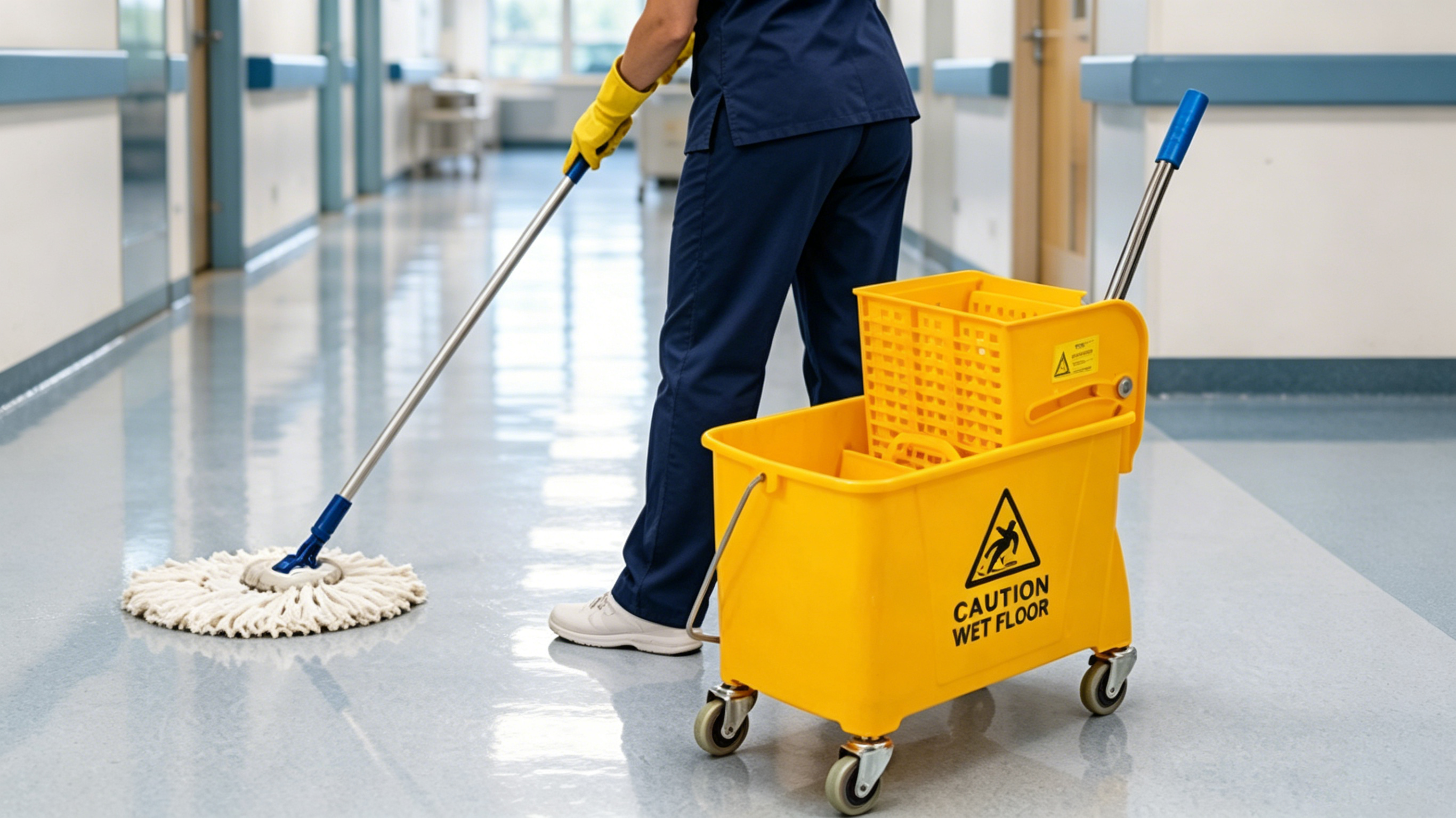
In 2026, commercial cleaning buyers are looking beyond the simple question of how many tools a trolley can hold. The more important question is whether one mobile unit can help a cleaner complete a route with fewer unnecessary trips, better separation of supplies, easier access to frequently used items and smoother movement through corridors, lifts and public areas.
That is why the compact multifunctional commercial cleaning cart is becoming an increasingly practical B2B product for hotels, office buildings, shopping centres, serviced apartments, schools, public facilities, residential property management and professional cleaning contractors. A well-designed trolley can carry clean microfiber cloths, spray bottles, gloves, waste bags, brushes, mop handles, warning signs, small buckets, refill consumables and a separate collection area for used materials in one organised workstation.
The product is not valuable merely because it has wheels. Its value comes from workflow design. A cleaner who must repeatedly return to a janitor closet for missing bags, clean cloths or a floor tool loses time in small increments throughout a shift. A trolley that keeps the right materials in the right position can reduce those interruptions and make the service process easier to standardise across rooms, floors and multiple sites.
For cross-border buyers, there is another layer of value. Commercial carts are physically bulky products, so international sourcing economics depend heavily on knock-down design, nesting, Flat Pack construction, master-carton dimensions and spare-parts compatibility. A trolley that performs well on-site but ships inefficiently can lose its cost advantage before it reaches the customer.
Our company supports OEM, ODM and Private Label projects for commercial cleaning carts. We can customise PP body components, overall dimensions, tray depth, shelf spacing, bucket positions, waste-bag frames, clean/used segregation, TPR or PU castors, wheel diameter, brake placement, handle height, tool clips, warning-sign slots, colours, logos, barcode labels, multilingual packaging, Flat Pack structure, master cartons and replacement parts.
There is no official international database reporting a specific 2026 growth rate for compact janitorial carts as an individual product category. We therefore do not invent one. Instead, this article uses authoritative data from the U.S. Bureau of Labor Statistics, Eurostat, the UK Health and Safety Executive and UN Trade and Development to demonstrate the scale of commercial cleaning labour, hospitality operations, ergonomic requirements and global sourcing conditions around the product.
1. The commercial cleaning market is fundamentally a workflow market
Cleaning quality matters, but so does the path used to achieve it. In a commercial building, a worker may service multiple rooms, corridors, toilets, glass areas and shared spaces in one shift. Every forgotten tool creates another trip. Every poorly organised shelf adds searching time. Every unstable bottle creates a risk of leakage onto clean supplies.
A commercial trolley therefore acts as a mobile workstation. Its design should follow the sequence of work rather than simply maximise internal volume.
2. The scale of cleaning labour shows why workflow equipment matters
The U.S. Bureau of Labor Statistics reported in its latest Occupational Outlook Handbook that the United States had approximately 2.43 million janitors and cleaners, excluding maids and housekeeping cleaners, in 2025. BLS projects about 321,800 openings per year on average for janitors and building cleaners over the 2025–2035 period, largely because workers need to be replaced as they leave occupations or the labour force.
This is not a sales forecast for carts, and the United States is only one market. It does show that commercial cleaning is a labour-intensive service performed at very large scale. Equipment that reduces unnecessary handling or makes a route easier to organise can therefore have practical value.
3. BLS also highlights the continuing need for clean, orderly buildings
BLS states that the continued need for clean and healthy spaces is expected to support demand for janitors and building cleaners. Technology may change how some tasks are done, but many buildings still require people to move supplies, handle waste, replace consumables and perform detailed cleaning.
A manual cleaning cart fits into this human workflow. It does not automate the cleaner; it supports the cleaner by placing tools and materials within reach.
4. Hospitality creates repeated room-by-room cleaning routes
Hotels and short-term rentals create one of the clearest use cases. Each occupied unit generates a sequence of tasks involving bathroom surfaces, floors, waste, mirrors, linen handling and replenishment.
Eurostat reported that guests spent 144.3 million nights in EU short-term rental accommodation booked through major online platforms during the first quarter of 2026, up 9.7% from the same quarter of 2025.
Those figures do not measure janitorial-cart demand. They demonstrate the scale of accommodation turnover in just one part of the European hospitality market, where cleaning equipment is used repeatedly between guest stays.
5. A one-stop trolley reduces the number of separate items carried by hand
Without a cart, workers may carry a spray bottle in one hand, cloths under an arm and a warning sign separately, then return for bags or a mop. This fragments the route.
A properly configured trolley can combine those items while allowing the worker to keep both hands available for steering, opening doors or handling the task itself.
6. The top tray should be designed around frequency of use
Frequently used items belong at the top: spray bottles, gloves, small brushes, cloths, disposable liners and replacement pads. The worker should not need to bend down or move other objects to reach them.
In ODM development, we can change tray depth, lip height, bottle recesses and removable dividers. A small partition can prevent a bottle from sliding during a turn and reduce the chance of leakage.
7. The middle zone can protect clean consumables
Clean microfiber, spare bags and sealed consumables should be kept away from wet or used materials whenever the client’s operating procedure requires separation.
Open shelves are inexpensive and accessible. Removable baskets offer better organisation. Enclosed boxes protect items from splash and visual exposure. The correct choice depends on the buyer’s SOP, not on a universal design rule.
8. Heavy items should usually stay low
Filled buckets, concentrated cleaning-product containers and other heavier items should generally be positioned lower to help keep the centre of gravity down.
A trolley that is loaded high can feel unstable during turns or while crossing a threshold. Shelf layout should therefore be evaluated dynamically, not only by static capacity.
9. Waste-bag frames change the cart’s real operating width
A catalogue may list a compact chassis width, but a side-mounted waste bag can make the working footprint much larger. That difference matters in lifts, guest corridors and busy retail aisles.
We can develop fixed, removable or folding bag frames. The frame should be sized around the buyer’s actual liner dimensions so the bag does not slip off or hang excessively low.
10. A bag cover can improve appearance in customer-facing spaces
In hotels, offices and malls, cleaning equipment often remains visible to guests or visitors. A cover can conceal the contents of the waste bag and create a tidier appearance.
However, every cover adds an opening action. For high-frequency waste collection, a simple lightweight flap may be better than a complicated mechanism. Design should support speed as well as appearance.
11. Clean and used textiles should not become one mixed pile
Separating unused microfiber from used cloths makes workflow easier to control. A removable return bag, a second basket or a colour-coded container can help staff follow internal procedures.
This physical separation does not disinfect or sterilise materials. Hygiene performance still depends on the facility’s washing, chemical, replacement and training procedures. The cart provides organisation, not a medical effect.
12. Buckets should be modular
Some sites need a small bucket for wet floor work. Others use pre-dosed microfiber systems and may not need one at all.
A modular platform lets a buyer choose one bucket, two separate buckets or no bucket. Removing an unnecessary bucket can reduce weight and free valuable storage space.
13. A wringer is useful only when the workflow actually needs it
A mop wringer adds bulk, weight and cost. In traditional wet-mopping operations it may be necessary. In office cleaning based on pre-prepared pads, it may be unnecessary.
Good ODM development begins by asking which task the feature solves. Adding components solely to make a specification list longer can hurt both mobility and landed cost.
14. Long-tool holders turn loose handles into organised equipment
Mop handles, floor brushes, glass squeegees and long dusting tools are difficult to store horizontally on a compact cart. Side clips or vertical tubes allow them to travel upright.
The holder diameter should match the actual handle. A clip that is too tight slows the worker; one that is too loose allows the tool to swing and strike walls.
15. A dedicated warning-sign slot can save a free hand
Wet-floor warning signs are commonly moved with cleaning teams in public areas. If the sign must be carried separately, the worker has less ability to control the cart.
A rear or side slot keeps the sign with the workstation and gives it a defined storage location between tasks.
16. The UK HSE treats pushing and pulling as an ergonomic issue
The UK Health and Safety Executive lists several risk factors for pushing and pulling loads: the effort needed to start or stop movement, repeated travel, obstacles, slopes, awkward turns, unsuitable wheels, restricted routes and poor hand position.
This is important because a trolley is supposed to reduce manual carrying. If wheel resistance, handle position or route compatibility is poor, the trolley can simply replace one physical burden with another.
17. Handle height changes worker posture
HSE guidance says hand position during pushing and pulling is best kept between hip and shoulder height. A low handle can force a tall worker to lean, while an excessively high one may reduce control for a shorter worker.
For ODM projects, we can adjust handle height, grip diameter and angle. Where one fleet is used by a diverse workforce, the buyer may also consider an adjustable or multi-position design.
18. Pushing should be the primary movement where practical
HSE guidance for wheeled handling equipment generally favours pushing over pulling where conditions allow. A good trolley should therefore provide a secure forward-control position and a clear view of the route.
High loads stacked above the front edge can block visibility. This is another reason not to treat maximum capacity as the only design target.
19. Wheel diameter directly affects obstacle performance
HSE provides a useful example for wheeled equipment: the force needed to overcome a small step can be around 20% greater with a 100 mm wheel than with a 125 mm wheel.
This does not mean every janitorial cart should use 125 mm castors. It demonstrates the mechanical principle that larger wheels can reduce the effort needed to cross thresholds and floor joints.
20. Bigger wheels are not automatically better
Large castors increase overall height, cost and packing volume. On smooth hotel corridors, an oversized wheel may add little benefit.
The buyer should consider tile joints, lift thresholds, carpet, vinyl flooring and small ramps before selecting wheel diameter.
21. Castor material should match floor and noise requirements
TPR and PU are common options in commercial trolley projects. Their rolling feel, noise, wear resistance and cost differ depending on formulation and wheel structure.
We avoid promising an absolutely “silent” wheel without measurement. Real sound levels also depend on bearing quality, load, floor texture and loose components on the cart.
22. Bearing quality changes the starting force
A high-quality wheel with a poor bearing can still feel heavy. Dirt, hair and thread around the axle can also increase rolling resistance over time.
QC should therefore check free rotation, wobble, axle play and consistency across all castors rather than inspecting only appearance.
23. Four swivel castors are useful in tight spaces
A full-swivel layout makes it easier to rotate inside lifts and small service rooms. However, on long corridors, some operators may prefer more directional stability.
Depending on use, a combination of swivel and fixed wheels can be considered. There is no single wheel layout that is best for every building.
24. Brakes are useful when a cart has to remain stationary
HSE stresses that brakes on wheeled equipment should be effective. A hotel corridor may appear level, but ramps, loading areas and uneven floors can allow a cart to roll.
We can specify brakes on selected castors and place the pedal where staff can activate it without awkward bending.
25. Castor placement affects stability
HSE recommends robust design and notes that castors close to the corners improve stability in wheeled equipment. The principle applies naturally to cleaning-cart design.
Moving the wheels too far inward may make packaging easier but can reduce the support footprint. Wheel location, body width and load distribution should be reviewed together.
26. Rounded corners protect both people and buildings
Commercial carts operate close to walls, door frames, furniture and guests. Sharp projections increase the chance of damage or contact.
Rounded PP edges, recessed fittings and optional bumper elements can reduce the impact of minor collisions. For hotels, avoiding damage to finished walls can be more valuable than saving a small amount on the trolley itself.
27. PP offers a useful balance for the main body
Polypropylene can be practical for trays, shelves, buckets and panels because it is relatively lightweight and mouldable. Strength, however, should come from intelligent geometry, not simply excessive material thickness.
Ribs and reinforcement can be placed around castor mounts, posts, handle joints and shelf edges where stress is concentrated.
28. Metal reinforcement should be selective
Steel or aluminium parts may be useful for axles, handles or high-load connections, but too much metal increases product weight and shipping cost.
An ODM design should use material where it contributes measurable stiffness or durability, not merely to make the product feel heavier.
29. Bottle storage should anticipate leakage
Cleaning-product bottles can tip during a turn. A high lip, divider or dedicated bottle pocket keeps them away from clean cloths.
Material compatibility with concentrated chemicals must be considered separately. We do not claim that every PP, TPR or coating is universally resistant to every cleaning chemical without verification.
30. Colour coding can support a facility’s internal system
Some facility-management teams use colour to distinguish working areas, material types or teams. Buckets, baskets, rings and accessories can be produced in different colours when required.
OEM colour coding is a relatively efficient way to adapt one platform to different operating procedures without creating entirely new tooling.
31. Private Label should go deeper than a logo
A logo panel is useful, but a competitor can easily add another logo to the same generic cart. Stronger differentiation comes from a proprietary module combination: shelf layout, tool clips, bag system, colour, cover, wheel specification and spare-part programme.
The goal of Private Label should be to create a recognisable working system, not just a branded sticker.
32. Hotels and offices need different module priorities
A hotel may carry guest-room supplies, bathroom consumables, linen-related materials and waste liners. An office cleaning team may devote more capacity to washrooms, glass, floor tools and shared-space consumables.
A modular base allows different upper components to serve each segment without rebuilding the full chassis.
33. Shopping centres care about operating width during opening hours
In a busy retail environment, side bags and protruding handles can interfere with customer traffic. A folding bag frame and inward-positioned tool holders can reduce the cart’s working footprint.
Visibility also matters: the worker should be able to see around the trolley while moving through pedestrian areas.
34. Office buildings value appearance and low disturbance
Cleaning may take place while offices are occupied. Rattling castors, loose metal pieces and exposed waste reduce the professional appearance of the service.
Neutral colours, well-fitted components, stable wheels and covered waste modules can make the cart more appropriate for premium commercial interiors.
35. Education and public buildings often need simplicity
Equipment may be shared across multiple staff members and shifts. Complex adjustment systems can become failure points if users are not trained.
A simple modular cart with obvious attachment points, robust baskets and easy-to-order spare parts may offer more value than an over-engineered unit.
36. Flat Pack design is critical for cross-border B2B
A fully assembled trolley contains a large amount of empty volume between shelves. Shipping that configuration internationally means paying to move air.
Removable posts, detachable handles, nested bins and separately packed castors can dramatically improve packing density. For an importer, this may matter more than a small reduction in factory unit price.
37. Flat Pack must remain easy to assemble
There is no advantage in reducing freight if the destination warehouse must spend excessive labour assembling each cart. Too many screws, small fasteners and ambiguous parts create new costs.
We can evaluate snap-fit, bolted and hybrid assembly systems and test repeated assembly for looseness before mass production.
38. Master-carton design should start before production, not after it
Retail packaging and master cartons are often treated as a final-stage task. For a bulky trolley, they should be part of engineering from the beginning.
We can calculate how posts nest inside shelves, how wheels fit around voids, whether handles can sit diagonally and how many cartons fit a pallet or container plan.
39. UNCTAD shows why shipping efficiency matters in 2026
UN Trade and Development estimates that global goods trade reached approximately US$13.7 trillion in the first half of 2026, 12.5% higher than the same period in 2025. UNCTAD also stresses that a significant share of the increase came from higher prices and that shipping and energy disruptions raised transport, logistics and production costs.
This is not a 12.5% growth rate for janitorial carts. The relevance is that international buyers must protect landed cost by improving cube utilisation, packaging efficiency and supply-chain consistency.
40. Service growth makes operational equipment strategically relevant
UNCTAD’s September 2026 Global Trade Update reports that services account for about 71% of global intermediate inputs, while their share of global exports rose to 27% in 2025. Services exports grew 8.3% in 2025.
Commercial cleaning is a service activity. A cart does not replace the service, but it supports the physical process behind it: moving materials, organising tools, handling waste and maintaining repeatable routes.
41. A cross-border product needs a spare-parts strategy
If one castor fails, replacing an entire trolley is inefficient. The same is true for bag covers, clips, baskets and handles.
We can assign component codes to replacement parts and maintain interface compatibility across repeat orders. This is especially valuable for facility-management companies operating fleets of equipment across multiple sites.
42. BOM control protects repeat orders
A cart purchased a year later should accept the same replacement castor or basket unless a change has been approved.
Wheel diameter, bearing type, colour, brake layout, PP grade, fasteners and module dimensions can be controlled through an agreed BOM and Golden Sample.
43. QC must include dynamic functions
Appearance inspection alone is not enough. A commercial cart should be checked for wheel rotation, brake engagement, handle looseness, shelf fit, bag-frame security, basket retention and post-assembly stability.
Load claims should be tied to the actual configuration and test method. We do not apply one universal capacity figure to all versions without verification.
44. Route testing can reveal problems that a factory floor hides
A perfectly smooth production floor does not reproduce a lift threshold, small ramp, tile joint or carpet transition.
For demanding B2B projects, a representative route test can evaluate starting effort, manoeuvrability, wheel noise, braking and stability under an agreed working load.
45. Packaging information must match the real configuration
If the carton says two buckets, two buckets must be inside. If the product page shows brake castors, a non-brake variant cannot be shipped under the same SKU.
We can support model codes, barcodes, assembly instructions, country-of-origin markings, carton marks and multilingual labels based on buyer-approved artwork.
46. Compliance should be checked against the exact target market
A manual plastic cleaning cart may face different product, packaging, chemical-contact or labelling considerations depending on its configuration and destination. Adding electrical components or specialised attachments can change the compliance picture.
We provide actual materials, dimensions, product photos and specifications so the importer or compliance adviser can confirm the applicable classification and requirements for the final SKU.
47. OEM is ideal when the base platform already works
When an existing structure meets the buyer’s workflow, OEM can customise body colour, basket colour, logo, barcode, label, bag, cover, castor option, packaging, instruction sheet and carton marks.
This approach reduces tooling investment and can shorten development compared with a completely new structure.
48. ODM is appropriate when the workflow itself needs to change
Changing overall width, shelf spacing, handle height, wheel size, clean/used separation, folding mechanisms or tool-holder geometry is an ODM project.
Every change should answer a practical question: Does it reduce trips? Does it pass a narrower doorway? Does it make the worker push with less effort? Does it reduce shipping cube? If not, the feature may not justify its cost.
49. A Basic–Standard–Professional range can serve different buyers
Basic: two or three shelves, simple waste-bag frame, standard swivel castors and a straightforward handle.
Standard: removable baskets, brakes, upgraded castors, long-tool clips and a bag cover.
Professional: clean/used separation, larger wheels, protective bumpers, spare-part programme and a module layout built around a specific facility SOP.
This structure lets distributors cover different budgets without forcing one cart to serve every application.
50. Hotel buyers should begin with the route, not the catalogue
Measure the corridor, service-lift door, lift cabin and janitor closet. List the number of rooms served per route, the bag size, bottle count, textile quantity and long tools.
Once these facts are known, unnecessary modules can be removed and the cart can be made more compact without sacrificing useful capacity.
51. Facility-management buyers should think in fleets
A contractor operating across many buildings benefits from standard wheels, clips and baskets. Too many incompatible versions increase spare-parts complexity.
A common chassis with modular accessories can make procurement and maintenance easier while still supporting different site types.
52. Distributors need advantages that can be demonstrated
A larger wheel for thresholds, a folding bag frame for narrow aisles, a brake for stationary work, a removable used-textile bag and a Flat Pack carton all create visible, explainable value.
Claims such as “professional quality” without measurable design differences are much harder for a sales team to defend.
53. What we can customise through OEM
PP body colour, tray and bucket colours, logo, printed label, model name, barcode, multilingual packaging, bag colour, bag cover, number of baskets, castor option, brakes, assembly instructions, carton marks and Private Label artwork.
54. What we can develop through ODM
Overall length, width and height; shelf spacing; tray depth; bucket placement; waste-bag frame and cover; folding structure; clean/used separation; mop and brush holders; warning-sign slot; handle height and angle; wheel diameter; TPR or PU castors; brake position; bumpers; removable baskets; spare-part interfaces; Flat Pack architecture; nesting and master-carton geometry.
55. Which buyers can gain the most value?
Hotel and serviced-apartment suppliers: compact carts that fit lifts and room-service routes.
Facility-management contractors: standard platforms, spare parts and repeatable specifications across multiple sites.
Shopping-centre operators: narrow working footprint, waste handling and warning-sign storage for public areas.
Office-building service providers: tidy appearance, controlled noise and modular storage.
Cleaning-equipment distributors: Basic–Standard–Professional ranges built around one platform.
Private Label brands: deeper differentiation through module layout, colour, wheels, packaging and branded components.
Conclusion: the real export opportunity is a mobile workflow system, not just a trolley
The cross-border opportunity for commercial cleaning carts in 2026 is not based on a fashionable shape or an invented market-growth percentage. It comes from the scale and repetition of commercial cleaning itself. The U.S. Bureau of Labor Statistics counts more than 2.4 million janitors and cleaners in one national market and projects hundreds of thousands of annual openings. Eurostat records 144.3 million platform-booked short-stay accommodation nights in the EU in the first quarter of 2026 alone. These figures show how large the underlying cleaning and hospitality service environment can be.
Ergonomics makes product design equally important. The UK HSE identifies starting force, wheel condition, obstacles, handle height, route width and brakes as factors in pushing and pulling risk. Its example comparing 100 mm and 125 mm wheels shows why a small engineering decision can materially change the effort needed to cross a threshold.
Cross-border economics adds a third layer. UNCTAD estimates global goods trade at about US$13.7 trillion in the first half of 2026 but also notes rising price and logistics pressures. For a bulky plastic cart, Flat Pack design, nesting, master-carton dimensions and container utilisation can therefore matter as much as small reductions in factory price.
Our company supports OEM, ODM and Private Label commercial cleaning cart projects from workflow layout to export packaging. We can customise PP components, shelf architecture, buckets, waste-bag frames, clean/used zones, TPR or PU castors, wheel diameter, bearings, brakes, handle position, bumpers, tool clips, warning-sign slots, colours, logos, barcodes, multilingual packaging, spare parts, Golden Samples, BOM control, QC and master cartons.
If you are an importer, cleaning-equipment distributor, hotel supplier, facility-management contractor, commercial-property operator or Private Label brand, contact us with your route dimensions, target load, floor type, storage list, desired modules, packing limits and order volume. We can help turn a generic cleaning trolley into a one-stop mobile workstation that is easier to use on-site, easier to standardise across properties and more economical to move through an international supply chain.
commercial cleaning cart, janitorial cart, commercial cleaning trolley, multifunction cleaning cart, compact cleaning cart, housekeeping cart, hotel cleaning cart, facility management cart, office cleaning trolley, shopping mall cleaning cart, commercial janitorial trolley, PP cleaning cart, cleaning cart with waste bag, cleaning cart with bucket, cleaning cart with shelves, mop holder cleaning cart, brush holder cleaning cart, wet floor sign holder cart, modular cleaning trolley, folding cleaning cart, Flat Pack cleaning cart, TPR caster cleaning cart, PU caster cleaning cart, cleaning cart with brakes, cleaning cart spare parts, clean and used separation cart, OEM cleaning cart, ODM cleaning cart, Private Label cleaning cart, custom commercial cleaning cart, custom logo janitorial cart, custom cleaning cart packaging, commercial cleaning equipment importer, cleaning equipment distributor, hotel supply buyer, facility management buyer, commercial property cleaning equipment, janitorial equipment wholesaler, OEM ODM cleaning equipment manufacturer, international cleaning cart supplier



