


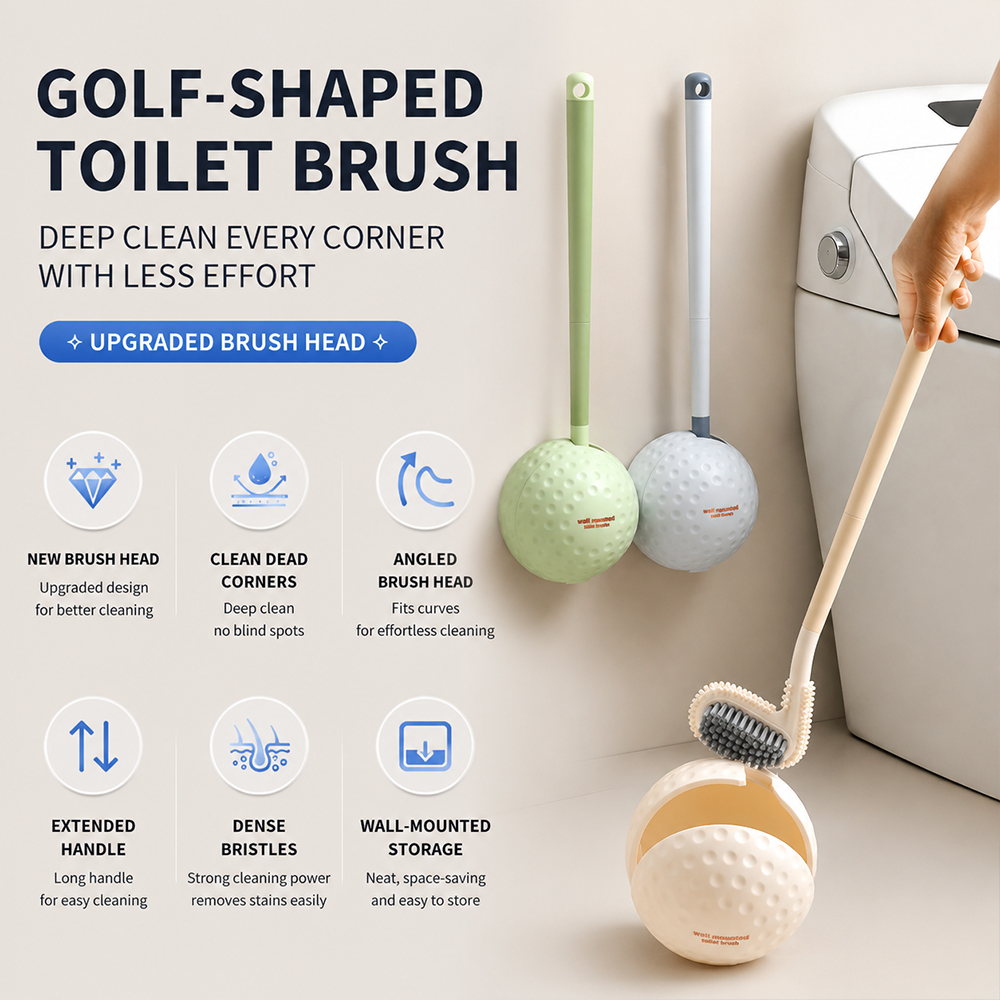
In 2026, the bathroom-cleaning category is becoming more visual, more brand-driven, and more competitive. On major marketplaces, dozens of toilet brushes may appear on the same screen with similar colors, similar dimensions, and similar claims. When products look almost identical, the buyer’s decision often collapses into price, review score, and delivery speed. That is exactly why a distinctive shape can become commercially valuable.
The golf-club-style toilet brush creates an immediate visual cue. Its elongated shaft and recognizable club-inspired profile make a routine bathroom tool easier to remember, easier to photograph, and easier to position as a private-label product. But appearance alone is not enough. A toilet brush still has to clean curved ceramic surfaces, reach under the rim, feel stable in the hand, return neatly to its holder, and survive repeated use.
Our approach is therefore simple: combine visual differentiation with real cleaning utility. We support OEM and ODM projects covering body material, bristle material, TPR or flexible cleaning elements, head size, head profile, stiffness, density, handle length, grip angle, anti-slip texture, holder design, ventilation, replaceable heads, color, logo, barcode, private label, gift packaging, e-commerce packaging, and master-carton optimization.
There is no official international database that tracks the sales growth of “golf-club-style toilet brushes” as a separate product category. We therefore do not invent a global growth rate. Instead, we use authoritative data to explain the environment in which a visually differentiated household cleaning tool can be tested: mature online retail in the United States and Europe, large global merchandise flows, persistent sanitation needs, and stronger expectations around durability and credible product information.
1. Why appearance matters more in bathroom tools than it did before
A traditional toilet brush was designed to disappear. It was placed behind the toilet, made in neutral colors, and rarely treated as part of bathroom styling. E-commerce has changed that logic because the consumer sees the product image before ever seeing the product in the bathroom.
On a mobile screen, visual recognition happens before technical comparison. A distinctive silhouette can stop the scroll, create curiosity, and give the seller a reason to build a stronger hero image. That does not replace function, but it improves the first stage of conversion: getting attention.
2. Why the golf-club form is commercially useful
A golf club has a simple and recognizable structure: a long shaft, a defined grip zone, and a visually distinctive head. That structure translates naturally into a toilet-brush concept because a toilet brush also needs a long handle and a functional working head.
The best version does not copy a golf club at the expense of cleaning. Instead, it borrows the visual language while preserving the correct size, stiffness, access angle, and balance for bathroom use.
This gives a buyer two selling points at the same time: a familiar cleaning function and an uncommon visual identity.
3. U.S. e-commerce gives visually demonstrable household tools a large channel
The U.S. Census Bureau reported that retail e-commerce sales in the second quarter of 2026 reached an estimated $340.2 billion on a seasonally adjusted basis. That was 12.2% higher than the second quarter of 2025, and e-commerce represented 17.1% of total U.S. retail sales.
This does not mean toilet brushes grew by 12.2%. The important point is that U.S. shoppers are buying a very large volume of products online, where photography, video, dimensions, reviews, and packaging all influence purchase decisions.
A golf-style toilet brush is well suited to this environment because the design can be understood immediately in a thumbnail and demonstrated clearly in short video.
4. Europe is also a mature online-buying market
Eurostat’s Digitalisation in Europe – 2026 edition reports that 78% of internet users in the European Union bought or ordered goods or services online in 2025, up from 62% in 2015.
This means a bathroom accessory does not have to rely only on supermarket or homeware-store shelf space. Importers can test products through marketplaces, their own online stores, social commerce, and multi-country e-commerce operations.
The more mature the channel becomes, however, the more important product differentiation becomes. A generic toilet brush is easy to compare directly. A recognizable private-label design creates a different comparison set.
5. Distinctive design can reduce pure price competition
When ten listings use nearly the same product, the shopper naturally asks which one is cheaper. When one product has a different silhouette, holder, color system, or refill concept, the shopper has more reasons to evaluate it on features rather than price alone.
That is the commercial purpose of the golf-club shape. It is not just decoration; it can help create a product identity that is harder to reduce to a generic commodity.
6. The head must remain a cleaning tool, not a design sculpture
The most common risk in creative products is allowing appearance to interfere with the job. If the golf-inspired head becomes too wide, too flat, or too rigid, it may have difficulty reaching curved areas or the space under the toilet rim.
We therefore begin ODM work with the cleaning geometry first. The visual shape is then built around the required contact zones.
7. Head width affects both coverage and access
A larger head covers more surface per stroke but may be harder to use in tighter curves. A smaller head is more precise but may require more passes.
For mass-market use, the ideal design is usually a compromise between surface coverage and access. We can adjust head width, height, side profile, tip shape, and overall diameter according to the target market.
8. Under-rim access should be designed deliberately
The underside of the rim is one of the most important cleaning zones in many toilet designs. A brush that looks good but cannot approach this area will quickly disappoint users.
ODM options can include an asymmetrical edge, a tapered section, a slight head angle, or flexible cleaning elements that improve access. The final geometry should be tested on representative toilet shapes before mass production.
9. Bristle material changes the cleaning feel
Traditional brush heads may use polymer bristles such as PP, PET, or another material appropriate to the design. Material choice affects stiffness, recovery, feel, water retention, and manufacturing cost.
We do not recommend selecting bristles only by appearance. A very stiff bristle may feel aggressive and create more splashing, while an overly soft bristle may require more passes. Material, filament diameter, filament length, and tuft density should be evaluated together.
10. TPR or flexible blade designs create a different product position
Some buyers prefer TPR or silicone-like flexible cleaning elements because they look modern, rinse easily, and support a minimalist aesthetic. These designs can fit especially well with a golf-inspired silhouette.
However, “flexible” does not automatically mean “cleans better.” Performance depends on rib geometry, stiffness, spacing, and how the head follows the bowl surface.
We can develop both traditional-bristle and flexible-head versions so a brand can choose based on target user and price point.
11. Stiffness should match the intended cleaning style
A toilet brush is used on glazed ceramic surfaces that typically require controlled mechanical cleaning, not excessive force.
A head that is too stiff can feel harsh, move abruptly, and increase splashing. A head that is too soft may not provide enough resistance on stubborn residue.
For ODM development, we can compare several stiffness levels and create Basic, Soft, or Pro variants.
12. Density affects cleaning, water retention, and drying
Dense bristles increase contact area but also tend to hold more water. Very sparse bristles may rinse faster but can look inexpensive and reduce contact.
The optimal density must therefore be coordinated with the holder design. A dense head paired with a poorly ventilated holder can retain moisture longer than necessary.
13. Handle length affects comfort and packaging cost
A handle that is too short forces the user to bend closer to the bowl. A handle that is excessively long may become awkward in compact bathrooms and increase package length.
We can customize total handle length, shaft diameter, grip zone, and balance for different markets. A compact-market version and a longer standard version can be built from the same design language.
14. The golf inspiration works especially well in the grip area
The grip is one of the safest places to express the sports concept without interfering with the cleaning head. Ribbed textures, tapered shapes, contrasting inserts, and club-inspired proportions can create a recognizable feel.
For OEM projects, the grip can also carry a printed or molded logo, brand mark, or color accent.
15. Grip diameter influences control
A very thin handle may feel cheap or uncomfortable during repeated scrubbing. A very thick one can be difficult for smaller hands.
We can adjust diameter, texture, soft-touch zones, and anti-slip patterns to improve control. The correct answer depends on product weight and target market.
16. Handle angle can improve access without looking technical
A small change in the angle between shaft and head can help the working area follow the bowl curve more naturally. This is especially useful when trying to reach under the rim or around tight transitions.
The design should not force the wrist into an uncomfortable position merely to preserve the visual golf theme.
17. Splash control should be treated as a design issue
A brush can create splashing when the head is very stiff, the user has to apply excessive force, or the geometry causes abrupt movement through water.
We do not claim “zero splash” without testing. A more responsible approach is to design stiffness and head movement for controlled use and to avoid exaggerated promises.
18. The holder is half of the product experience
The brush spends most of its life in the holder, not in the toilet bowl. A beautiful handle paired with an unstable or difficult-to-clean base will undermine the entire product.
The holder needs enough footprint to resist tipping, a suitable center of gravity, easy insertion, and a structure that can be cleaned without complicated disassembly.
19. Ventilation and drainage matter more than a completely closed appearance
A fully enclosed holder may look premium, but it can trap water after use if the internal design is poor.
ODM options include ventilation slots, drainage gaps, a removable inner cup, or a raised internal support that keeps the brush head from sitting directly in pooled water.
The exact design should balance appearance, stability, cleanability, and manufacturing cost.
20. Drainage is not disinfection
This distinction is important. Allowing water to drain and air to circulate can help manage moisture, but it does not sterilize or disinfect a toilet brush.
The World Health Organization’s 2026–2035 water, sanitation, hygiene and waste strategy notes that 3.4 billion people globally still lack safely managed sanitation. That statistic highlights the continuing importance of sanitation systems, but a toilet brush remains a mechanical cleaning tool, not a medical, sterilizing, or disinfecting device.
Honest claims protect both the brand and the buyer.
21. A replaceable head can create a refill business
If the working head can be replaced, the user may keep the handle and holder while purchasing a new head later.
This creates a separate refill SKU and can support repeat purchasing. The key requirement is long-term compatibility: the connection system should remain stable across production batches.
22. Replaceable-head architecture can support multiple product tiers
A brand can offer a Starter Kit with handle, holder, and one head, then sell 2-pack or 4-pack refills. Professional buyers may prefer bulk refill packs.
This turns a single bathroom accessory into a small product system.
23. Color can strengthen the golf concept
Black, white, gray, and beige fit minimalist bathrooms. A golf concept also creates room for darker greens, forest green, navy, cream, metallic accents, or two-tone combinations.
OEM color selection can be coordinated with a brand palette and packaging graphics. Color consistency should be controlled from batch to batch.
24. The product can move from “cleaning supply” toward “lifestyle accessory”
An ordinary toilet brush is rarely used in lifestyle content. A creative design can be photographed as part of a coordinated bathroom interior.
This opens additional positioning opportunities for apartment-move-in sets, housewarming collections, novelty homeware stores, and social-media-driven brands.
25. Gift packaging becomes more realistic when the design has a story
A basic utility brush is difficult to present as a gift. A golf-inspired version has a recognizable theme, which makes gift packaging more logical.
A clean retail box, interior photography, a short product story, and a well-organized internal layout can elevate the product without changing its basic cleaning function.
26. E-commerce packaging must protect long and shaped components
A long shaft, shaped head, and separate holder create multiple impact points during shipping. Poor internal fixation can lead to scratches, cracks, or movement inside the box.
We can design inner trays, protective sleeves, end protection, molded supports, or cardboard structures depending on target price and channel.
27. Package volume directly affects landed cost
For a relatively lightweight cleaning tool, dimensional volume may matter more than weight. A box that is unnecessarily large increases freight, warehousing, and fulfillment cost.
ODM can include a detachable handle, nested holder structure, or alternative orientation inside the box, provided the connection remains strong and easy for the user.
28. UNCTAD data explains why packaging efficiency matters in 2026
UN Trade and Development estimates that global goods trade reached approximately US$13.7 trillion in the first half of 2026, up 12.5% from the same period in 2025. UNCTAD also stresses that a significant share of the increase reflects higher prices rather than stronger trade volumes, while shipping disruption and higher energy and logistics costs are raising pressure across supply chains.
This is not a 12.5% growth forecast for toilet brushes. It is a reason for buyers to care more about carton density, packaging dimensions, and true landed cost.
29. OEM is the fastest path when the base structure already works
If a buyer likes the existing structure, OEM can quickly create a branded version.
Options include body color, bristle color, grip color, logo, model name, barcode, language, retail box, insert card, master-carton marks, and private-label graphics.
30. ODM is required when the buyer wants real differentiation
If the buyer wants a narrower head, better under-rim access, a different golf profile, a longer handle, a replaceable head, a new holder, or a detachable structure, ODM becomes the correct route.
ODM changes the function and geometry, not just the surface appearance.
31. Body material should follow engineering needs
Depending on the structure, handle and holder components may use PP, ABS, TPR inserts, or other suitable materials. Each option has different characteristics for stiffness, finish, weight, cost, and molding.
We do not promote one plastic as universally best. Material should be chosen after the target price, appearance, and structural load are defined.
32. The working material should also match the channel
A mass-market supermarket buyer may prioritize cost and familiar bristles. A design-focused online brand may prefer a flexible TPR head. A hospitality supplier may care more about durability, spare parts, and stable model numbers.
The same golf design language can therefore support several product tiers.
33. Private label creates a moat around a simple product
When shape, color, package, model name, refill system, and imagery are coordinated, the product becomes more difficult to compare directly with an unbranded generic brush.
A buyer can also extend the design into a broader bathroom-accessory family, such as dispensers, cups, storage accessories, or other cleaning tools, if that fits the brand strategy.
34. Product consistency is more important than a perfect first sample
Marketplace reviews accumulate across production batches. If the first batch has one stiffness and the second has another, customers will describe the same listing in contradictory ways.
QC should therefore check handle length, head dimensions, bristle density, color, connection strength, holder stability, surface finish, packaging, and set completeness.
35. Replaceable-head models need cycle testing
If the head is designed to be removed repeatedly, the connection must tolerate multiple installation and removal cycles without loosening prematurely.
This should be part of product validation, not left to chance after launch.
36. U.S. and European online channels reward clear product demonstration
The U.S. Census Bureau’s 2026 e-commerce figures and Eurostat’s 2025 online-shopping rate both show that consumers in major markets are comfortable buying products without first handling them physically.
That makes dimensions, close-up material photography, video, comparison images, and honest feature claims critical. The golf-style toilet brush is especially suited to this because the design can be understood instantly.
37. But online buyers also punish quality inconsistency quickly
Eurostat reports that 35% of recent EU online shoppers encountered some type of problem in 2025, and 10% reported wrong or damaged goods or services.
For our category, this reinforces a practical point: creative design has to survive packaging, delivery, unpacking, assembly if applicable, and repeated use. A strong listing cannot compensate for unstable production.
38. Sustainability claims should be specific, not vague
The European Commission emphasized in July 2026 that products should last longer, use resources more efficiently, generate less waste, and provide consumers with reliable information. It also stressed the importance of credible environmental claims.
This does not mean a standard toilet brush automatically qualifies for the EU Ecolabel. We should not imply that without certification.
A more credible message is to describe concrete features when they are true: replaceable head, reusable handle and holder, reduced package volume, durable connection, or clearly identified materials.
39. The golf-style product can work differently by channel
Marketplace sellers can use the visual shape for hero images and short videos.
Homeware retailers can use the silhouette for shelf differentiation.
Gift and lifestyle stores can emphasize the novelty aspect.
Hotels and serviced apartments may prefer a more restrained color version with the same functional structure.
Private-label brands can create an exclusive geometry, color palette, refill system, and package.
40. Why hospitality buyers evaluate the product differently
Hotels are less interested in novelty for novelty’s sake. They need easy cleaning, repeatable supply, stable model numbers, bulk packaging, and a design that fits the room concept.
A boutique hotel may like a playful golf-inspired version, while a large chain may prefer a minimal black or white edition with the same holder and refill architecture.
41. Why supermarket buyers care about shelf communication
In a physical store, the consumer may not be able to touch or use the brush. Packaging therefore has to explain the design, size, cleaning head, holder, refill option, and key use points quickly.
The visual golf story attracts attention; the packaging must then prove that the item is a serious cleaning tool.
42. Why e-commerce sellers need a structured image sequence
We recommend a product page that shows: hero image, golf silhouette, close-up of working head, under-rim use angle, holder and drainage structure, dimensions, color options, refill system, packaging, and set contents.
This sequence moves the buyer from curiosity to understanding.
43. A smart first launch uses a small, differentiated SKU set
Launching twenty colors at once creates inventory complexity without proving demand. A better approach is to begin with three or four meaningful variants.
For example: Classic Golf, Minimal Golf, Soft/Flexible Head, and Replaceable Head. Each has a functional or positioning reason.
44. The first batch should be treated as a market-learning tool
After launch, reviews should be translated into engineering questions. Is the head too large? Is the grip too slippery? Does the holder tip? Is the shaft too short? Do buyers ask for replacement heads?
Those answers become the brief for the next ODM iteration.
45. What we can customize through OEM
We can support color, logo, printed branding, model number, barcode, packaging language, retail box, insert card, master-carton marks, private-label graphics, pack quantity, and color combinations.
OEM is ideal when the base product already fits the market and the buyer wants fast branding.
46. What we can customize through ODM
We can discuss body material, handle geometry, handle length, grip angle, head width, head profile, bristle or TPR material, stiffness, density, under-rim access, holder footprint, ventilation, drainage, removable inner cup, replaceable head, detachable shaft, packaging geometry, and set architecture.
ODM is most valuable when each change solves a real customer or channel problem.
47. Why repeatable specifications matter to global buyers
A buyer does not only need a good sample. They need the same product on the second, fifth, and tenth purchase order.
We therefore encourage approval of a golden sample and fixed specifications for materials, dimensions, colors, head density, connections, packaging, and carton quantity before mass production.
48. Which buyers can benefit most
Household-goods importers: a differentiated bathroom SKU with clear private-label potential.
Cleaning-tool distributors: a design-led product plus refill opportunities.
Marketplace sellers: strong visual storytelling for images and short-form video.
Retail chains: shelf differentiation and coordinated color programs.
Hospitality suppliers: restrained or branded versions, stable models, and bulk packs.
Bathroom-accessory brands: OEM and ODM from surface branding to complete geometry redesign.
Conclusion: in 2026, attractive design works best when the cleaning function is equally strong
The golf-club-style toilet brush has commercial potential because it solves one of the hardest problems in a mature household category: how to make a familiar product noticeable without making it difficult to understand.
The design attracts attention. The practical details determine whether attention becomes repeat sales. Head geometry, under-rim access, bristle or TPR stiffness, handle length, grip angle, holder stability, drainage, refill compatibility, packaging, and batch consistency all matter.
The external environment supports product testing. The U.S. Census Bureau reports strong 2026 e-commerce sales; Eurostat shows that online shopping is deeply established in Europe; UNCTAD documents the massive scale of global merchandise trade while highlighting cost pressures; WHO reinforces the long-term importance of sanitation; and the European Commission is pushing markets toward durability and credible product information.
None of these institutions says that golf-style toilet brushes are guaranteed to become a global blockbuster. That outcome depends on the product itself. But they do show that buyers operate in large, digital, highly competitive channels where a visually distinct and operationally reliable bathroom tool has a real opportunity to stand out.
That is where we can help. Our company supports OEM, ODM, and Private Label projects for bathroom cleaning tools. We can customize body material, bristles or flexible TPR elements, stiffness, density, head dimensions, handle length, grip, holder, ventilation, replaceable parts, color, logo, barcode, multilingual packaging, gift packs, multipacks, and master cartons.
If you are an importer, distributor, marketplace seller, retail chain, hospitality supplier, or bathroom-accessory brand, contact us. Tell us your target market, price level, preferred shape, material, packaging format, and test-order plan. We can help turn the golf-club concept from a visually interesting idea into a stable, scalable product that is easier to market, easier to differentiate, and easier to reorder.
golf club toilet brush, golf style toilet brush, designer toilet brush, creative toilet brush, modern toilet brush with holder, bathroom cleaning brush, toilet bowl cleaning brush, under rim toilet brush, ergonomic toilet brush, long handle toilet brush, replaceable head toilet brush, toilet brush refill head, ventilated toilet brush holder, draining toilet brush holder, TPR toilet brush, flexible toilet brush, plastic toilet brush set, bathroom cleaning tools, bathroom accessories set, toilet cleaning kit, OEM toilet brush, ODM toilet brush, private label toilet brush, private label bathroom accessories, custom toilet brush bristles, custom toilet brush head, custom toilet brush handle, custom toilet brush holder, custom bathroom tool color, custom toilet brush packaging, household goods importer, cleaning tools distributor, toilet brush wholesaler, homeware retail buyer, marketplace bathroom seller, hospitality bathroom supplier, hotel cleaning supplies buyer, bathroom accessories brand, OEM ODM cleaning tools manufacturer, global cleaning tools buyer



