


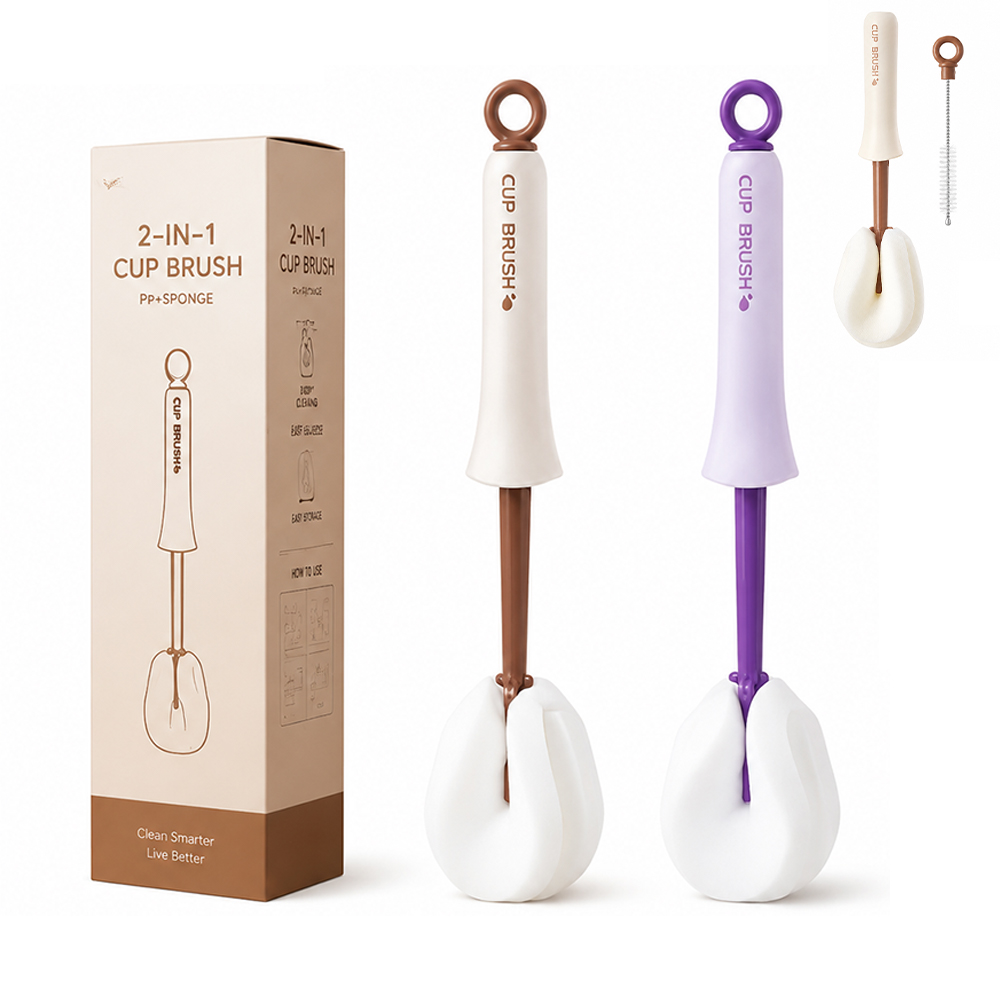
In 2026, some of the most commercially interesting cleaning products are not large appliances or complicated electronic devices. They are compact tools that remove one repeated inconvenience from everyday life. The pull-rod draining sponge cup cleaning brush belongs to this category. It combines a soft sponge cleaning head with a long, easy-to-control handle and a pull-rod wringing or draining mechanism designed to squeeze excess water from the sponge after use. The concept is simple, but the commercial logic is strong: deeper reach inside cups, gentler contact than many stiff-bristle tools, less direct hand contact with a wet sponge, faster draining, easier storage and a function that can be demonstrated in seconds on an e-commerce product page.
There is no single authoritative global database that tracks the sales of this exact brush design, so it would be misleading to claim that one specific SKU is growing at a fixed global percentage. What can be measured, however, is the market environment surrounding it. U.S. e-commerce continues to expand, online shopping is deeply established across Europe, global merchandise trade remains enormous, international tourism is still generating hundreds of millions of trips, and major institutions continue to emphasize hygiene, product durability and reliable consumer information. These trends create favorable conditions for compact kitchen-cleaning tools that are easy to ship, easy to understand and easy to customize for private-label programs.
Our company supports both OEM and ODM development. Buyers can discuss sponge material and density, head diameter and length, handle length, pull-rod travel, compression strength, grip texture, drainage structure, colors, logo, replacement-head concepts, hanging features, retail packaging, multi-piece sets, barcodes and multilingual labeling. Our goal is not simply to sell another cup brush. It is to help importers, distributors, retailers, hospitality suppliers and e-commerce brands build a product that solves a clear problem and can be reordered with stable specifications.
1. Why a cup brush can become an innovation product
A conventional cup brush usually relies on a fixed head and a simple handle. It can clean, but after use the head may retain a significant amount of water. If the user wants to remove that water quickly, they may need to squeeze the sponge by hand or press it against the sink. That extra step is exactly where product innovation can happen.
A pull-rod draining design adds a mechanical action to the cleaning process. Depending on the selected structure, pulling or sliding the mechanism compresses the sponge head so that retained water is released more efficiently. The user gains a more controlled way to wring the sponge without repeatedly grabbing the saturated cleaning surface.
The commercial lesson is important: innovation does not always mean electronics. A useful mechanical improvement can create a new reason to buy in a mature household category.
2. The product solves a visible, repeatable problem
Many mugs, tumblers, glasses and reusable drink containers are deeper than the user’s fingers can comfortably reach. Narrow mouths and curved bottoms make direct hand washing less convenient. A long-handled sponge brush extends reach and distributes pressure across the internal wall of the cup.
The benefit is especially easy to understand because almost every household has drinkware. The buyer does not need to educate the consumer about an unfamiliar cleaning problem. The problem already exists; the product simply offers a more convenient method.
That makes the product attractive for international sourcing. It can be sold through kitchenware, home cleaning, household accessories, gift, supermarket, hotel-supply and online channels without requiring a complex explanation.
3. U.S. e-commerce growth supports compact household tools
The U.S. Census Bureau reported on August 18, 2026 that U.S. retail e-commerce sales reached an estimated $340.2 billion in the second quarter of 2026, seasonally adjusted. That was 12.2% higher than the second quarter of 2025. E-commerce accounted for 17.1% of total U.S. retail sales during the quarter.
This does not prove that cup-cleaning brushes grew by 12.2%. It shows that the digital retail channel itself continues to expand faster than total retail. For a compact kitchen tool, that matters because the product can be explained with close-up images, short videos and a simple before-and-after demonstration.
The pull-rod feature is particularly suitable for video commerce. A shopper can watch the sponge enter a mug, rotate against the interior wall, then see the mechanism squeeze out water. The function is visual, fast and memorable.
4. Europe is already a mature online-shopping market
Eurostat’s Digitalisation in Europe – 2026 edition reports that 78% of EU internet users bought or ordered goods or services online in 2025, up from 62% in 2015. In other words, online purchasing is already a normal consumer behavior across much of Europe.
For a buyer, this reduces one important barrier: the sales channel is mature. The challenge is not convincing consumers to shop online; it is giving them a reason to choose one product over dozens of similar alternatives.
That is where mechanical differentiation matters. A standard sponge-on-a-stick can be compared mainly on price. A pull-rod draining structure creates a visible functional story that can justify a different positioning, different packaging and potentially a higher perceived value.
5. Eurostat also shows why packaging and quality consistency matter
Eurostat found that 35% of people who had recently purchased online in the EU experienced some kind of problem. Twenty percent reported slower delivery than expected, while 10% reported receiving wrong or damaged goods or services.
For a cleaning brush, the lesson is practical. A good design can still receive a poor review if the handle arrives bent, the sponge is deformed, the pull mechanism jams or the retail box is crushed. E-commerce quality is not only product performance; it is also how the product survives warehousing, sorting and last-mile delivery.
For this reason, our OEM/ODM work includes packaging dimensions, internal protection, master-carton quantity and the way the brush is positioned inside the pack.
6. Global trade remains large enough to support continuous product sourcing
UN Trade and Development (UNCTAD) estimates that global goods trade reached approximately US$13.7 trillion in the first half of 2026, up 12.5% from the same period in 2025. UNCTAD also makes an important qualification: a significant part of the value increase came from higher prices rather than equivalent growth in physical trade volume.
This distinction matters. We do not use the global trade figure as proof that one cleaning brush is booming. We use it to show that international product flows remain enormous and that importers continue to search for new suppliers, new price points, private-label opportunities and small products that can be tested without excessive technical complexity.
A manual sponge cup brush fits that sourcing profile: no battery, no motor, a relatively simple bill of materials and broad room for customization.
7. The hospitality market adds another practical use case
UN Tourism reported that approximately 307 million tourists travelled internationally in the first quarter of 2026, around six million more than in the same period of 2025. Europe alone welcomed more than 130 million international tourists during the quarter, up 4% year over year.
Tourism statistics do not directly measure demand for cup brushes, but they show the scale of hospitality activity that sits behind hotels, serviced apartments, cafés, breakfast areas, restaurants and housekeeping operations. These environments repeatedly wash cups, mugs and reusable drinkware.
For hospitality distributors, the product can be developed differently from a consumer version: stronger handle structure, larger multipacks, simple bulk packaging, color coding for work areas and stable model numbers for repeat procurement.
8. WHO hygiene guidance supports the long-term importance of clean utensils
The World Health Organization’s “Five Keys to Safer Food” includes a fundamental instruction: keep clean, including cleaning and sanitizing surfaces and equipment used for food preparation. WHO uses this message globally to promote safer food-handling behavior.
A cup brush should not be advertised as a medical device or as something that automatically prevents disease. Its role is much more specific: it helps users physically clean drinkware and kitchen vessels more conveniently.
That distinction is important for credible marketing. Instead of making exaggerated health claims, a stronger product page explains how the head reaches the bottom of a cup, how the sponge contacts curved surfaces and how the draining mechanism helps the tool dry more efficiently after rinsing.
9. Why sponge contact is attractive for cups and glasses
Many consumers prefer a softer cleaning surface for glassware, glazed ceramic mugs and coated drinkware. A sponge can conform to curved walls and contact a larger internal area than a narrow line of stiff bristles.
However, “non-scratch” should never be treated as an automatic claim. Sponge grades vary, and some products include abrasive layers. Delicate coatings, printed surfaces, acrylic products and specialty finishes should be tested before use. If a buyer wants a gentle-positioned product, we can discuss a softer, non-abrasive sponge specification and appropriate usage instructions.
This is an example of why OEM material selection matters more than simply choosing a color.
10. The pull-rod draining function is the core selling point
After cleaning, a saturated sponge can hold water. Leaving it fully soaked may increase dripping around the sink and extend drying time. The pull-rod mechanism gives the user a deliberate way to compress the head and release more retained water.
The benefit is not sterilization; squeezing does not disinfect the sponge. The user should still rinse the head thoroughly and allow it to dry in a ventilated area. But reducing excess water can improve everyday handling and storage.
From a product-development perspective, the mechanism must balance three factors: sufficient compression, smooth movement and durability. Too little compression weakens the feature. Too much resistance makes the tool uncomfortable to use. A loose mechanism can feel cheap. ODM optimization focuses on this balance.
11. Handle length determines which drinkware the product can serve
A brush that works perfectly in a coffee mug may be too short for a tall tumbler. A very long handle may reach deep vessels but feel less precise in a small glass.
That creates a natural product-family opportunity. A standard household version can target mugs and everyday glasses, while an extended-handle version can target tall tumblers, reusable bottles with wider mouths and hospitality drinkware.
For OEM/ODM projects, we can discuss total length, grip length, distance from hand to sponge head and the mechanical travel required by the pull rod. These dimensions should be designed together rather than independently.
12. Sponge head diameter controls contact and access
A larger sponge head contacts more surface area and can clean wide mugs efficiently, but it may be difficult to insert into narrow openings. A smaller head improves access but may require more passes in wide glassware.
For retailers, two sizes can be more commercially useful than one “universal” claim. For example, a standard cup model and a slim model can serve different drinkware profiles.
ODM allows us to discuss head diameter, length, edge shape and the way the sponge is attached to the internal support. The best design starts from the target cup dimensions.
13. Sponge density affects both cleaning feel and wringing performance
Density is a critical but often overlooked specification. A very soft sponge compresses easily and feels gentle, but may lose shape more quickly under heavy use. A denser sponge can provide firmer contact, but it may require more force to wring.
The pull-rod mechanism and sponge density therefore must be matched. If the sponge is changed without adjusting the compression structure, the user experience may also change.
For private-label buyers, we recommend approving the sponge density together with the finished mechanism, not as a separate sample.
14. Water drainage is also a storage-design problem
A kitchen cleaning tool often lives beside the sink. The user wants it accessible, but does not want water collecting on the countertop.
That creates additional design options: hanging holes, hooks, vertical stands, ventilated holders or packaging that can double as a simple storage concept. Not every market needs the same solution, but storage can add real value because it addresses what happens after cleaning.
When buyers develop a premium version, the storage accessory can become a differentiator and an upsell opportunity.
15. A replaceable-head concept can create a repeat-purchase model
Depending on the selected construction, an ODM project can explore a detachable or replaceable sponge head. This can allow the user to keep the handle and replace only the consumable cleaning portion.
Such a design may support repeat sales and reduce the need to replace the entire tool, but it must be engineered carefully. The head connection needs sufficient holding force, must be easy to understand and should not detach during washing.
A replaceable system should never be added only as a marketing label. The connection, spare-head availability and packaging architecture all need to be planned as a complete system.
16. Why the product works well for short-form video marketing
Many household products need several paragraphs to explain their benefit. This brush can demonstrate its story in a sequence of actions: insert, rotate, pull, squeeze, rinse and hang.
That makes it suitable for marketplace videos, social commerce, live selling and distributor presentations. The buyer can show both cleaning reach and water drainage without special equipment.
For private-label projects, visual design should support this demonstration. Contrasting colors between the sponge and handle can make the movement easier to see, while a clear pull zone helps viewers understand the mechanism immediately.
17. OEM is the fastest route to a branded market test
If the buyer is satisfied with an existing structure, OEM allows a faster launch. We can discuss brand color, logo placement, model name, barcode, packaging, instruction card, set quantity and carton marking.
This matters because an unbranded product is easily compared only by price. A coherent color system and package design can connect the cup brush to a wider kitchen-cleaning range.
For example, a household brand can use the same palette across sink brushes, cup brushes, soap dispensers and other cleaning accessories, building shelf recognition and repeat purchase.
18. ODM goes beyond branding and changes the user experience
ODM is appropriate when the standard product is not good enough for the target market. The buyer may want a longer handle, softer sponge, stronger pull mechanism, larger grip, shorter head or a different drainage configuration.
We can use market feedback to guide these changes. If users say the head is too large for their tumblers, we reduce the profile. If the pull force is too high, we adjust the compression geometry. If the handle is slippery with detergent, we add or redesign the grip texture.
This is the real value of ODM: turning customer feedback into the next product version.
19. Grip ergonomics matter because wet hands change control
A cup brush is normally used near water and detergent. A smooth, narrow handle may be acceptable when dry but become difficult to control when wet.
We can discuss grip diameter, thumb support, surface texture, soft-touch areas where appropriate, and the relationship between the grip and pull-rod movement. The user should not have to change hand position awkwardly every time they wring the sponge.
Ergonomic improvements can also be shown clearly on packaging and product pages, giving the buyer another reason to differentiate from low-cost generic brushes.
20. Color is more than decoration
Color can separate product lines by use. A brand may choose one color for kitchen drinkware, another for bathroom accessories and another for professional cleaning. Hospitality buyers may prefer color coding to help staff distinguish work zones.
For consumer channels, color also influences shelf presence and social-media images. Neutral tones can support a minimalist kitchen brand, while brighter colors may be better for mass retail.
OEM color selection should therefore be connected to channel strategy, not chosen randomly from a color chart.
21. Private label helps buyers move away from direct price comparison
When ten products look identical, the marketplace algorithm and the shopper often reduce the choice to price, rating and delivery speed. Private label adds another layer: recognizable design, unique packaging, a defined product name and a consistent family of related tools.
The pull-rod feature is especially useful for private label because the product already has a visual story. The brand can name and explain the mechanism in its own tone without making unsupported performance claims.
22. Multi-piece sets can improve e-commerce economics
A single low-priced brush can carry a relatively high share of fulfillment, advertising and packaging cost. A well-designed set can raise average order value.
Possible configurations include one handle plus spare sponge heads, a two-size cup-brush set, a cup brush paired with a narrow bottle-cleaning tool, or a sink-cleaning kit. The best bundle is not simply “more pieces”; each component should solve a related task.
We can help buyers optimize set composition and packaging dimensions so that added value does not create unnecessary shipping volume.
23. Retail packaging should explain the mechanism immediately
A new mechanical feature can fail at retail if shoppers do not understand it. The front of the pack should clearly show the pull-and-wring action through a diagram, icon sequence or cutaway illustration.
On the back, simple instructions can explain how to rinse the sponge, activate the draining mechanism and hang the tool to dry. Warning language can remind users to test delicate surfaces and replace a worn sponge when necessary.
For international buyers, we can reserve space for importer information, barcodes and multilingual instructions.
24. E-commerce packaging should prioritize protection and dimensional efficiency
For online fulfillment, a large glossy box may look attractive but increase dimensional shipping cost. The product should be protected without wasting space.
Possible formats include a compact carton, recyclable paper card with protective sleeve, bag with insert, or set box. The correct choice depends on the destination market, retail channel and brand positioning.
Master-carton quantity also matters. Better packing density can reduce freight cost per unit and improve warehouse utilization for distributors.
25. Durability is becoming a stronger purchasing argument in Europe
In July 2026, the European Commission highlighted that a circular economy requires products to last longer, use resources more efficiently and generate less waste, while consumers need reliable information rather than vague environmental claims.
A standard cup brush should not automatically be marketed as “EU Ecolabel,” “eco-friendly” or “sustainable” without evidence and applicable certification. But the broader direction is relevant: buyers increasingly care about whether a handle survives repeated use, whether the mechanism remains smooth and whether packaging is unnecessarily excessive.
We therefore prefer concrete claims based on design and testing rather than unsupported green language.
26. Material choices should be matched to the destination market
The handle resin, internal pull components, sponge material, printing ink and packaging all affect cost and market positioning. Buyers should also consider the applicable product-safety, chemical, labeling and packaging requirements in the destination country.
Because requirements vary by market and product construction, we do not claim that one material configuration is automatically compliant everywhere. The importer or qualified compliance specialist should confirm applicable rules.
Our role is to provide accurate production information, material specifications and manufacturing data so that the buyer can complete the correct assessment.
27. Quality control must focus on the moving mechanism
A static brush can be checked mainly for dimensions, appearance and attachment strength. A pull-rod brush adds moving parts, which means additional quality points.
Buyers should care about pull smoothness, compression consistency, return position, connection strength and repeated operation. If the mechanism works perfectly in the sample but becomes stiff in mass production, the product experience changes immediately.
For repeat orders, approved parameters should be recorded so that later batches reproduce the same feel.
28. Sponge attachment must remain stable during washing
The sponge head experiences twisting, compression, detergent, water and repeated contact with glassware. Its connection to the internal support should therefore be designed for the expected use cycle.
If the project uses a replaceable head, the attachment should be easy for the consumer to operate but secure during normal washing. If the head is fixed, the buyer may prioritize long-term holding strength.
This is another reason why sampling and mechanical testing are more important than choosing a product only from photos.
29. The product can serve household and professional channels differently
Household buyers may value appearance, convenient hanging and attractive packaging. Hotels and cafés may care more about durability, multipacks, consistent replacement supply and clear model numbers.
Retail chains may want a strong shelf message and barcode-ready packaging. E-commerce sellers may prioritize compact dimensions and video-ready features. Promotional buyers may want custom color and logo at scale.
One basic product platform can therefore support multiple channel-specific versions without becoming an entirely different product.
30. Why cafés and hospitality distributors can be a meaningful B2B audience
The global travel market remains very large. UN Tourism’s estimate of 307 million international trips in the first quarter of 2026 highlights the continued activity of hotels, cafés, restaurants and accommodation businesses.
Professional cup washing often uses dishwashing machines and established sanitation procedures, so a manual sponge brush should not be positioned as a replacement for every commercial cleaning system. Its value is in supplementary hand cleaning, small operations, staff areas, reusable drinkware or situations where targeted manual contact is useful.
For B2B, honesty about the use case improves credibility and reduces unrealistic expectations.
31. A product like this is well suited to controlled market testing
Because the product is compact and mechanically simple compared with an appliance, importers can test a limited range before committing to a broad rollout.
A practical test can compare two sponge densities, two handle lengths or a single version against a multipack. The seller can then analyze conversion, return reasons, customer questions and reviews.
ODM should follow the data. If consumers love the wringing action but want a slimmer head, the next version changes the head. If packaging damage appears, the packaging changes. This is more efficient than adding random SKUs.
32. We can customize the sponge specification
Depending on the project, we can discuss sponge material, density, softness, head diameter, head length, color and construction. Buyers can choose a softer positioning for glassware or a firmer feel for more general kitchen cleaning.
The sponge should be selected together with the wringing mechanism because compression behavior affects user force and drainage performance.
33. We can customize the handle and pull-rod system
Options can include handle length, grip thickness, surface texture, pull-zone dimensions, hanging hole, color and overall geometry. The exact mechanism can be adjusted according to the desired compression and ease of use.
For buyers targeting tall tumblers, an extended version may be more useful. For compact retail, a shorter model may reduce package size. The right answer depends on the channel.
34. We can customize branding and information architecture
OEM programs can include molded or printed logo, brand color, model name, barcode, retail card, carton, instruction sheet and master-carton marks.
For multi-market projects, packaging can be designed with several languages. A QR code can link to demonstration videos or expanded instructions if the buyer wants to keep the physical package clean and readable.
35. We can build a private-label product family
The cup brush does not have to remain a single isolated SKU. A buyer can develop a series around drinkware and sink cleaning: standard cup brush, slim tumbler brush, replacement sponge heads, narrow-detail brush and sink-side set.
Using consistent colors, model numbers and packaging creates a recognizable family. This helps retailers expand shelf space and gives e-commerce brands opportunities for cross-selling.
36. We can support test orders and repeat production
A strong sourcing relationship should not end with one sample. Buyers need a product that can be reproduced at the same agreed specification.
After a sample is approved, critical dimensions, sponge specification, colors, mechanism and packaging should be fixed. If a future change is needed, it should be treated as a controlled revision rather than an unannounced substitution.
This stability is especially important online, where reviews from different production batches accumulate on the same listing.
37. What global buyers should evaluate before placing an order
First, define the drinkware: mugs, glasses, tall tumblers or wide-mouth bottles. Second, define the intended cleaning feel: soft or firmer. Third, test the pull force and actual water-release behavior. Fourth, evaluate grip comfort with wet hands. Fifth, check sponge attachment and repeated movement. Sixth, design packaging around the real fulfillment channel.
Only after those points are confirmed should color and graphic design become the main discussion. Function should come before decoration.
38. Why this category can create incremental overseas business in 2026
The opportunity comes from the intersection of several trends: expanding e-commerce in the United States, widespread online shopping in Europe, massive international goods trade, continued hospitality activity and the long-term need for practical hygiene tools. None of these factors alone proves a specific brush will succeed.
But together they create a favorable commercial environment for a product that is small, easy to demonstrate, inexpensive to sample, simple to customize and connected to a daily use case.
The winning product will not be the one with the loudest claim. It will be the one that makes the cleaning process visibly easier and delivers the same quality in every shipment.
39. Why buyers choose an OEM/ODM partner instead of a generic supplier
A generic supplier can quote a product. An OEM/ODM partner should help answer more difficult questions: Which sponge density fits the mechanism? How long should the handle be for the target cup? Can the package be reduced without damaging the brush? Should the market test use one head or a refill pack? Which dimensions must remain fixed for repeat orders?
These decisions affect conversion, reviews, shipping cost and reorder potential. That is why our service focuses on product architecture, not only unit price.
40. Conclusion: a simple mechanical idea can create a strong global product story
The pull-rod draining sponge cup cleaning brush is a good example of how a mature cleaning category can still produce innovation. It does not need a motor, app or battery. Its value comes from solving a small but frequent problem more conveniently: reaching deep inside cups, using a soft contact surface, squeezing excess water through a mechanical action and storing the tool more neatly after use.
Current market data support the broader opportunity. The U.S. Census Bureau shows continued double-digit year-over-year growth in retail e-commerce in the second quarter of 2026. Eurostat shows that online shopping is mainstream across the EU. UNCTAD confirms the enormous scale of international merchandise trade. UN Tourism highlights continued global travel activity. WHO reinforces the long-term importance of keeping food-handling equipment and utensils clean, while the European Commission is pushing product markets toward greater durability and more credible consumer information.
For importers and brands, the real opportunity is therefore not to buy a random sponge brush and compete only on price. It is to build a product around a defined user experience. Sponge density, head size, handle length, pull force, grip, drainage, packaging and replacement strategy can all be optimized.
If you are an importer, kitchenware distributor, household-products wholesaler, supermarket buyer, hospitality supplier, e-commerce seller or private-label brand, contact us. We support OEM and ODM development from basic color and logo customization to deeper structural changes. Tell us your target market, sales channel, drinkware type, price range and packaging requirement. We can help you develop a pull-rod draining sponge cup brush that is easier to demonstrate, easier to ship, easier to brand and more suitable for repeat orders.
pull-rod draining sponge cup brush, self-wringing cup brush, sponge glass cleaning brush, cup cleaning sponge brush, deep cup cleaning brush, bottle and cup brush, mug cleaning brush, tumbler cleaning brush, glassware cleaning tool, kitchen cup brush, long handle cup brush, water-draining sponge brush, squeeze sponge cup cleaner, manual cup washing brush, non-abrasive sponge cup brush, soft sponge glass brush, reusable cup cleaning tool, kitchen cleaning accessories, sink-side cleaning brush, household cleaning tools, OEM cup cleaning brush, ODM cup cleaning brush, private label cup brush, custom sponge density, custom sponge shape, custom cup brush head, custom handle length, custom pull-rod mechanism, custom color cup brush, custom cleaning brush packaging, household goods importer, kitchenware distributor, cleaning products wholesaler, supermarket buyer, kitchenware retail buyer, hospitality supplies distributor, hotel procurement buyer, cafe supplies distributor, e-commerce home seller, global cleaning tools buyer



