


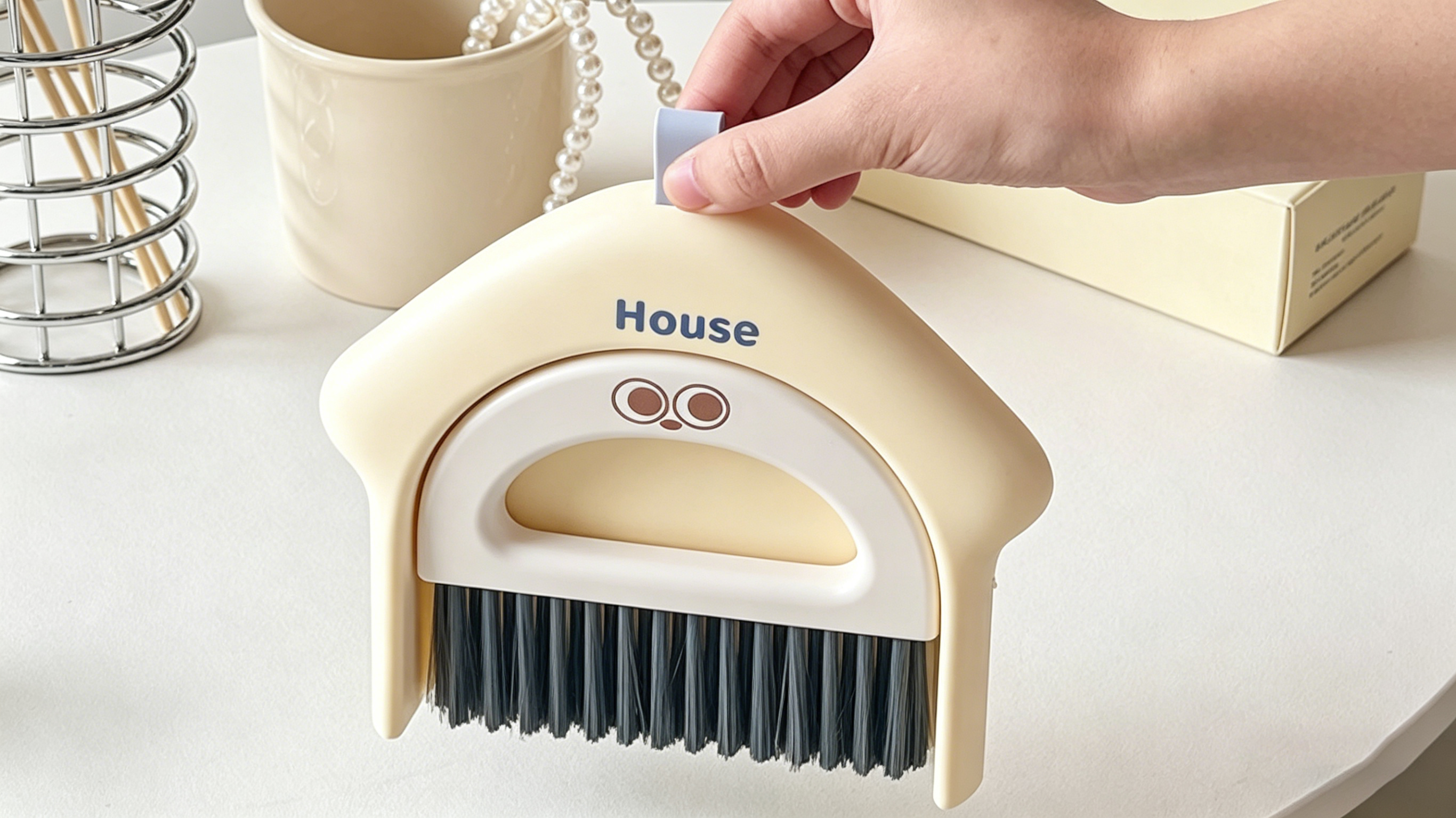
In 2026, the global desktop cleaning category is becoming more commercially interesting for a simple reason: people are using more small, shared and multifunctional work surfaces, while buyers increasingly want low-cost products that solve an obvious daily problem. A plastic mini broom and dustpan set is not a complicated appliance, but that is precisely its strength. It requires no battery, no charging cable, no replacement filter and almost no learning curve. It can sit inside a desk drawer, beside a coffee machine, in a classroom cabinet or on a kitchen shelf and be used the moment crumbs, pencil shavings, paper scraps, hair, dust or other small dry debris appears.
For international importers, distributors, private-label brands and marketplace sellers, the important question is not whether a mini cleaning set is technologically advanced. The important question is whether the usage occasion is frequent, visible and easy to demonstrate. In 2026, several independent trends make the answer increasingly positive: workers are spending more time in offices again, hybrid work is becoming more structured, shared desks are more common, consumers continue to maintain dedicated work areas at home, and global goods trade remains active despite geopolitical uncertainty.
Our plastic mini broom and dustpan set is designed around these real-world conditions. It provides a simple way to remove small dry debris from desktops, kitchen counters, shelves, reception counters, study desks, craft tables, café service areas and other compact surfaces. Our company also supports OEM and ODM customization, allowing buyers to develop their own colors, shapes, logos, packaging, material specifications and market positioning.
1. The 2026 workplace is creating more frequent desktop cleaning occasions
The strongest evidence comes from global workplace data rather than from advertising claims. JLL, one of the world’s largest commercial real-estate services and research companies, published its Global Occupancy Planning Benchmark Report 2026 in May 2026. The report draws on 84 organizations representing 716 million square feet across North America, Latin America, Europe, the Middle East, Africa and Asia Pacific.
JLL found that global office utilization reached 56% in 2026, up from 54% in 2025 and 49% in 2024. It also reported that 70% of employees now attend the office three to five days per week. In addition, 62% of organizations require a fixed number of in-office days, compared with 49% in 2025. These figures matter to cleaning-product suppliers because a desk that is used more often naturally creates more cleaning occasions. More coffee cups, snacks, notebooks, packaging, paper, eraser crumbs and everyday movement all create small debris.
The same JLL report also shows that workspaces are shifting from assigned environments toward more shared formats. Private offices continue to decline while focus rooms, small meeting rooms and flexible spaces increase. In a traditional assigned office, one employee may tolerate a small amount of debris because only that person uses the desk. In a shared workspace, expectations change. The next employee wants a surface that feels ready to use. That creates demand for fast, local cleaning rather than waiting for a scheduled evening cleaning crew.
This is where a mini broom and dustpan has a practical advantage. It can be stored directly at the point of use and requires only a few seconds to operate. For facility managers and corporate procurement teams, it is inexpensive enough to place in multiple locations. For employees, it gives immediate control over visible debris without requiring a vacuum cleaner or wet chemical cleaner.
2. Gensler’s 2026 research shows that people actively adjust their own workspaces
Gensler Research Institute provides another useful perspective. Its Global Workplace Survey 2026 surveyed 16,459 full-time office workers across 16 countries. The study found that the average worker still spends more than half of the workweek in the office. It also found that two-thirds of employees report “hacking” or modifying their workspaces to compensate for performance gaps, and one in four has used do-it-yourself fixes for issues such as ergonomics, temperature or visual privacy.
Although Gensler is not studying cleaning tools specifically, the behavioral message is important. Workers do not passively accept the environment around them. They adapt it. They add organizers, laptop stands, personal accessories, storage tools and other small objects that make the workstation function better for them. A compact cleaning set belongs naturally in this same family of small, practical workplace tools.
The product also fits a broader shift away from the idea that office support must come only from centralized facilities. Employees want immediate solutions. If there are crumbs beside a keyboard five minutes before a client video call, the user does not want to submit a facility request. If coffee powder spills near a shared machine, staff do not want to wait for a large cleaning cart. A miniature broom and dustpan solves the problem at the same scale at which it occurs.
3. Global trade data supports continued opportunity for export-oriented everyday goods
The World Trade Organization provides important context for exporters. In July 2026, the WTO reported that world merchandise trade volume increased 1.9% in the first quarter of 2026 compared with the previous quarter and 3.2% compared with the same quarter a year earlier. In value terms, global merchandise trade was 11% higher year on year in the first quarter.
The WTO also notes that the global environment remains uncertain because of energy prices, conflict and shipping disruptions. For buyers, this uncertainty makes simple, compact and easy-to-ship consumer products more attractive in many portfolios. A plastic mini broom and dustpan does not require batteries, electronics or complex after-sales support. It can be packed efficiently, bundled into multipacks and sold across multiple channels.
It is important to be precise: WTO data does not prove that every mini broom exporter is receiving more orders. What it does show is that global goods trade remained resilient in early 2026. When that wider trade environment is combined with higher office utilization, strong home-cleaning demand and broad e-commerce distribution, the category has a credible commercial foundation.
4. The wider cleaning market is still expanding
Specialist market-research companies also show continued growth in cleaning categories. Grand View Research estimates the global cleaning and hygiene products market at approximately US$34.0 billion in 2026, up from US$33.0 billion in 2025, and forecasts continued expansion through 2033. Its segmentation specifically includes cleaning tools as an application category.
Fortune Business Insights, in a report updated in August 2026, estimates the broader global household cleaning products market at US$294.33 billion in 2026, compared with US$282.28 billion in 2025, and forecasts a 4.40% compound annual growth rate through 2034. Asia Pacific represented the largest regional share in 2025.
A mini broom and dustpan set is not identical to liquid cleaners, detergents or every product counted in those reports, so these numbers should not be presented as the exact market size of mini desktop brooms. However, they demonstrate a larger consumer environment in which cleaning, hygiene and surface-maintenance products remain essential and commercially active.
For private-label buyers, that matters because consumers already understand the category. There is no need to educate the market about why a surface should be kept clean. The challenge is simply to offer a product that makes one particular cleaning task easier.
5. Why plastic remains commercially important for mini broom and dustpan sets
Plastic remains one of the most practical material choices for compact cleaning tools because it balances weight, durability, design flexibility and manufacturing efficiency. A desktop broom needs to be light enough to pick up frequently, but rigid enough to maintain its shape. A dustpan needs a thin functional front edge, but also enough structural strength to survive repeated handling.
Injection-molded plastic allows manufacturers to control curves, grip shapes, joining structures, wall thickness and color with high repeatability. This makes it suitable for mass-market retail and for customized private-label projects.
Plastic is also highly compatible with visual branding. Office brands may prefer neutral colors. Kitchen brands may want warm lifestyle colors. Student products can use brighter palettes. A beauty or craft brand may want softer, trend-led tones. The same underlying function can therefore be positioned for very different audiences without changing the basic product logic.
For importers, plastic also simplifies weight management compared with heavier materials. Lower unit weight can improve carton efficiency and make the product more suitable for e-commerce fulfillment. When freight and last-mile costs are important, small differences in size and nesting design can have a meaningful commercial effect.
6. The strongest trend is not “more cleaning”; it is more localized cleaning
Traditional cleaning tools were designed around rooms and floors. The 2026 opportunity is increasingly about micro-zones: the keyboard area, the coffee corner, the study table, the makeup station, the craft bench, the reception desk and the kitchen preparation surface.
These locations generate small quantities of debris repeatedly. A full-size broom is too large. A vacuum cleaner creates unnecessary setup. A wet wipe may not be ideal for dry crumbs and can introduce moisture near electronics or papers. A hand sweep is fast but transfers the debris to the floor.
The mini broom and dustpan works because it matches the scale of the problem. This “right-sized tool” principle is important in product development. Consumers often do not want maximum power; they want minimum friction. A product that can be reached, used and returned to storage in under a minute is more likely to become part of a daily routine.
7. Home-office demand remains relevant even as employees return to offices
Return-to-office trends do not eliminate the home-office market. Hybrid workers still split time between multiple locations. Gensler’s 2026 survey shows that workers spend a meaningful share of their week outside the main office, including at home, coworking spaces, client sites and other third places.
This creates a multi-location accessory opportunity. A consumer may want one small cleaning set at home and another in the office. A company can include the product in an employee welcome kit. A stationery retailer can merchandise it beside desk organizers. A home-organization seller can position it as a tool for maintaining study and work zones.
For exporters, this is valuable because the target customer is not one demographic. The same product can serve office workers, students, teachers, parents, remote professionals, cafés, hotels, craft users, beauty salons and small retailers.
8. Shared desks make visible cleanliness more important
In flexible offices, visual cleanliness becomes part of the user experience. A shared desk with crumbs or paper debris signals that the previous user did not reset the space. Even if the surface is not technically unsafe, it feels less professional and less welcoming.
A compact cleaning kit can become part of a workstation reset routine. The concept is simple: remove personal items, collect dry debris, wipe the surface if needed and leave the desk ready for the next person. The mini broom handles the dry-debris stage efficiently.
This can also help facilities teams. Professional cleaners still perform deep and scheduled cleaning, but employees can handle minor messes between service cycles. The product should not be marketed as a replacement for professional cleaning. It is a complementary tool that helps maintain the environment between full cleaning sessions.
9. Why the product works well on e-commerce platforms
Products perform well online when their benefit can be understood quickly. A mini broom and dustpan is visually intuitive. A short video can show bread crumbs beside a laptop, pencil shavings on a study desk or coffee grounds near a machine. The user sees the problem, the action and the result in seconds.
This makes the product suitable for Amazon-style marketplaces, social-commerce platforms, short-video marketing and direct-to-consumer stores. Sellers can create before-and-after demonstrations without complex claims. They can also target multiple keywords around desk cleaning, crumb cleaning, office accessories, study accessories and kitchen countertop cleaning.
Bundling creates another advantage. The set can be sold as a single unit, a two-pack for home and office, a family multipack, a school pack or a branded corporate gift. It can also be paired with desktop trash bins, organizers, cleaning cloths or keyboard accessories.
10. Why importers are interested in products with low technical risk
International buyers increasingly evaluate not only gross margin but also operational risk. Electronic products may require certification, battery transport rules, warranty service and replacement parts. A simple manual cleaning tool has fewer technical failure points.
That does not mean quality is irrelevant. On the contrary, because the product is simple, small defects become very visible. Buyers should examine brush density, bristle retention, dustpan edge contact, handle comfort, part fit, surface finish, odor, color consistency, packaging strength and carton efficiency.
A good supplier therefore needs to understand not only molding but also the final user experience. If the front edge of the dustpan does not sit close enough to the table, crumbs remain behind. If the bristles are too soft, heavier particles are difficult to move. If they are too stiff, the brush may feel harsh on delicate surfaces. If the brush and pan do not store together securely, the product creates clutter instead of reducing it.
11. Our OEM service helps buyers launch private-label versions faster
Our company supports OEM projects for importers, retailers, wholesalers and established brands that already know the product format they want. OEM is especially useful when the buyer wants to bring an existing functional concept to market under its own identity.
Customization can include logo application, brand colors, packaging artwork, label language, barcode placement, carton marks, multipack quantity and promotional inserts. Depending on project requirements, buyers can also discuss material specifications and accessory combinations.
The commercial advantage of OEM is speed and risk control. The buyer does not need to start from a blank page. Instead, it works from a proven product structure and adapts the elements that matter most to its channel.
For a marketplace seller, this may mean a distinctive color and compact box optimized for fulfillment. For a retail chain, it may mean matching a seasonal color program and shelf-ready packaging. For a corporate-gift distributor, it may mean logo printing and a branded presentation box.
12. Our ODM service creates deeper product differentiation
ODM is appropriate when a buyer wants something more distinctive than a logo change. Our team can discuss product dimensions, handle shape, brush geometry, dustpan structure, storage method, material selection, bristle configuration, visual style and packaging concept.
Why does this matter? Because the mini cleaning category is easy to understand, but that also means many products can look similar. To build a stronger brand, the buyer needs a reason for customers to choose its version.
That reason can be ergonomic. For example, a longer grip may suit adults, while a rounded compact grip may suit students. It can be functional, such as an improved snap-together storage design. It can be visual, through a recognizable silhouette or coordinated color system. It can be commercial, such as a two-pack designed specifically for home-and-office use.
ODM allows the product to be built around a market position rather than simply selected from a catalog.
13. The correct customization process starts with the user, not the color
Many buyers begin by asking, “Can you make this in our color?” Color matters, but it should not be the first question. The first question should be: who will use the product, where will they use it and what type of debris will they clean?
A set for keyboard crumbs has different priorities from one designed for kitchen counters. A student product may prioritize bright color and affordability. A premium office accessory may prioritize matte texture, muted tones and compact storage. A café or hotel may prioritize durability and frequent use.
Once the scenario is clear, the supplier can make better decisions about size, bristle stiffness, material, packaging and presentation. This reduces the risk of producing a visually attractive product that does not fit the buyer’s actual channel.
14. Packaging is part of the product strategy
For global trade, packaging does more than protect the item. It influences freight efficiency, shelf presentation, marketplace fees and customer perception.
A compact nested design can reduce wasted volume. A hanging card may work for hardware or household stores. A printed box may suit e-commerce and gifting. A simple recyclable carton can support a minimal retail identity. A multi-language label can help distributors serving several markets.
OEM and ODM buyers should therefore evaluate packaging at the same time as product design. Changing the product dimensions by a small amount may allow more units per carton. Improving the nesting design may reduce shipping volume. Adding clear usage graphics may make the product easier to sell in markets where consumers speak different languages.
15. Sustainability questions are becoming part of B2B purchasing
International buyers increasingly ask suppliers about material choice, packaging reduction and compliance. For plastic products, the practical response should not be vague green marketing. Buyers need specific information: what material is used, whether recycled-content options are feasible for the target application, how durable the product is, whether unnecessary packaging can be removed and what documentation is available.
A durable manual cleaning tool can also have a simple sustainability advantage over disposable solutions: it is designed for repeated use and does not require batteries or power. However, claims should remain specific and evidence-based. The strongest export suppliers are those that can discuss material and packaging options transparently rather than relying on exaggerated environmental language.
16. Different regions require different product positioning
North American e-commerce buyers may focus on convenience, multipacks and home-office use. European buyers may pay closer attention to packaging, material documentation and minimalist design. Asian markets may show strong interest in compact storage, small living spaces and attractive color systems. Middle Eastern corporate and hospitality buyers may value customized gifts and premium presentation.
The function remains the same, but the sales story can change. This is why OEM and ODM capability matters in export trade. A single factory platform can support several market-specific versions without forcing every buyer into one identical product.
17. Who should consider adding a mini broom and dustpan set in 2026?
The category is relevant to household-goods importers, cleaning-tool distributors, office-supply wholesalers, stationery chains, e-commerce sellers, home-organization brands, kitchen-accessory brands, promotional-product companies, school suppliers, hotel-supply companies and corporate-gift distributors.
It is also suitable for retailers looking for low-complexity add-on products. Because the item is easy to understand, it can be placed near desktop organizers, small trash bins, keyboard products, stationery, kitchen accessories or cleaning supplies.
For B2B customers, it can be used in office welcome kits, school cleaning kits, hotel room accessories, shared workspace stations or branded employee gifts.
18. Why the order opportunity can continue even in an uncertain global economy
Economic uncertainty often changes the type of products buyers prefer. Large, expensive and technically complex products may require more cautious purchasing. Small, useful and affordable items can remain attractive because they involve lower consumer commitment.
The mini broom and dustpan also addresses a recurring problem rather than a fashion-only need. Crumbs, dust and small debris will continue to appear regardless of economic cycles. The product can be refreshed through color, packaging and branding without losing its core function.
For importers, that combination is valuable: a stable everyday use case plus flexible merchandising. Buyers can test a small range, expand successful colors, build multipacks or develop private-label variants without changing the fundamental category.
19. What makes our product suitable for international cooperation
Our objective is not simply to supply a generic plastic item. We focus on the factors that international buyers need to manage: practical function, repeatable quality, customization, packaging, visual differentiation and channel fit.
We support OEM branding for buyers who want a faster route to market, and ODM development for customers who want a more distinctive product. We can discuss colors, logos, product structure, bristle configuration, material options, packaging formats, multipack concepts and market positioning based on the intended user.
For distributors, we can help turn one basic format into a family of SKUs. For e-commerce sellers, we can discuss compact presentation and visually demonstrable features. For corporate clients, we can discuss branding and gift packaging. For retailers, we can support packaging and color programs that fit category merchandising.
20. Conclusion: a small cleaning tool fits a large global change
The 2026 desktop-cleaning opportunity is not based on one dramatic trend. It comes from several smaller trends moving in the same direction.
JLL reports rising global office utilization and more structured office attendance. Gensler shows that workers spend more than half their time in offices and actively modify their workspaces to make them function better. The WTO reports resilient merchandise trade in early 2026. Cleaning-market research continues to show growth in household and hygiene categories.
Together, these signals support a straightforward commercial idea: small surfaces are being used more intensively, consumers want immediate control over their environment, and buyers still need compact, affordable products that are easy to ship and easy to sell.
A plastic mini broom and dustpan set meets those conditions. It is simple, portable, reusable, easy to demonstrate and suitable for offices, homes, schools, cafés, reception areas and many other environments.
For international buyers, the opportunity becomes stronger when the product is customized for the target market. Our OEM and ODM services allow brands, importers and distributors to move beyond a generic item and create a version that fits their own customer, channel and price position.
In a global market where large innovations receive most of the headlines, small everyday tools can still create reliable business when they solve a frequent problem well. In 2026, the mini broom and dustpan set is one of those products.
plastic mini broom · mini dustpan set · desktop cleaning tools · table crumb brush · small broom and dustpan · desk cleaning set · keyboard crumb cleaner · countertop cleaning brush · portable dustpan · handheld cleaning brush · compact cleaning tools · office desk accessories · home office cleaning · study desk cleaning · kitchen crumb cleaner · reusable cleaning tools · plastic cleaning products · household cleaning accessories · office cleaning supplies · small surface cleaning · OEM mini broom · ODM mini dustpan · private label cleaning tools · custom cleaning products · custom logo broom · custom color dustpan · cleaning tool manufacturer · cleaning tool supplier · wholesale mini broom · bulk dustpan sets · cleaning product importer · household goods distributor · office supply wholesaler · Amazon cleaning product seller · e-commerce cleaning accessories · stationery retailer · corporate gift supplier · school supply buyer · hotel supply distributor · home organization brand



