


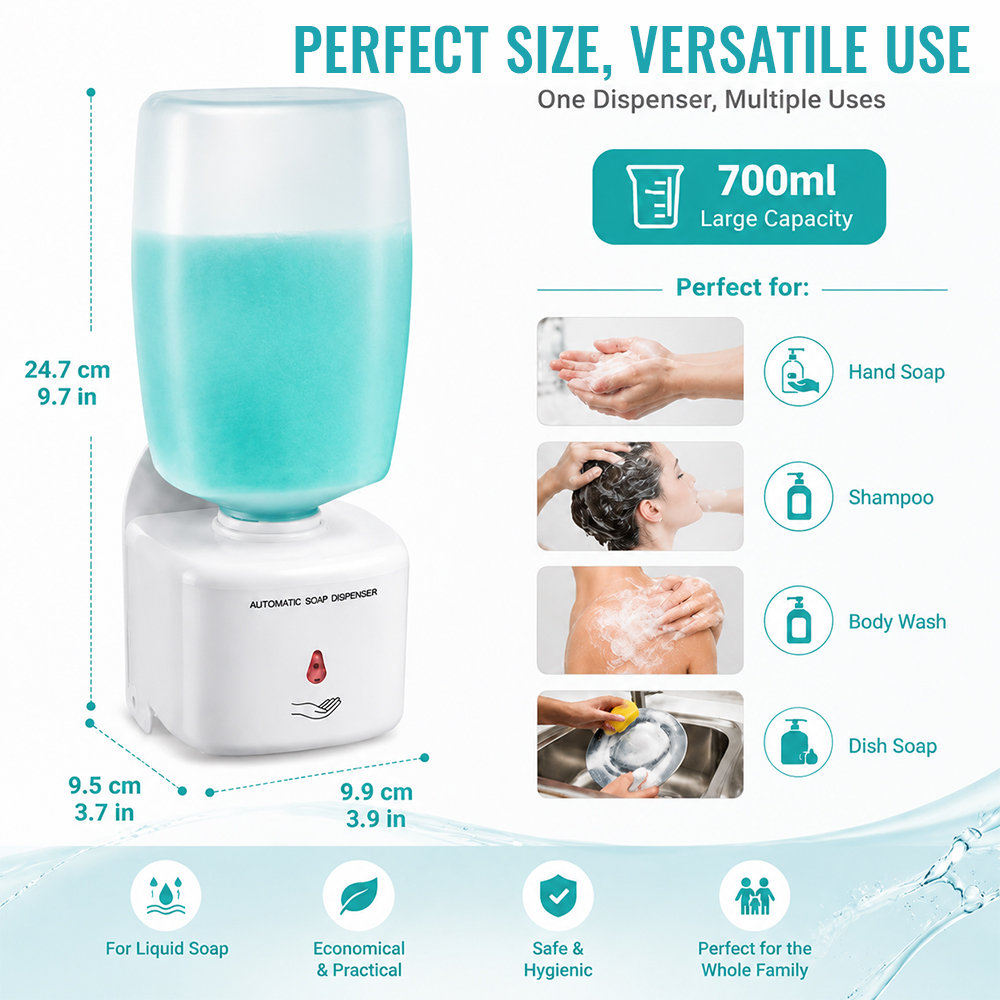
By 2026, the idea of a “smart washroom” is no longer limited to flagship airports, luxury hotels or futuristic office towers. Touchless faucets, automatic hand dryers, occupancy sensors, smart flushing systems and sensor soap dispensers are increasingly being specified in renovation programs for mainstream commercial properties. Among these upgrades, the wall-mounted automatic soap dispenser stands out because it addresses several operational priorities at the same time: hygiene, user experience, labor efficiency, controlled soap consumption and visual consistency.
The change is being driven by a broader shift in consumer expectations. People have become accustomed to contactless doors, mobile payments, motion-activated lighting and app-based services. As a result, touching a heavily used manual pump in a premium hotel lobby washroom or a modern Grade-A office building can feel increasingly out of step with the rest of the customer journey. A touch-free dispenser is therefore not only a hygiene device; it is also part of the perceived quality of the property.
For commercial buyers, however, appearance is only the beginning. A dispenser installed in a hotel, office tower or other public facility may be activated hundreds or thousands of times each day. The real purchasing question is whether the unit can deliver reliable infrared sensing, consistent dosing, easy refill access, secure wall mounting and stable performance across a large estate. These are the points that determine whether a retrofit creates long-term value or simply adds another maintenance problem.
1. Touch-free behavior is moving from a temporary concern to a lasting design preference
Consumers increasingly expect fewer shared touchpoints
Public expectations changed sharply during the pandemic years, but the long-term shift is broader than disease anxiety. Contactless interaction has become part of everyday convenience. People tap a phone to pay, walk through sensor-operated doors and use motion-activated fixtures without thinking about the technology behind them. When that same user enters a hotel or office washroom, a touch-free soap dispenser feels intuitive because it matches a behavior pattern already established in other areas of life.
This matters for facility owners because users judge a property through small, repeated interactions. A lobby can be beautifully designed, yet an outdated washroom with sticky manual pumps can weaken the overall impression. In hospitality, where brand perception is built through details, the washroom is part of the guest experience. In corporate offices, especially those competing for premium tenants, modern washroom fixtures reinforce the message that the building is well managed.
International health guidance supports convenient, accessible hand-hygiene infrastructure
The trend is also consistent with international public-health guidance. In October 2025, the World Health Organization (WHO) and UNICEF released their first global Guidelines on Hand Hygiene in Community Settings. The guidance covers homes, public spaces and institutions, and emphasizes that hand-hygiene facilities should be convenient, accessible and easy to use. In the technical guidance, WHO and UNICEF specifically note that touchless features such as sensor taps and dispensers can be considered because they can reduce contamination and increase ease of use.
This point is important for commercial property managers. The objective is not to claim that a sensor dispenser eliminates every hygiene risk. It does not. Its value is more specific: it removes one unnecessary shared contact step from the handwashing process and can make soap access easier. That is a practical improvement that can be repeated across every visit, every floor and every building in a portfolio.
CDC continues to emphasize the importance of handwashing access in public settings
In February 2026, the U.S. Centers for Disease Control and Prevention (CDC) reiterated that access to handwashing facilities in community gathering places can help stop the spread of diseases including cholera, influenza and COVID-19. CDC described markets, schools, border crossings and other public gathering points as locations where handwashing access matters.
For hotels and office buildings, the practical lesson is straightforward: soap access is part of basic public infrastructure. If a dispenser is difficult to activate, empty too often, badly positioned or unreliable, the washroom fails at a fundamental level. A well-designed automatic unit can make that infrastructure easier to use and easier to standardize.
2. Why wall-mounted automatic soap dispensers are especially suitable for hotels
Guest experience is built through small details
Hotels sell more than rooms. They sell an experience of cleanliness, order, comfort and trust. Guests form opinions from the condition of corridors, elevators, breakfast areas and public washrooms. A wall-mounted infrared soap dispenser contributes to that experience because it looks organized, works without manual contact and supports a cleaner sink area.
For upscale hotels, this can reinforce premium positioning. For midscale chains, it can support consistent standards across multiple properties. In both cases, the objective is not simply to add technology. The objective is to make the guest journey feel smoother and more hygienic.
Wall mounting creates a cleaner washbasin area
Countertop dispensers are easy to install, but they introduce several operational problems in busy washrooms. They can be moved by guests, knocked over, positioned too close to water, or leave residue beneath the bottle. During cleaning, staff must pick them up, wipe the surface underneath and return them to the correct position.
A wall-mounted unit solves much of this. The location is fixed, the countertop remains open, and cleaning staff can wipe the basin and surrounding surface more efficiently. Across a hotel with dozens of public washrooms, staff toilets, spa areas, restaurants, conference rooms and back-of-house facilities, the savings in small repeated actions can become meaningful.
Standardization helps hotel groups control quality
A single hotel can manage a few different fixtures without much difficulty. A group with 50, 100 or 500 properties cannot. Large hospitality organizations need standard specifications because standardization simplifies procurement, training, spare-parts management and visual consistency.
If a wall-mounted sensor dispenser is approved as a group standard, the same model can be specified for multiple renovation projects. Maintenance teams learn one refill method. Procurement teams negotiate one product family. Brand teams can control color, logo and finish. This is why a commercially suitable dispenser should be evaluated as a platform for repeated deployment, not merely as a single item.
3. Why office buildings are a natural growth market
Modern offices compete on tenant experience
Office landlords increasingly recognize that building quality is judged outside the leased workspace as well as inside it. Elevators, lobbies, corridors, fitness areas and washrooms all influence how tenants perceive a property. In markets with high vacancy or strong competition, landlords use amenity upgrades to retain tenants and protect rental value.
A washroom retrofit is often more practical than a major structural renovation. Fixtures can be replaced in stages, floor by floor, without changing the entire building. Touchless soap dispensers fit well within this approach because they are visible upgrades with a clear user benefit.
Corporate occupants also care about workplace hygiene
Large employers have become more attentive to employee wellbeing and workplace hygiene. A touch-free washroom cannot prevent every illness, but it can reduce unnecessary shared contact and make handwashing more convenient. For human resources and facilities teams, those are tangible improvements that can be communicated as part of workplace standards.
In multi-tenant buildings, consistency is particularly important. A landlord may have dozens of washrooms across multiple floors. Using the same wall-mounted unit makes inspection and maintenance easier. If every floor uses different dispensers, batteries, keys or refill formats, facilities management becomes unnecessarily complicated.
Wall-mounted designs fit refurbishment projects
Many office buildings are not new. The opportunity therefore lies in retrofit rather than new construction. A wall-mounted dispenser can often be added without redesigning the entire washbasin. Depending on the product and the site, it can be mounted in a location that avoids major plumbing changes. This makes the upgrade comparatively straightforward while still creating a more modern appearance.
4. Market research shows that electronic and touchless dispensers are moving deeper into commercial spaces
Grand View Research identifies commercial applications as the largest segment
Grand View Research estimates that the global electronic soap dispenser market was worth about USD 929 million in 2023 and projects it to reach approximately USD 1.52 billion by 2030. The firm forecasts a compound annual growth rate of around 7.3% from 2024 to 2030.
More relevant for B2B buyers, Grand View Research states that commercial applications represented the largest revenue share in 2023. The company links market growth to the adoption of smart restroom technology, expanding hospitality and real estate activity, and greater awareness of touch-free functions in commercial washrooms.
This supports what suppliers and facility managers are seeing on the ground: automatic dispensers are no longer a narrow residential gadget category. They are becoming part of commercial building infrastructure.
Automatic dispensers are expected to outgrow manual models
In its broader soap dispenser market analysis, Grand View Research projects the automatic segment to grow at a faster rate than the market overall. The organization connects this growth with rising demand for hands-free dispensing and with wider adoption across commercial environments.
The implication for distributors is important. Manual dispensers will remain in the market because they are inexpensive and simple, but automatic products give suppliers access to higher-value projects where customers care about hygiene, design, user experience and technology integration. That creates room for differentiation beyond low price.
5. Why smart-washroom retrofit penetration is increasing
Retrofits offer visible benefits without rebuilding the property
Property owners rarely replace an entire washroom at once unless a major renovation is planned. Instead, they often modernize in layers. First they may replace taps, then dispensers, then hand dryers, then introduce occupancy monitoring or maintenance sensors. This phased approach spreads capital expenditure and reduces disruption.
Wall-mounted automatic soap dispensers are well suited to this strategy because they deliver an immediate visual and functional upgrade. Once installed, the washroom looks more contemporary and the user can immediately experience the touch-free interaction.
Smart upgrades can support operations, not just aesthetics
A smart retrofit should produce operational value. For a soap dispenser, this begins with consistent dosing. A mechanical pump may deliver different amounts depending on how it is pressed and how many times the user pushes it. An electronic dispenser can be engineered to provide a controlled amount per cycle.
Across thousands of activations, predictable dosing helps purchasing teams estimate soap consumption more accurately. It can also reduce over-dispensing. The savings from a few milliliters may appear insignificant at one sink, but they become meaningful when multiplied across hundreds of devices and millions of annual uses.
Facilities teams increasingly think in systems
The smart-washroom trend is also changing the way buyers evaluate equipment. Instead of asking only, “What is the unit price?”, professional buyers increasingly ask: How long will the batteries last? How quickly can staff refill the reservoir? Is the unit easy to clean? Is the housing durable? Can one product be standardized across multiple properties? Can the supplier support custom branding and future replacement orders?
These questions favor suppliers that can support the full lifecycle of a project, including product selection, customization, production, packaging and repeat procurement.
6. Infrared sensing must be engineered for real-world washrooms
Sensor stability affects both convenience and cost
The infrared sensor is the core interface between the user and the dispenser. If the sensor is too insensitive, the guest waves repeatedly under the unit and becomes frustrated. If it is too sensitive, reflections from a glossy basin or nearby movement may cause unwanted dispensing.
Commercial washrooms are particularly challenging because lighting, sink materials, mounting heights and surrounding surfaces vary. A supplier should therefore pay attention to detection distance, response time and false-trigger control. A good product should feel effortless to use without wasting soap.
Dispensing consistency matters more than decorative features
Displays, indicator lights and fashionable finishes can add value, but the primary commercial requirement is reliable soap delivery. The pump, motor, tubing, seals and control board must work together consistently. In a hotel or office, a dispenser that looks modern but fails frequently creates more complaints than a simple product that works every time.
For this reason, commercial buyers should ask for performance testing, cycle testing and sample evaluation before placing a large order. A pilot installation is often the best way to identify how the product performs in the actual environment.
7. Controlled dosing can create a better total cost of ownership
The cheapest dispenser is not always the lowest-cost solution
Procurement teams sometimes compare products only by unit price. This can be misleading. The real cost includes purchase price, soap consumption, battery replacement, refill labor, cleaning time, breakdowns and the cost of maintaining spare units.
A slightly higher-cost dispenser may be more economical over several years if it reduces soap waste, requires fewer service visits and performs more reliably. This is especially true for large buildings, where small efficiency differences are multiplied across dozens or hundreds of units.
Predictable dispensing supports budget control
If each activation releases a controlled quantity of soap, facilities teams can develop a more accurate consumption model. They can estimate how many liters are required per month based on traffic and refill frequency. This makes purchasing more predictable and reduces the risk of emergency replenishment.
Ease of refill reduces labor
Refilling is one of the most common maintenance tasks. The reservoir should therefore be accessible without complicated disassembly. The lid and lock should be secure but simple for authorized staff. A visible level indicator can help staff determine whether a refill is necessary without opening the unit.
In a large property, saving even one minute per refill matters. If 200 dispensers are checked several times a week, small design improvements translate directly into labor efficiency.
8. OEM customization creates value for distributors and hotel groups
Private labeling turns a generic dispenser into a brand asset
Our company supports OEM customization for customers who want to sell or deploy the product under their own brand. Logo printing, product labeling, instruction manuals, packaging design, barcodes and other branding elements can be adapted according to project requirements.
For a distributor, this means the dispenser does not have to compete only as an anonymous commodity. It can become part of a private-label washroom collection. For a hotel group, branding can help ensure visual consistency across properties. For a facilities supplier, customized packaging can simplify channel distribution and inventory management.
Color and finish can match the interior concept
Washroom design has become more sophisticated. Architects may specify black fixtures, brushed metal, white minimalism or other coordinated finishes. A standard one-color dispenser may not fit every project. OEM programs can support selected color, logo and surface requirements subject to order quantity and manufacturing feasibility.
This matters because the dispenser is highly visible. It sits directly above or beside the basin, often at eye level. A product that matches the faucet, hand dryer and other accessories makes the entire washroom look more intentional.
Packaging can be adapted to the sales channel
A hospitality project, a facilities-management distributor and an e-commerce private label may need the same dispenser but completely different packaging. One may prefer bulk cartons for installation teams. Another may need retail-ready individual boxes with multilingual instructions. OEM customization allows the supply chain to be designed around the customer’s actual route to market.
9. ODM customization is the next step for customers that need a differentiated product
ODM goes beyond adding a logo
Our company also supports ODM development for customers whose requirements cannot be met by a standard model. Depending on project scope and feasibility, ODM discussions can include reservoir capacity, external shape, internal layout, sensor configuration, dispensing volume, mounting method, indicator placement, power options, opening mechanism and other functional details.
This is especially useful for large distributors, established hygiene brands and hotel groups that want a product tailored to a specific operating model.
A unique design can reduce direct price competition
When many suppliers sell visually identical dispensers, buyers compare primarily on price. A customized design gives the brand a more defensible market position. The product may have a distinctive silhouette, a unique refill method or features developed for a specific customer segment.
That differentiation can support better margins because the product is no longer directly comparable with every low-cost listing in the market.
ODM can solve real operational problems
The strongest ODM projects begin with a problem, not with appearance. A hotel chain may need a larger reservoir because public washrooms are serviced only twice a day. An office operator may need a specific mounting footprint to replace an existing dispenser without repairing the wall. A distributor may need a different dispensing volume for a local soap formula.
By defining these requirements early, product development can be focused on measurable operational needs.
10. How to evaluate a wall-mounted sensor dispenser before a large commercial order
Start with traffic and refill frequency
Estimate how many people use the washroom each day and how often the cleaning team can refill the dispenser. A small office and a convention hotel need different reservoir capacities and service schedules.
Confirm compatibility with the soap formula
Liquid soap, foam soap and different viscosities behave differently. The pump system should be matched to the intended consumable. Using a formulation that is too thick or otherwise incompatible can reduce dispensing consistency and pump life.
Test mounting height and basin geometry
The dispenser should be positioned so that hands naturally enter the sensor area without contacting the basin. A pilot installation can reveal whether reflections, sink shape or nearby fixtures affect sensing.
Evaluate refill and battery access
Maintenance staff should be able to refill the unit and replace batteries quickly. The design should prevent unauthorized access while avoiding unnecessarily complicated service procedures.
Run a pilot before full rollout
For projects involving hundreds of units, a pilot is one of the most valuable procurement steps. Install a small quantity in the real environment and monitor sensor performance, soap consumption, cleaning feedback and user complaints. The lessons from the pilot can then be incorporated before mass deployment.
11. Why our wall-mounted sensor soap dispenser fits 2026 commercial retrofit demand
Touch-free infrared dispensing
The product allows users to receive soap without pressing a shared pump. This directly supports the preference for reduced-touch interaction and aligns with the direction described in WHO and UNICEF guidance on convenient, accessible hand-hygiene facilities.
Wall-mounted format for cleaner public washrooms
Mounting the dispenser on the wall keeps the basin area more open, reduces accidental movement and supports faster cleaning. The fixed position also makes it easier to standardize installation across multiple washrooms.
Designed for commercial procurement logic
We understand that commercial customers evaluate more than the device itself. They consider packaging, batch consistency, lead time, repeat orders, branding, spare units and the ability to scale from a sample to a large project. Our supply approach is intended to support that purchasing process.
OEM support for private-label customers
We can work with distributors, importers, hospitality suppliers and hygiene brands that want logo, packaging and selected appearance customization. This helps customers build a coherent product family and strengthen their own market identity.
ODM support for larger or more specialized projects
When a standard model is not enough, we can discuss product adaptation and development. The goal is to create a configuration that fits the real operating environment rather than forcing the customer to redesign their process around a generic product.
12. Conclusion: touch-free washrooms are becoming part of the expected commercial standard
The strongest reason for the growth of wall-mounted sensor soap dispensers is that multiple trends are moving in the same direction. Consumers increasingly prefer touch-free interaction. International health organizations emphasize convenient and accessible hand-hygiene infrastructure. Hotels compete on guest experience. Office buildings compete on tenant experience. Facility managers want predictable operating costs. Smart-washroom renovation is spreading from premium projects into mainstream commercial properties.
Market data supports this direction. Grand View Research projects continued growth in electronic soap dispensers and identifies commercial applications as a major demand segment. Its research also links adoption to the expansion of hospitality, real estate and smart restroom technologies. WHO and UNICEF guidance specifically recognizes the potential of touchless dispensers to reduce contamination and improve ease of use, while CDC continues to highlight the public-health importance of accessible handwashing facilities in community gathering places.
For buyers, the conclusion is not that every manual dispenser must immediately be replaced. The more useful conclusion is that when a property is already planning a washroom renovation, a wall-mounted infrared dispenser deserves serious consideration because it combines hygiene, convenience, design consistency and operational control in a relatively compact upgrade.
For distributors and brands, the opportunity goes further. With OEM and ODM support, the product can be customized for private-label sales, hotel standards, facility-management programs or region-specific requirements. That flexibility makes the dispenser not just a fixture, but a scalable commercial product platform.
If your business supplies hotels, office buildings, real-estate developers, cleaning contractors, public facilities, restaurants, schools, healthcare-related facilities or washroom-equipment distributors, we can support both standard wholesale orders and customized OEM/ODM projects. By defining traffic, soap type, capacity, appearance, branding, packaging and installation requirements at the beginning, we can help identify a configuration suited to long-term commercial use.
wall mounted automatic soap dispenser, touchless soap dispenser, sensor soap dispenser, infrared soap dispenser, commercial soap dispenser, hotel soap dispenser, office washroom soap dispenser, automatic liquid soap dispenser, automatic foam soap dispenser, smart washroom dispenser, touch free washroom equipment, public restroom soap dispenser, commercial restroom accessories, hotel washroom accessories, office restroom accessories, smart bathroom retrofit, washroom modernization, restroom automation, infrared sensor dispensing, contactless hand hygiene, hands free soap dispenser, B2B hygiene equipment, soap dispenser manufacturer, automatic soap dispenser factory, soap dispenser supplier, wholesale soap dispenser, bulk soap dispenser, OEM soap dispenser, ODM soap dispenser, private label soap dispenser, custom logo soap dispenser, custom soap dispenser packaging, hotel hygiene equipment, office hygiene equipment, facility management washroom products, commercial washroom retrofit, hospitality washroom equipment, property management restroom equipment, smart restroom technology, touchless commercial hygiene solution.



