


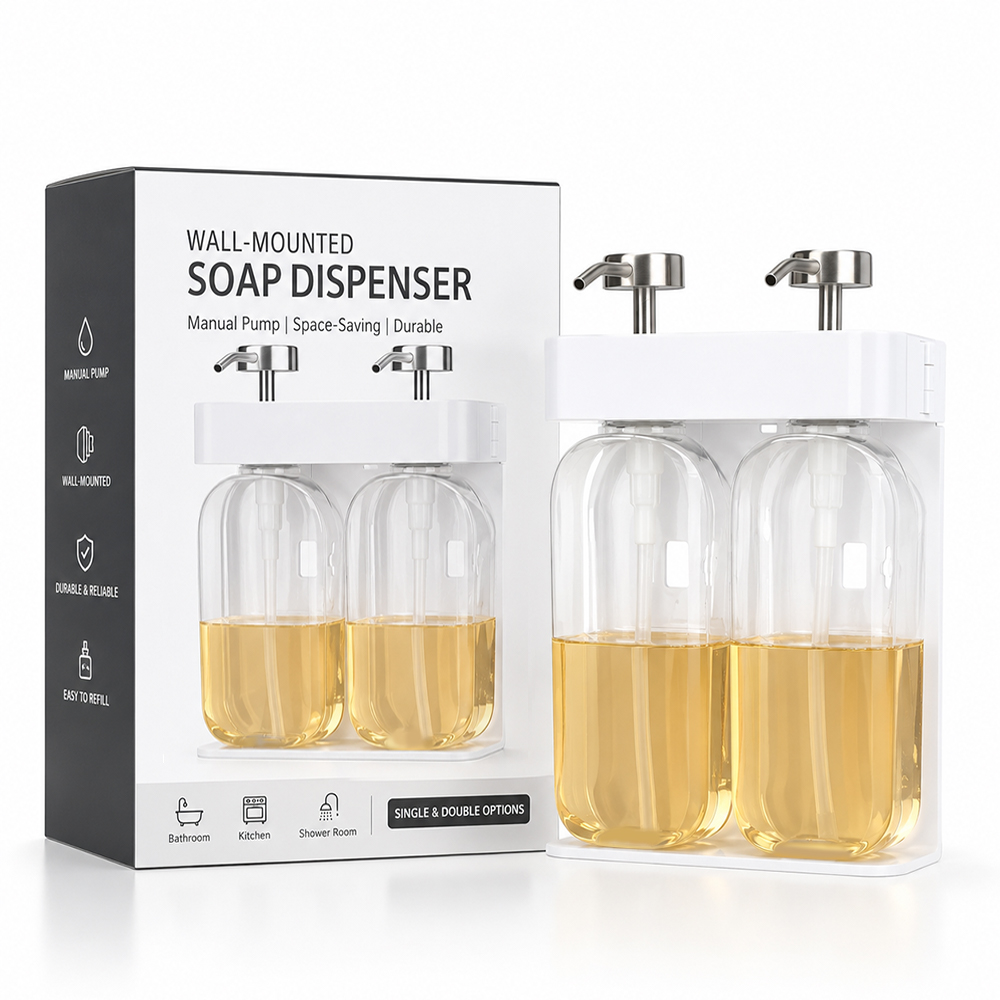
Commercial washrooms are no longer treated as purely functional back-of-house spaces. In offices, hotels, restaurants, hospitals, clinics, schools, shopping centers and transport facilities, the washroom has become part of the user experience, the hygiene program and the building’s operating cost structure. In 2026, the strongest upgrade logic is not simply “add more equipment.” It is to make hygiene supplies easier to access, easier to refill, easier to identify and easier to maintain while using limited wall and counter space more intelligently.
That is exactly where a wall-mounted dual-head manual soap dispenser with two independent reservoirs creates value. One chamber can be configured for liquid hand soap, while the second can be configured for a compatible hand sanitizer or another approved hygiene liquid. The two media remain separated, and each head dispenses independently. Instead of installing two unrelated dispensers, the facility can organize two hygiene functions in one coordinated wall-mounted unit.
The benefit is not that every user should automatically wash with soap and then apply sanitizer immediately afterward. Public-health guidance does not support that as a universal requirement. The benefit is that a facility can make both options available for different situations while simplifying hardware layout. The World Health Organization (WHO), UNICEF and the U.S. Centers for Disease Control and Prevention (CDC) all distinguish between soap-and-water handwashing and alcohol-based hand rub. Soap and water remain essential in many situations, especially when hands are visibly dirty. Alcohol-based hand rub can be an effective alternative in appropriate situations when hands are not visibly soiled. A dual-chamber design gives facility managers flexibility without forcing them to scatter separate bottles and dispensers across the same wall.
1. The 2026 upgrade direction is moving from “more fixtures” to “better hygiene infrastructure”
WHO and UNICEF: facilities should be convenient, reliable and easy to use
In October 2025, the World Health Organization and UNICEF released the first global Guidelines on Hand Hygiene in Community Settings. The guidance covers public and institutional environments outside routine healthcare, including spaces that closely resemble the commercial environments served by washroom equipment suppliers. WHO and UNICEF state that effective hand hygiene depends on access to basic materials, clear information and a physical environment that makes hygiene convenient and easy to practice. They also emphasize that facilities need to be reliably stocked with water and soap or alcohol-based hand rub.
This matters for commercial washroom design because availability is not only a purchasing issue. It is also a placement and maintenance issue. A building may technically own enough dispensers, but if they are poorly positioned, frequently empty or confusing to users, the infrastructure is not working as intended. A dual-reservoir wall-mounted dispenser can help consolidate stocking points. Maintenance staff can inspect two liquids at one location, compare fill levels more quickly and reduce the number of separate housings that must be opened, cleaned and recorded.
For multi-site operators, that matters even more. A hotel chain with 80 properties or a restaurant group with 200 locations does not manage one restroom; it manages hundreds or thousands of identical maintenance points. Reducing two separate dispenser bodies to one integrated platform can simplify installation instructions, cleaning routines, spare-parts planning and visual checks.
WHO World Hand Hygiene Day 2026: infrastructure remains a core prerequisite
WHO’s 2026 World Hand Hygiene Day materials again emphasized that hand-hygiene standards depend on adequate infrastructure, including soap, clean towels and alcohol-based hand rub where appropriate. This is a useful reminder for commercial buyers: hygiene behavior cannot be separated from the physical equipment that makes the behavior possible.
For a new-build or renovation project, the question therefore becomes: how many hygiene points are needed, where should they be placed, how much wall space is available, how frequently will they be used, and how easy will they be to service? A dual-head manual dispenser directly addresses several of those questions at once. It brings two supply functions into one organized footprint, while keeping the liquids physically separated inside independent chambers.
2. Why two independent chambers are more useful than simply putting two bottles on a counter
Separate reservoirs prevent product mixing
The first design principle is separation. Hand soap and hand sanitizer have different formulations, viscosities and use cases. They should not be mixed in one reservoir. A proper dual-chamber soap and sanitizer dispenser uses two independent containers and two independent dispensing paths. This allows the facility to use a liquid soap on one side and a compatible sanitizer on the other without cross-mixing the contents.
This is especially important for B2B projects because buyers may use different liquid specifications in different markets. One customer may use a relatively viscous liquid soap. Another may use a lower-viscosity hygiene liquid. An alcohol-based hand sanitizer can also require different material compatibility from a conventional soap. For that reason, our OEM/ODM process does not treat the words “soap” and “sanitizer” as interchangeable labels. We ask the customer to provide the target liquid characteristics so the appropriate pump, seals, reservoir materials and output configuration can be evaluated before mass production.
Independent heads make the function easy to understand
Two clearly separated dispensing heads also make operation easier to explain. The left side can be labeled “HAND SOAP” and the right side “HAND SANITIZER,” or the labels can be adapted to the customer’s language and brand guidelines. Different icons, colors or windows can further reduce confusion. This is more professional than placing two generic pump bottles next to each other and asking users to guess which is which.
For hospitals, clinics, laboratories, foodservice back-of-house areas and staff washrooms, clear identification matters because workers may be moving quickly. For hotels, airports and shopping centers, the same clarity improves the experience for visitors who may speak different languages. Through OEM production, we can customize printed labels, pictograms and multilingual instructions so the dispenser communicates its function immediately.
One coordinated body can reduce visual and physical clutter
Two separate wall-mounted dispensers need two mounting locations, two sets of alignment decisions and sufficient clear wall space between other fixtures. A dual-head unit combines those functions within one coordinated product. The exact space saving depends on the dimensions of the dual unit compared with the two single units being replaced, so it would be misleading to promise a fixed percentage. However, in many layouts, consolidating two functions in one housing can materially improve wall-space efficiency, reduce visual clutter and simplify the installation zone.
This is especially valuable above narrow handwashing counters, between mirrors, beside sinks in compact staff washrooms, or in renovation projects where plumbing locations cannot easily be moved. In those projects, every usable section of wall has value.
3. Authoritative guidance explains why soap and sanitizer should both be planned carefully
CDC: soap and water remain the best option in many everyday situations
The U.S. Centers for Disease Control and Prevention states that washing hands with soap and water is the best way to remove germs in most everyday situations. CDC also explains that when soap and water are not available, an alcohol-based hand sanitizer containing at least 60% alcohol can be used. The agency notes important exceptions: sanitizer is less effective when hands are visibly dirty or greasy and does not remove every type of germ or harmful chemical.
For a commercial buyer, this means a dual dispenser should not be marketed as if the two liquids are identical. Their value lies precisely in offering different tools for different circumstances. At a restroom sink, soap remains the core product for washing. The second reservoir can provide a facility-approved sanitizer for users or staff who need that option under the facility’s hygiene policy.
CDC guidance for organizations supports access to both types of hand-hygiene infrastructure
CDC’s 2025 respiratory-virus hygiene guidance tells organizations to ensure that facilities are equipped with soap, water and a way to dry hands. It also recommends placing hand-sanitizer dispensers in suitable locations, particularly around frequently touched surfaces or where soap and water are not readily available. CDC’s workplace guidance follows the same general principle.
A commercial washroom project can use that logic in different ways. In a large building, the dual dispenser may be installed at selected staff sinks, while additional standalone sanitizer points are placed at entrances or shared equipment areas. In a compact clinic or staff washroom, the dual unit may place both products at one controlled station. The correct layout depends on the building’s risk assessment, user flow and local rules.
Healthcare environments may use sanitizer more frequently, but soap still matters
CDC’s July 2026 patient-safety guidance states that alcohol-based hand sanitizer is the preferred method for healthcare providers in many clinical situations, while soap and water are required or preferred in specific circumstances. That difference makes a two-product system particularly relevant to certain healthcare support spaces. A staff hand-hygiene point can provide access to both products without requiring two unrelated dispenser bodies.
However, if the sanitizer is alcohol based, installation must be handled responsibly. CDC’s fire-safety information for healthcare facilities notes that alcohol-based hand sanitizer is a flammable liquid and that dispensers must be installed and maintained correctly, with applicable fire-safety requirements and local authorities taken into account. Therefore, our dual-chamber product should be configured for alcohol-based sanitizer only after confirming material compatibility, dispenser design and the project’s local fire-code requirements.
4. Foodservice projects show why availability, convenience and clear zoning matter
FDA Food Code requires soap at handwashing sinks
The U.S. Food and Drug Administration Food Code 2022 remains the agency’s latest complete model Food Code. It states that each handwashing sink, or a group of two adjacent handwashing sinks, must have a supply of hand-cleaning liquid, powder or bar soap. FDA also emphasizes that handwashing sinks should be accessible and properly equipped so food employees can wash frequently.
This is highly relevant to restaurant and commercial-kitchen projects. The soap chamber in a dual dispenser can support the required handwashing function. The second chamber should be treated as supplemental and configured according to the facility’s approved hygiene program; it does not replace the soap required for proper handwashing.
One installation point can simplify kitchen and staff-area maintenance
In a foodservice environment, wall and counter space are already crowded with sinks, paper-towel dispensers, gloves, cleaning tools, signage and storage. Installing one coordinated dual-reservoir unit instead of two unrelated dispensers can reduce the number of separate maintenance points. Staff can inspect both liquid levels during one routine check.
This is not merely a cosmetic advantage. FDA’s Food Code discussion explains that conveniently located, properly stocked handwashing facilities encourage frequent handwashing. A dispenser that is easy to see, easy to identify and easy to refill supports that practical objective. For a chain operator, the same hardware can also be standardized across multiple restaurants, which reduces the number of dispenser models that procurement and maintenance teams need to manage.
5. Space efficiency must be considered together with accessibility, not instead of it
Wall-mounted equipment has to respect circulation space
The U.S. Access Board, the federal agency responsible for accessibility guidelines and standards, explains that objects mounted on walls along circulation paths can become hazards if they project too far into the path. Under the ADA Standards discussed by the Access Board, objects with leading edges in the relevant height range generally may not project more than four inches into a circulation path unless another permitted condition applies.
This is a powerful reason to think about washroom hardware as a coordinated system. The goal is not simply to “put more products on the wall.” The goal is to provide the necessary functions while controlling depth, clearances and placement. A compact dual-head unit can reduce the number of separate wall-mounted objects, but the final installation still needs to comply with local accessibility rules, reach ranges and clear-floor-space requirements.
Consolidation can make renovation planning easier
Commercial renovation projects often have fixed mirror widths, existing tiles, plumbing locations and electrical routes. Moving a sink may be expensive; changing a wall finish may disrupt operations. A wall-mounted manual dispenser needs no electrical connection for normal operation, which can make it easier to add during renovation than a powered system. Combining two reservoirs in one body can further simplify mounting planning.
For project buyers, that translates into fewer separate mounting templates, fewer alignment decisions and one standardized position that can be repeated across rooms. When hundreds of rooms are involved, small reductions in installation complexity can become meaningful.
6. Manual dual-head operation can reduce maintenance variables in large projects
No batteries means one less recurring service task
Sensor dispensers can be appropriate for many facilities, but they introduce batteries, electronics and sensors that must be monitored. A manual dual-head dispenser uses mechanical actuation, so normal dispensing does not depend on electrical power or battery condition. For projects with large quantities, this can make operating costs more predictable.
Consider a hotel group installing several hundred dispensers. If every device requires batteries, the facility must stock them, replace them and investigate failures that may be related to power rather than liquid supply. A manual system has a different maintenance profile: staff mainly monitor liquid level, pump function, cleanliness and mechanical wear.
Two reservoirs can be refilled on separate schedules
The soap chamber and sanitizer chamber do not need to empty at the same rate. Independent reservoirs allow the facility to refill each side according to actual usage. In a restroom, soap may be consumed much faster. In a staff hygiene area, sanitizer may be used more frequently. The maintenance team can therefore work with real consumption instead of replacing a combined cartridge that forces both liquids onto the same schedule.
Transparent level windows or other visual indicators can be customized to make inspection faster. For large B2B buyers, this is one of the practical areas where ODM creates measurable operational value: the window size, reservoir capacity and labeling can be designed around the maintenance routine, not only the appearance of the dispenser.
Separate pumps make servicing more targeted
A true dual-head structure allows each liquid path to have its own pump. If one side develops a problem, the facility can inspect that side instead of treating the entire dispenser as a single undifferentiated system. Depending on the agreed design, pumps or reservoirs can also be made replaceable as service parts. That can reduce unnecessary disposal of an otherwise functional housing.
7. OEM customization turns a generic dispenser into a standardized commercial fixture
Branding and wayfinding can be designed together
Our company supports OEM dual-head soap dispenser production. For hotel groups, restaurant chains, facility-management companies and sanitary-product distributors, OEM is more than adding a logo. It can create a unified identification system across multiple buildings.
The left and right chambers can use different labels, icons or colors. The housing can carry the buyer’s logo. Packaging can match the customer’s brand. Installation instructions and refill guidance can be produced in the required language. This reduces the chance that local teams invent their own labels or use inconsistent terminology.
Packaging and project coding can support large rollouts
For engineering projects, we can discuss project codes, barcode labels, carton markings and room-level packaging. A buyer may want every master carton marked by building, floor or zone. A distributor may need retail-ready private-label cartons. A facilities contractor may prefer bulk protective packaging optimized for installation crews.
These requirements can be built into the OEM project from the start, allowing the product and logistics plan to support each other.
8. ODM customization allows the two chambers to match real liquids and real usage
Capacity does not have to be identical on both sides
A common assumption is that a dual dispenser must contain two equal reservoirs. That may be visually symmetrical, but it is not always operationally ideal. If a customer expects soap consumption to be twice as high as sanitizer consumption, an ODM project can evaluate whether an asymmetric capacity arrangement makes more sense, subject to tooling, structural and order-volume requirements.
Alternatively, both chambers can remain the same size to simplify spare parts and manufacturing. The correct answer depends on the project’s priorities. Our role is to discuss the trade-off with the buyer rather than impose a single configuration.
Pumps and seals should be selected around the liquid
One of the most important technical points in a dual soap-and-sanitizer system is chemical and viscosity compatibility. A pump that performs well with conventional liquid soap may not be the right pump for a thinner sanitizer. Alcohol-based formulations can also require careful material selection.
For this reason, we recommend that the customer provide the intended liquid specification or test samples before final mass-production approval. ODM can then address pump output, spring force, seals, tubing, reservoir materials and other relevant components. This approach is much more responsible than promising that a single generic pump works with every liquid worldwide.
Mounting, locking and service access can be customized
Different facilities have different risks. A public restroom may need a locking cover to reduce tampering. A controlled staff area may prioritize very fast refill access. A hotel may focus on appearance, while a hospital may emphasize cleanability and serviceability. ODM can evaluate the lock, cover opening direction, wall bracket, refill opening, reservoir removal method and other details around the customer’s operating procedure.
9. Where a dual-head wall-mounted dispenser creates the most value
Hotels and premium commercial buildings
Hotels increasingly treat washroom design as part of brand presentation. Two unrelated plastic dispensers can make an upgraded interior look improvised. A coordinated dual-head housing provides a cleaner visual language while offering two hygiene products. The same model can be repeated in public washrooms, staff areas or selected service zones.
Restaurants and foodservice operations
Restaurants need dependable soap access at employee handwashing sinks, as reflected in FDA’s Food Code. A dual unit can provide the soap required for washing and a separately labeled supplemental hygiene product if the operator’s program calls for it. Wall mounting also keeps the sink deck clearer for cleaning.
Healthcare and care facilities
Healthcare environments may have strong reasons to provide both soap and alcohol-based hand sanitizer. A dual station can be useful in selected locations, but alcohol-based sanitizer placement requires special attention to fire safety, dispenser capacity, spacing and local regulations. Our product should therefore be specified with the facility’s infection-prevention, engineering and fire-safety teams, not selected by appearance alone.
Offices, schools and public facilities
These buildings serve large numbers of users but often have limited maintenance staff. A manual dual-head system can reduce the number of separate dispenser housings and concentrate routine level checks in one location. Clear labels help users understand the choice between soap and sanitizer.
10. How to specify a dual-head dispenser correctly for a commercial project
First, define the two liquids. Do not start with the dispenser and assume every product is compatible. Identify the soap formulation and whether the second chamber will contain alcohol-based sanitizer, non-alcohol sanitizer or another approved hygiene liquid.
Second, estimate consumption. Calculate users per day, likely doses per user and refill frequency. This determines reservoir size more rationally than choosing capacity by appearance.
Third, review the mounting zone. Confirm wall type, depth, clearances, accessibility, proximity to ignition sources where relevant, sink position and user reach.
Fourth, determine identification. Decide how users will distinguish the two sides. Use text, icons, color or a combination of all three. For multinational projects, multilingual labels may be necessary.
Fifth, test the actual liquids. Before a large order, evaluate output volume, pump feel, leakage, chemical compatibility and refill procedure with the customer’s intended products.
Sixth, lock the specification. Once the sample is approved, fix the reservoir, pump, materials, color, labels, packaging and mounting components so that later batches remain consistent.
Conclusion: the real 2026 trend is not adding more dispensers—it is making every hygiene point work harder
The public-health guidance from WHO, UNICEF and CDC points in the same direction: reliable hand hygiene requires convenient access to the right materials. FDA’s Food Code shows how important properly stocked handwashing points are in foodservice. The U.S. Access Board reminds designers that wall-mounted equipment must coexist with accessibility and safe circulation. Together, these requirements create a strong case for more carefully integrated washroom hardware.
A wall-mounted dual-head manual soap dispenser with independent chambers can support that integration. It can hold hand soap on one side and a compatible sanitizer on the other, keep the two liquids separated, reduce the need for two separate housings, simplify maintenance checks and create a cleaner commercial installation. The improvement in space utilization depends on the exact model and layout, but the design can substantially reduce duplicated hardware compared with installing two independent dispensers.
For global engineering buyers, the value becomes even greater when the dispenser is treated as a configurable platform. Our company supports OEM and ODM customization, including logo, housing color, reservoir capacity, pump configuration, level windows, labels, icons, locking design, mounting components, packaging, barcodes, multilingual instructions and project-specific cartons. We can also work with customers to evaluate different configurations for hotels, restaurants, healthcare facilities, offices and public buildings.
The most successful 2026 washroom upgrades will not be the ones with the greatest number of fixtures. They will be the projects that make hygiene access intuitive, maintenance predictable and every square centimeter of commercial space more purposeful. A well-designed dual-chamber wall-mounted dispenser is a practical way to move in that direction.
wall-mounted dual soap dispenser, dual-head manual soap dispenser, dual-chamber soap dispenser, soap and sanitizer dispenser, two-reservoir dispenser, commercial soap dispenser, manual wall-mounted dispenser, double liquid dispenser, dual pump soap dispenser, commercial washroom dispenser, hotel soap dispenser, restaurant soap dispenser, hospital soap dispenser, clinic hygiene dispenser, office washroom dispenser, school washroom dispenser, public restroom dispenser, foodservice handwashing dispenser, hand sanitizer dispenser, liquid hand soap dispenser, space-saving soap dispenser, compact wall-mounted dispenser, commercial bathroom accessories, commercial restroom upgrade, 2026 washroom design, high-traffic washroom equipment, facility hygiene equipment, wall-space optimization, bulk soap dispenser supply, project soap dispenser supplier, OEM soap dispenser, ODM soap dispenser, private label soap dispenser, custom logo soap dispenser, custom color dispenser, custom capacity dispenser, custom pump dispenser, custom packaging dispenser, hotel project procurement, commercial facility procurement



