


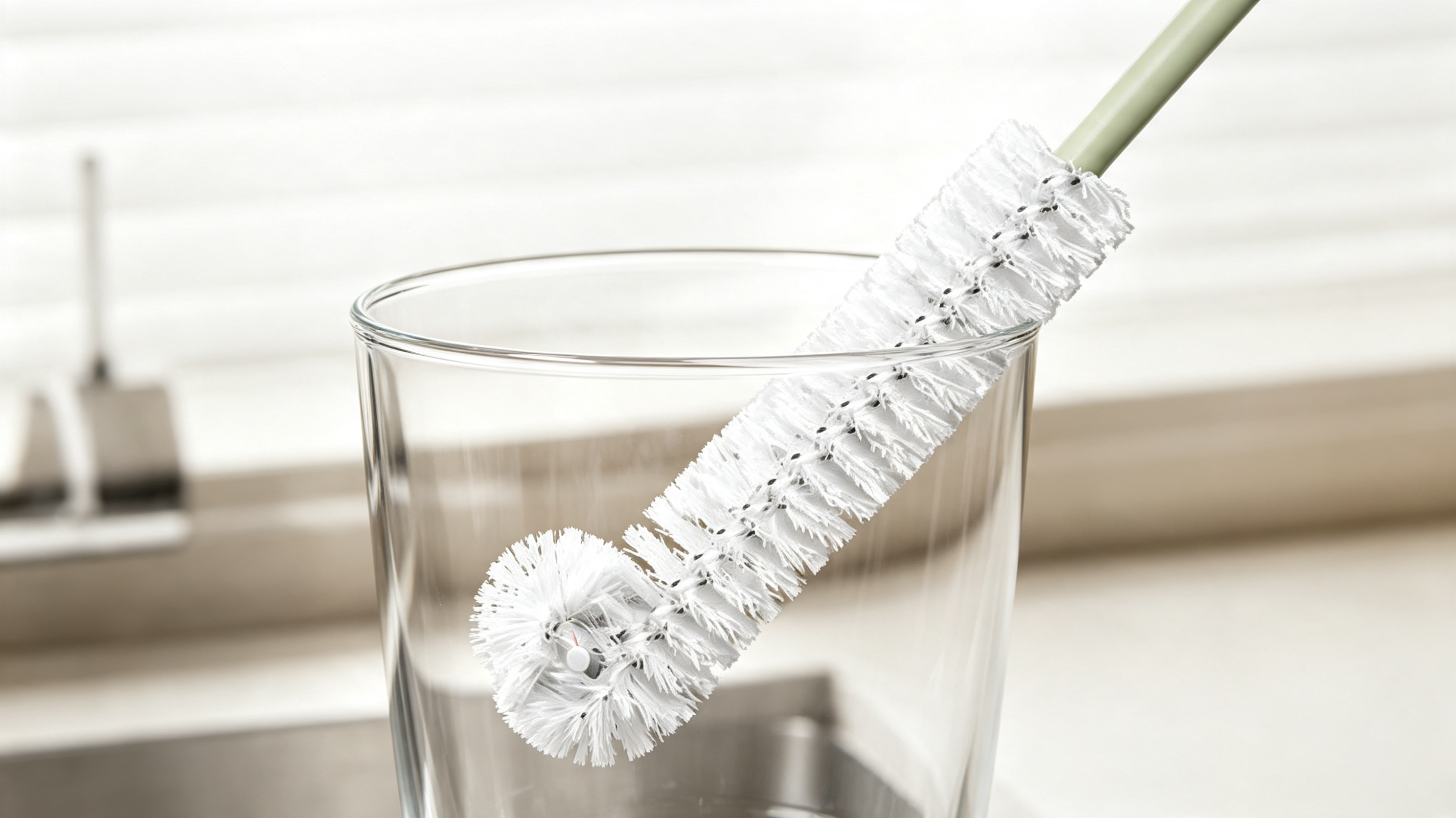
Sustainable consumption is changing the way everyday kitchen tools are evaluated. A few years ago, a cleaning brush could be sold almost entirely on color, price and basic function. In 2026, international buyers increasingly ask a broader set of questions: How long will the tool last? Can it be washed and dried properly? Can the worn part be replaced without discarding the whole handle? Is the packaging oversized? Is the recycled-content claim documented? Does the product really reduce waste, or does it only look “green” in marketing?
These questions are especially relevant to cup and bottle cleaning. Reusable water bottles, insulated tumblers, coffee cups, baby bottles and straw cups are designed to be used again and again. It is logical that the cleaning tool supporting them should also be designed for repeated use.
Our reusable cup cleaning brushes are developed around that principle. Instead of treating the brush as a disposable accessory, we focus on a durable handle, stable bristle retention, washable construction, easy drying, replaceable heads where appropriate, compact packaging and a clear maintenance cycle. OEM and ODM services allow buyers to customize material, length, head diameter, bristle stiffness, color, logo, drainage stand, replacement program and packaging for different markets.
However, “reusable” does not automatically mean “better for the environment.” A reusable brush still uses plastic, metal, elastomer, packaging and transport. Its environmental advantage depends on how long it actually lasts, how often it is used, whether unnecessary material is avoided and whether replacement parts extend useful life. Our approach is therefore based on measurable design decisions rather than an unsupported “100% eco-friendly” claim.
1. Reuse is becoming a central part of the international circular-economy agenda
The United Nations Environment Programme (UNEP) used World Environment Day 2025 to reinforce the #BeatPlasticPollution agenda and reported continuing work in dozens of countries to address plastic pollution across the full material life cycle. UNEP also launched the Plastic Reboot programme to help 15 countries move away from single-use plastic packaging and supported cities in Latin America in developing reuse programmes.
The direct subject here is mainly packaging, not cleaning brushes. But the policy direction is relevant: international sustainability strategies are moving from “dispose and recycle later” toward reducing unnecessary single use and building systems where products and materials remain useful longer.
A reusable cup brush fits this logic only if it is genuinely built to survive repeated cleaning cycles.
2. OECD: circularity means keeping material value in use for longer
The OECD describes a circular economy as one in which the value of materials is maximized and maintained for as long as possible, material inputs and consumption are minimized, waste generation is prevented and environmental impacts are reduced throughout the material life cycle.
This definition is important because it prevents a common marketing mistake. A brush is not circular merely because the word “reusable” appears on its packaging.
The product must retain useful value. That means a handle that does not crack prematurely, bristles that remain attached, a replaceable head that actually stays compatible, and a storage design that allows the brush to dry rather than deteriorate quickly.
3. The household cleaning-tools market already identifies reusable tools as a growth trend
The Business Research Company estimates that the global household cleaning tools and supplies market will grow from USD 19.77 billion in 2025 to USD 21.16 billion in 2026, with a forecast of USD 27.41 billion by 2030.
The report specifically identifies growing adoption of reusable cleaning tools and increasing demand for eco-friendly cleaning products among major forecast trends. Its cleaning-brush subsegments include bottle brushes and long-handled brushes, while its wipes category separately includes disposable cleaning wipes.
This is useful market context: reusable brushes and disposable wipes coexist in the same wider cleaning ecosystem, but they answer different tasks. For deep bottle cleaning, a durable brush can take over many repeated scrubbing tasks that would otherwise consume short-life wipes, improvised paper products or quickly discarded cleaning accessories.
4. Reusable bottles create a natural use case for reusable cleaning tools
Grand View Research estimates the global reusable water bottle market at USD 10.1 billion in 2025, USD 10.5 billion in 2026 and approximately USD 14.5 billion by 2033. The report connects market growth with environmental awareness and movement away from single-use plastic bottles.
Again, this is not a sales statistic for cup brushes. It describes the installed base of containers that need repeated cleaning.
If a consumer uses the same bottle hundreds of times, using a dedicated brush repeatedly can be more operationally logical than treating cleaning as a series of disposable actions. That creates a product opportunity for manufacturers that can build tools to match the same repeated-use mindset.
5. Sustainable consumers increasingly expect practical value, not sacrifice
GlobeScan’s 2025 Healthy & Sustainable Living research reports that self-reported sustainable purchasing continued to increase even as environmental concern softened in some markets. The research also highlights a shift toward framing sustainability through personal well-being, convenience and smarter living.
This is important for our product strategy. A consumer rarely buys a bottle brush because of climate policy alone. They buy it because it reaches the bottom, feels comfortable, cleans well, dries easily and can be used again.
The sustainability benefit becomes more credible when it is built into practical performance rather than added as a slogan after the product is finished.
6. European consumers show willingness to support more sustainable products
A European Commission Eurobarometer survey found that almost six in ten respondents were willing to pay more for sustainable products that are easier to repair, recyclable and/or produced in an environmentally sustainable way. The same survey found support for reducing waste and using reusable packaging.
A cup brush is not a repairable appliance, but the principle translates well to small household goods: durability, replaceable wear parts and less unnecessary packaging can be meaningful decision factors.
For European Private Label buyers, that makes a replaceable-head brush or a clearly documented recycled-content housing more credible than a generic “green product” badge.
7. Green claims are now under stronger scrutiny
The OECD warned in 2025 that growing interest in environmentally friendly products has been accompanied by concern about misleading and unsubstantiated green claims. Consumer-protection authorities in many countries are increasingly focused on greenwashing.
The EU has also strengthened rules intended to prevent consumers from being misled by broad environmental claims that cannot be substantiated.
For our OEM and ODM customers, this changes product language. We prefer statements such as “replaceable brush head reduces the mass of material discarded when the bristles wear out” or “housing contains X% recycled PP by documented mass” when evidence exists. We avoid “planet safe,” “zero impact” or “100% eco” without a defensible assessment.
8. Reusable does not mean zero waste
Every brush eventually wears. Bristles deform, the head loses performance, the handle can be damaged and a storage stand may need replacement.
The goal is therefore not to pretend there is no waste. The goal is to delay full-product disposal and reduce the amount of material discarded per cleaning cycle.
If the head is the wear component, making it replaceable may allow the handle to remain in service. If the head cannot be replaced safely, then improving whole-brush durability may be more sensible than adding a complicated connector simply for marketing.
9. The environmental benefit depends on actual use frequency
A reusable brush that is thrown away after three uses may provide little advantage over a short-life alternative. A brush used hundreds of times is a different case.
That is why product longevity matters. We can define cycle tests based on expected use rather than selecting an impressive number with no connection to reality.
For example, a daily-use household brush should be evaluated for repeated wetting, drying, twisting and detergent exposure. A café or hospitality version may need a much higher cycle target.
10. A durable handle is the foundation of reuse
The handle usually contains more material than the bristle head. If it cracks early, the entire product becomes waste.
We therefore evaluate resin grade, wall thickness, ribs, neck geometry and stress concentration around connection points. PP, ABS or other materials are selected according to stiffness, water exposure, impact behavior and the project’s sustainability goals.
Using less material is positive only until structural reliability begins to suffer. Lightweighting must be balanced with service life.
11. Replaceable heads can reduce discarded material
For many bottle brushes, the bristles wear faster than the handle. A replaceable-head architecture can allow the consumer to replace only the working part.
In ODM, we can design bayonet, threaded, snap-fit or push-lock connections. Each has trade-offs in cost, cleaning, assembly and durability.
The connector is cycle-tested because a replacement system that becomes loose after ten changes creates a new waste problem rather than solving one.
12. Replacement compatibility must remain stable
A replaceable head has environmental value only if the correct replacement remains available. Constantly changing the connector makes old handles obsolete.
We can establish a platform code so multiple product generations keep the same interface. A buyer can then launch Soft, Medium or Baby heads while maintaining one handle standard.
This also simplifies inventory for retailers and reduces the number of packaging formats required for replacement parts.
13. Modular design can support different cleaning scenarios
One reusable handle can potentially support a soft bottle head, a narrow detail head and a straw brush module. This creates functionality without requiring three full-size handles.
However, modularity should not be forced. If a joint traps water or is difficult to clean, a separate simple brush may be better.
Our ODM process evaluates the full use cycle: attach, scrub, detach, rinse, dry and store.
14. Bristle retention is a sustainability issue
If bristles shed quickly, the product has failed both functionally and environmentally. The user will replace it earlier and loose fibers become waste.
We can perform tuft pull-out tests, inspect wire retention where twisted-wire construction is used, and repeat checks after hot-water and detergent exposure.
For mass production, the approved specification is linked to the BOM so a change in bristle material or tufting process triggers review.
15. Bristle durability must not compromise surface safety
A stiffer bristle may last longer but can be too aggressive for coated drinkware. A very soft filament may be gentle but lose effective scrubbing contact.
Sustainable design is not simply “make it last forever.” It is “make it last while continuing to perform the intended task safely.”
We can develop Soft, Medium and Heavy-Duty variants and define compatible surfaces for each.
16. A soft reusable brush is useful for coated cups
Many premium mugs and bottles use internal finishes that should be cleaned with non-abrasive tools. A soft PBT or nylon brush can be engineered to reduce aggressive contact while still reaching deep walls and rounded bottoms.
But even soft bristles cannot guarantee universal scratch-free performance. Hard particles trapped in the brush can scratch a delicate surface.
We therefore recommend rinsing the brush, removing hard debris and following the drinkware manufacturer’s care instructions.
17. Repeated washing requires chemical compatibility
A reusable brush will contact dishwashing liquid, warm water and sometimes stronger cleaning agents many times.
The handle, elastomer grip, printed logo, adhesive, bristles and connector must remain stable. We can conduct immersion and repeated-use tests with the customer’s target detergent.
If a material swells, becomes brittle or loses color, it may shorten product life and undermine the sustainability claim.
18. Drying is part of product longevity
A wet brush stored in a closed cup or sealed box dries slowly. Repeated moisture can create odor, staining or poor user experience.
Our designs can include hanging holes, ventilated stands, drainage slots, raised contact points and removable drip trays.
These features do not make the brush antimicrobial. They simply support proper rinsing and drying, which is a more defensible and practical benefit.
19. The stand should not become another disposable accessory
A flimsy stand that cracks before the brush contradicts the reuse concept. The holder must be designed for wet weight, repeated insertion and cleaning.
We can test retention force, drainage, tip stability and material fatigue. If the buyer wants a wall-mounted holder, the adhesive or mounting method must also match the target surface.
Storage is treated as part of the product system, not decoration.
20. Recycled-content plastics can be considered, but documentation matters
For suitable non-food-contact structural parts, a buyer may request recycled PP or another recycled-content material. The exact percentage and suitability depend on technical and regulatory requirements.
We can work with documented recycled-content grades and compare color, odor, impact strength and dimensional consistency against virgin material.
We do not print a recycled-content percentage unless the supply chain can support it with appropriate documentation.
21. Recycled content is not automatically better for every component
A highly stressed connector may require a material performance level that a specific recycled grade cannot reliably deliver. If it breaks early, the product may be discarded sooner.
In that case, using recycled content in the handle shell or stand while maintaining a higher-performance resin in the critical connector can be a better design decision.
The environmental conversation should account for service life, not only material origin.
22. Mono-material design can simplify end-of-life handling
Many small household products combine multiple plastics, elastomers, metal wires and adhesives. This can make recycling more difficult.
Where possible, we can reduce unnecessary material combinations, use compatible polymer families or design parts for disassembly.
However, a bottle brush often genuinely requires different material properties for handle, grip and bristles. We therefore avoid claiming “fully recyclable” unless the actual local recycling pathway and product construction support that claim.
23. Packaging can undermine an otherwise reusable product
A reusable brush wrapped in a large rigid blister with multiple plastic inserts sends the wrong message and increases material use.
Depending on the sales channel, we can use paper card, paper box, reduced-plastic window packaging, belly band or e-commerce carton. The product still needs protection from bristle deformation and transport damage.
The right target is “minimum packaging consistent with safe delivery,” not simply the smallest possible box.
24. The EU packaging framework is becoming stricter
Regulation (EU) 2025/40 on Packaging and Packaging Waste entered into force in February 2025, with its general application date on 12 August 2026. The framework introduces a more harmonized approach to packaging waste prevention, recyclability, reuse and design across the EU.
A bottle brush is not regulated merely because it is reusable, but its retail and transport packaging falls within the wider packaging environment.
For EU-facing OEM projects, we can therefore optimize packaging materials, labeling space, pack size and documentation with the importer’s compliance team.
25. Durability claims should have a test method
“Long lasting” is stronger when the buyer can explain what was tested. We can define brushing cycles, bending cycles, head replacement cycles and detergent exposure.
The result can be communicated carefully: for example, “completed X cycles under internal test protocol Y” rather than “lasts for five years in every home.”
Real households use different detergents, water temperatures and forces, so service-life claims should always reflect test limits.
26. A reusable brush can replace some disposable wiping tasks, not every disposable product
A bottle brush is excellent for scrubbing internal walls, bottoms, corners and narrow necks. It does not replace a paper towel used to dry a countertop, a disinfectant wipe used under a specific hygiene protocol or every sponge used in a kitchen.
The credible value proposition is narrower: for repeated bottle and cup scrubbing, a washable brush can reduce reliance on disposable wipes, paper improvised into a bottle or low-durability accessories that are discarded frequently.
Specific substitution depends on the household’s previous behavior.
27. Cleaning performance must remain the first reason to buy
A consumer will not keep using an environmentally positioned brush if it performs poorly. Sustainability only works when the product solves the task.
The head must pass through the bottle neck, reach the bottom, flex into curved corners and provide enough contact to remove residue with suitable detergent.
That is why our design process begins with actual container dimensions and cleaning tasks.
28. Long handles help deep reusable bottles
Reusable bottles often have deep bodies that are difficult to reach with a normal dish sponge. A longer handle creates access without requiring the user to force a hand into the opening.
We balance overall length with handle stiffness and packaging volume. An excessively long handle can create unnecessary material and logistics cost.
OEM sizes can be optimized around the customer’s bottle family rather than using one length for every market.
29. Rounded heads improve contact at the bottle bottom
Many bottles have a curved transition between the wall and bottom. A flat-cut brush can miss this ring.
We can use radial bristles, longer end tufts or a domed head to improve contact. This is especially useful for tea residue, coffee films and milk-based drink deposits when combined with suitable detergent and water.
The brush provides mechanical action; it does not chemically dissolve residue on its own.
30. Separate lid and straw tools can extend the system
A reusable tumbler may contain a complex lid, silicone gasket, slider or straw. A large bottle brush cannot clean every narrow channel.
Our 3-in-1 system can combine a main brush, detail brush and straw brush. These small tools can share one storage dock or integrate into the main handle.
This adds function without turning each task into a separate full-size product.
31. OEM: customize a proven reusable platform
Our OEM service is suitable for reusable-bottle brands, coffee-accessory brands, baby-product brands, kitchen retailers, importers, supermarkets and marketplace sellers.
OEM options include:
handle length and profile;
brush-head diameter and shape;
PBT, nylon or flexible bristle options;
Soft, Medium and Heavy-Duty stiffness;
PP, ABS, TPE and selected recycled-content grades;
replaceable-head structure;
detail and straw brushes;
drainage stand or hanging system;
Pantone color;
printed, laser or molded logo;
single, multipack and refill packs;
paper-forward packaging;
multilingual instructions and recycling information.
32. ODM: start with a measurable waste-reduction opportunity
ODM should not begin with “make it look eco.” It should begin with a specific question: which part wears out first, and can the rest remain in use?
If the head wears first, we design a replaceable head. If packaging dominates unnecessary material, we redesign the pack. If the brush is discarded because it cannot dry, we redesign the stand. If bristles fail early, we improve retention and filament durability.
Each sustainability feature should solve a known product-life problem.
33. ODM can reduce part count
Sometimes a product contains decorative caps, extra sleeves or inserts that add material but little function. We can perform a part-by-part review.
If one molded feature can replace a separate component, the product can become simpler to assemble and easier to maintain.
Reducing parts also reduces tooling, assembly errors and inventory complexity, but structural integrity must remain the priority.
34. ODM can build a long-term refill program
For brands that want repeat business, replacement heads can be sold in two- or three-packs with minimal packaging.
The handle remains the durable core while the wear component becomes a lower-mass refill SKU. A compatibility code prevents the consumer from buying the wrong head.
This gives the retailer recurring sales without requiring a complete new brush every time.
35. OEM/ODM can support “design for disassembly”
If metal wire, bristles and plastic handle can be separated with reasonable effort, end-of-life handling may become easier in some markets.
But recyclability still depends on local collection and processing systems. We therefore distinguish “designed for disassembly” from the much stronger claim “recyclable everywhere.”
Accurate language is part of responsible product development.
36. Carbon claims require more evidence than material savings
A lighter product may use less resin, but that does not automatically prove a lower total carbon footprint. Manufacturing energy, material origin, transport, service life and replacement rate matter.
If a customer wants a carbon-reduction claim, a proper life-cycle assessment or verified methodology may be needed.
Without that evidence, we focus on directly measurable attributes such as weight reduction, recycled content, replacement mass and tested durability.
37. Overseas eco-conscious consumers also value convenience
GlobeScan’s 2025 research shows that well-being and convenience can be stronger motivators than environmental concern alone. That is a useful insight for product positioning.
A reusable brush should therefore be easy to rinse, easy to hang, easy to replace and easy to understand. Consumers should not need a complicated “sustainable ritual” to use it.
Practical sustainability is more likely to survive daily life.
38. Color coding can support household hygiene without adding disposable labels
Different colors can separate bottle, baby and coffee use. Instead of adding removable stickers that are immediately discarded, the color can be molded into the handle or replacement head.
OEM buyers can define a color system across several cleaning tools. The same platform can create Baby, Coffee and Sports variants without separate structural tooling.
39. Private Label can grow from one brush into a reusable-care family
A brand can begin with a bottle brush and later add replacement heads, straw brush, lid brush, microfiber cup cloth and drying stand.
Because our factory covers multiple cleaning-tool categories, the visual language, materials and packaging can remain consistent.
This allows the buyer to build a “reusable drinkware care” category rather than depending on a single SKU.
40. Online content should show lifetime logic, not only a green leaf icon
Product pages can explain what is replaceable, how the brush dries, which materials are used and how long the internal cycle test ran.
A simple diagram showing “keep handle, replace head” is more informative than a generic eco symbol.
Where recycled content is documented, the percentage can be shown accurately. Where it is not, the claim should not be invented.
41. Product testing: handle bending and torsion
Deep bottle cleaning creates bending and twisting loads. We can repeat these loads and inspect whitening, cracking and permanent deformation.
A durable handle reduces premature disposal and protects the value of the replaceable-head concept.
42. Product testing: bristle-retention and wear
We can measure tuft pull-out force or wire retention and compare the brush before and after repeated wet cycles.
We also examine flare, permanent bending and change in effective head diameter. Sustainability depends on maintaining function, not merely remaining physically intact.
43. Product testing: replacement-head cycles
A replaceable system may be attached and detached dozens of times during its life. We test the connection for retention force and looseness after repeated cycles.
If a latch fails early, the handle becomes useless. The connection is therefore one of the most important durability points.
44. Product testing: detergent and temperature exposure
The brush is exposed to dishwashing liquid and warm water repeatedly. Target detergent can be used in immersion or cycle testing.
We inspect resin deformation, TPE swelling, bristle stiffness, printing and connector performance.
45. Product testing: drying and odor-control design
We can compare hanging, open-stand and enclosed storage conditions under defined temperature and humidity.
We do not claim the product is permanently odor-free or antimicrobial. Instead, we measure drainage and drying behavior and design the structure to avoid unnecessary water retention.
46. Packaging testing remains necessary even when packaging is reduced
Less packaging is only better if the product still arrives undamaged. A crushed bristle head that must be discarded creates more waste.
We can conduct drop, carton compression and transport-vibration tests, then inspect recovery of brush shape.
The final pack balances protection and material efficiency.
47. What an international buyer should ask before making an eco claim
How many use cycles has the brush completed?
Which component is designed to be replaced?
How much material does the replacement head use versus the full brush?
Is recycled content documented by the material supplier?
Can components be separated?
Does the brush dry effectively after washing?
Does the packaging use more material than necessary?
Is the “reusable” claim supported by durability testing?
Is “recyclable” actually supported by local recycling pathways?
Are carbon claims backed by a valid methodology?
Do environmental statements comply with the target market’s consumer-protection rules?
48. Why this product can appeal to overseas sustainability-minded consumers
The strongest case is not “buy this brush to save the planet.” The stronger message is: buy a useful tool that is designed to stay in service, replace only the part that wears, maintain a reusable bottle properly and avoid unnecessary short-life cleaning accessories.
This aligns with the direction described by UNEP and OECD: keep material value in circulation longer and reduce unnecessary single-use consumption. It also matches GlobeScan’s consumer insight that sustainability is more compelling when connected to smarter, healthier and more convenient living.
49. What we can offer global brands
We can supply a standard reusable bottle brush or build a complete OEM/ODM programme. This can include a durable handle, replaceable Soft and Medium heads, straw brush, lid brush, drainage stand, recycled-content housing where technically appropriate, color coding, logo, Private Label box and refill packs.
We can also create test specifications, lot traceability, component codes and replacement compatibility so the product remains manageable after launch.
50. Sustainability becomes a product-engineering discipline
For a small kitchen brush, sustainability may sound like a big concept. In practice, it becomes a series of engineering decisions: use the right amount of material, make the handle strong, keep the bristles attached, allow the head to be replaced, avoid trapping water, reduce unnecessary packaging and communicate claims accurately.
These choices are measurable, repeatable and useful to the consumer.
Conclusion
In 2026, sustainable consumption is influencing household cleaning in a more mature way. UNEP continues to promote reuse and life-cycle solutions in its fight against plastic pollution. The OECD defines circularity around extending material value, reducing inputs and preventing waste. European Commission consumer research shows substantial willingness to support more sustainable products, while GlobeScan reports continued growth in self-reported sustainable purchasing. The Business Research Company also identifies rising adoption of reusable cleaning tools as a key market trend.
For a cup cleaning brush, the opportunity is clear but should be communicated carefully. A reusable brush can reduce reliance on disposable or short-life cleaning supplies in repeated bottle-cleaning tasks, but it is not impact-free. Its value depends on durability, actual reuse, appropriate materials, replaceable wear parts, drying, packaging and responsible end-of-life design.
Our company turns these principles into practical OEM and ODM options. We can customize handle length, brush diameter, PBT or nylon bristles, stiffness, head shape, PP/ABS/TPE components, selected documented recycled-content grades, replaceable heads, drainage stands, lid and straw brushes, Pantone colors, logos, Private Label packaging and refill packs.
We also support durability testing, bristle-retention testing, head-replacement cycles, detergent and temperature compatibility, drying assessment, packaging tests and batch control. For buyers that need sustainability communication, we can provide the technical data needed to support specific, measurable product claims while avoiding broad greenwashing language.
The result is not simply a “green bottle brush.” It is a cleaning system designed to stay useful for longer, maintain reusable drinkware more effectively and give international consumers a practical alternative to repeated short-life cleaning accessories.
reusable cup cleaning brush · reusable bottle brush · sustainable bottle cleaning brush · eco-conscious cup brush · long lasting bottle brush · replaceable head bottle brush · refillable brush head system · long handle cup brush · soft bottle cleaning brush · PBT bottle brush · nylon bottle brush · recycled plastic brush handle · low waste cleaning tool · durable kitchen cleaning tool · reusable kitchen brush · tumbler cleaning brush · thermos bottle brush · coffee cup cleaning brush · baby bottle cleaning brush · straw cleaning brush · lid detail cleaning brush · drainage stand bottle brush · hanging bottle brush · modular cleaning brush · OEM bottle brush · ODM bottle brush · OEM cup cleaning brush · ODM cup cleaning brush · Private Label bottle brush · custom replaceable brush head · custom brush stiffness · custom brush length · custom brush color · custom eco packaging · recycled content cleaning tool · bottle brush durability test · bristle retention test · sustainable kitchenware brand · eco household products importer · bottle brush manufacturer



