


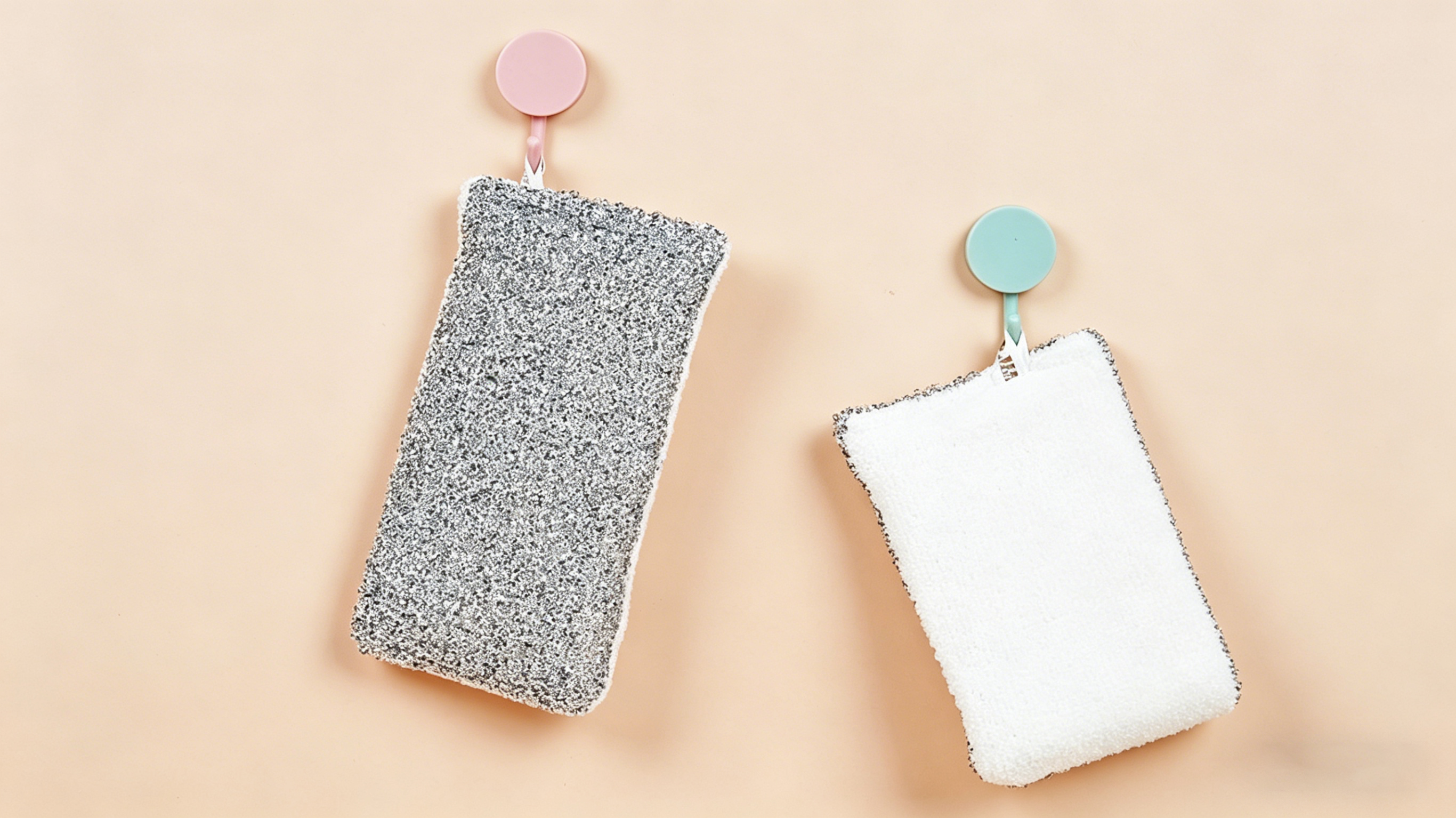
Kitchen cleaning rarely involves only one kind of mess. A breakfast plate may need nothing more than a soft wipe with warm water and dishwashing liquid. A glass may only have fingerprints and moisture. A sink edge can collect light grease and water marks. A stainless-steel pot, however, may carry dried sauce or burnt residue that a soft cloth alone cannot remove efficiently. Traditionally, households often keep several tools beside the sink: a soft cloth, a foam sponge, a non-scratch scrub pad, and sometimes a separate metal scourer.
The two-in-one composite dishwashing sponge is designed to simplify that arrangement. One face uses a soft fiber cloth for daily wiping, water pick-up and detergent-assisted grease removal. The opposite face uses a steel scrubbing layer for heavier residue on cookware and surfaces that are actually compatible with metal abrasion. Between them, a resilient sponge core can provide water retention, hand comfort and pressure distribution.
The commercial value is not that one sponge magically replaces every kitchen-cleaning tool. It does not. Delicate non-stick cookware, coated sinks, painted surfaces, soft metals and high-gloss finishes may require a non-abrasive tool. The real value is that two common cleaning intensities can be placed in one compact item: a soft daily-cleaning surface and a heavy-duty scrubbing surface. In a small kitchen, that can reduce the number of separate items stored around the sink while still giving the user a clear choice of cleaning strength.
There is no official global statistic showing that this exact soft-cloth-plus-steel dual-sided sponge has captured a specific share of compact kitchens. We therefore do not invent one. Instead, we combine current sponge and scouring-pad market data, household cleaning trends, apartment-living statistics and hygiene research to explain why a space-saving dual-purpose format has strong commercial logic in 2026.
1. The sponge and scouring-pad market continues to expand
Grand View Research, in a report updated in 2026, estimates the global sponge and scouring pads market at about USD 5.8 billion in 2026 and projects approximately USD 6.5 billion by 2030, representing a 2.8% compound annual growth rate from 2025 to 2030.
The segment structure is especially relevant to a dual-sided product. Grand View Research reports that heavy-duty products accounted for 34.5% of 2024 revenue, steel was the largest raw-material segment at 60.4%, and kitchen utensils were the largest application. The residential end-use segment is expected to grow at the fastest rate over the forecast period. This does not prove the sales growth of our exact sponge, but it confirms that both everyday household cleaning and heavy-duty scrubbing are meaningful parts of a growing category.
The Business Research Company provides a broader view. It estimates the global household cleaning tools and supplies market at USD 21.16 billion in 2026, with multifunctional cleaning products, reusable tools, ergonomic design and online distribution among the major trends. A two-sided kitchen sponge fits that direction because it consolidates two mechanical cleaning functions into one inexpensive, easy-to-store consumable.
2. Why two different cleaning faces are more practical than one “medium” surface
A single medium-abrasion surface always represents a compromise. If it is too rough, it can be unnecessarily harsh for ordinary dishes. If it is too soft, users need excessive pressure on burnt residue. A dual-sided construction separates these functions physically.
The soft face can handle fresh food residue, moisture, tableware and light oily films when combined with an appropriate detergent. The steel face can concentrate mechanical force against stubborn deposits on approved, scratch-resistant surfaces. Users can turn the same sponge over rather than search for another tool.
This is an important design principle: the two faces should not merely look different. Their friction, texture, flexibility and intended use must be genuinely distinct.
3. The soft fiber side: water management first
Soft fiber cloth has three main jobs. First, it can pick up and spread water over a surface. Second, it can distribute dishwashing liquid across a plate, cup or countertop. Third, its fiber structure helps lift loose particles and fresh oily residue during wiping.
We are careful with the phrase “oil removal.” A cloth does not chemically dissolve grease on its own. In most kitchen situations, grease removal depends on a combination of detergent chemistry, warm water, contact time and mechanical wiping. The soft face provides the mechanical component and helps the cleaning solution remain in contact with the soil.
OEM options may include polyester textile, microfiber-type fabric, fine woven cloth or other compatible soft materials. Density, pile height, texture and edge finishing change how the surface feels and how quickly it rinses.
4. The steel side: concentrated force for stubborn residue
Steel scrubbing works through localized mechanical pressure. Loops and contact points in the metal structure attack dried and burnt residue more aggressively than a soft fabric. On suitable cookware, this can reduce the number of repetitive strokes needed after food has been softened with water or detergent.
Grand View Research identifies steel as the leading raw material in the scouring-pad market, with a 60.4% revenue share in 2024, reflecting its established role in heavy cleaning. The same report notes the importance of heavy-duty pads in kitchens and food-service environments.
However, “strong cleaning” should not be confused with “safe for every surface.” The steel side is a specialized tool inside the sponge, not a universal face.
5. The critical limitation: do not use the steel side on delicate coatings
Non-stick pans are the clearest example. A metal scourer can scratch or remove a coating, shortening cookware life and creating a poor customer experience. The same caution may apply to decorative sink coatings, painted metal, polished finishes, some enamel, soft aluminum and other sensitive materials.
The packaging should therefore give a clear warning: use the steel side only on surfaces approved for metal scrubbing. For non-stick, coated or delicate items, use the soft side or another tool specifically approved by the cookware manufacturer.
Even the soft side is not automatically scratch-proof. If sand, metal fragments or hard food particles become trapped in the cloth, they can scratch a sensitive surface. For premium cookware, a test on an inconspicuous area remains sensible.
6. Why compact kitchens benefit from functional consolidation
Eurostat’s Housing in Europe 2025 publication shows that 48% of the EU population lived in flats in 2024. In cities, the figure rose to 73%. The EU averaged 2.3 people per household and 1.7 rooms per person. Around 17% of the population lived in overcrowded housing.
These statistics do not directly measure kitchen cabinet size or sponge purchasing behavior. But they show that apartment living and limited residential space are common realities, particularly in cities. In a compact kitchen, sink edges, under-sink cabinets and countertop organizers must accommodate many products in a small footprint.
A two-in-one sponge cannot create more kitchen space, but it can reduce one small category of duplication. Instead of keeping a soft cloth and a separate metal scourer for common tasks, one composite item can cover both functions when used correctly.
7. Housing affordability makes storage efficiency more relevant
The OECD continues to identify housing affordability as a major challenge across many countries. It reports that real house prices have risen substantially over the past decade across the OECD, while many low-income renters are heavily burdened by housing costs.
Housing affordability statistics do not prove demand for a particular cleaning sponge. The relevant inference is broader: when households live in smaller or more expensive urban spaces, products that use storage efficiently can become more attractive.
This is why compact household products often compete not only on unit price, but on how neatly they fit into existing routines and storage systems.
8. One item near the sink can reduce visual and physical clutter
Small-kitchen organization is often about reducing the number of wet objects sitting beside the sink. Separate cloths and metal scourers can overlap, drip and become difficult to distinguish. A single dual-sided sponge creates a more defined object: one soft face, one heavy-duty face, one storage position.
For OEM projects we can add a hanging loop, integrated label, color-coded edge or small ventilated holder. A well-designed holder should allow both sides to drain and should not trap the sponge flat against a wet wall.
9. The sponge core determines hand comfort
The inner sponge is more than filler. It controls thickness, compressibility, water retention and how pressure reaches the two working faces. A very soft core feels comfortable but may collapse under the pressure required for heavy scrubbing. A very dense core improves support but can feel tiring during long dishwashing sessions.
Key parameters include density, cell structure, thickness, rebound and compression set. An open-cell structure can improve rinsing and drying, while an excessively thick core may hold water for longer.
We can offer compact cores for multipacks or thicker premium versions for customers who prioritize hand comfort.
10. Steel-wire specification should be engineered, not chosen by appearance
The metal face can be tuned through wire material, wire diameter, loop size, knitting density and edge construction. Finer wire generally feels less aggressive but may deform sooner. Thicker wire increases mechanical strength and cleaning aggression but also increases the risk of surface damage.
Customers may specify stainless steel or another agreed metal grade. The actual alloy must match the claim. A shiny appearance alone does not prove corrosion resistance.
ODM projects can develop Soft, Medium and Heavy versions using different scrubbing materials while maintaining the same overall brand design.
11. Bonding is often the hidden failure point
Composite sponges can fail long before the materials themselves wear out. The soft cloth may peel from the core, or the steel mesh may separate after repeated soaking, bending and squeezing.
Depending on the design, we may use lamination, adhesive bonding, mechanical wrapping, stitching or a combined structure. The chosen process must withstand water, detergent, compression and repeated flexing.
A premium-looking sample means little if the layers begin separating after a week. We therefore evaluate bond durability after wet conditioning and repeated use simulation.
12. Edge reinforcement matters because hands contact the edge constantly
Users usually grip the sponge around its edge. If the steel layer ends with exposed sharp wire, the product becomes uncomfortable or unsafe. The edge can be wrapped, folded, stitched or recessed so that the user mainly contacts the soft core and fabric.
Rounded corners also reduce snagging. An ergonomic waist shape can improve grip for smaller hands while still leaving enough surface area for cleaning.
13. Wire shedding requires its own quality test
A metal scrubber should not release loose wire fragments into the sink or onto cookware. Wire ends, knit integrity and anchoring must therefore be checked after abrasion and repeated compression.
Our quality program can include rubbing the steel face against a defined test surface for a set number of cycles, then inspecting for loose pieces, broken loops and exposed sharp ends.
This is especially important for private-label buyers because consumer complaints about a single loose wire can damage trust in the entire kitchen range.
14. Corrosion resistance must match real kitchen chemistry
Steel cleaning material is repeatedly exposed to water, salt, acidic food residues and dishwashing liquid. Some households also use stronger cleaners. The metal should therefore be tested under the conditions expected in the target market.
Tests may include soak-and-dry cycles, detergent exposure, salt solution and visual inspection for rust or discoloration. If a customer intends to market the sponge for use with chlorine-based or strongly acidic products, compatibility requires separate evaluation.
15. Daily scenario: breakfast dishes
For cups, glasses and plates with fresh residue, the soft side should be the default. Warm water and an appropriate dishwashing liquid loosen food and oil. The cloth distributes the liquid and wipes the surface without introducing unnecessary metal abrasion.
This reduces wear on everyday tableware and keeps the steel side available for the tasks where it actually adds value.
16. Heavy scenario: burnt residue on suitable stainless-steel cookware
For a pot with dried or burnt residue, first soaking the cookware can reduce the required scrubbing force. After the deposit softens, the steel side can be used if the cookware manufacturer allows metal scouring.
Users should avoid assuming that “stainless steel” always means any abrasion is acceptable. Brushed, mirror-polished and decorative finishes can show visible scratch patterns. A small test is advisable.
17. Sink cleaning requires material-specific judgment
A conventional stainless-steel sink may tolerate stronger mechanical cleaning depending on its finish and manufacturer guidance. A black coated sink, composite sink, PVD finish or decorative metal basin may not.
For daily wiping, the soft face is the safer starting point. Heavy mineral scale may require a compatible chemical product rather than stronger mechanical abrasion.
18. Stove and oven cleaning: soil level and surface type are different questions
A burnt food deposit can be extremely stubborn, but that does not automatically mean the underlying surface accepts steel. Some oven racks and metal grates are suitable for aggressive scrubbing; glass, enamel or coated trays may require another method.
Our packaging can separate these decisions with two simple questions: “How difficult is the soil?” and “What does the surface manufacturer allow?”
19. Kitchen sponge hygiene must be part of the product story
A kitchen sponge is a reusable consumable that repeatedly contacts water, food residues and surfaces. Scientific Reports published a microbiome study involving 14 used household kitchen sponges and found extensive bacterial colonization in used sponge material. The researchers emphasized that the hygienic relevance of used sponges deserves attention and suggested regular replacement rather than relying indefinitely on sanitation methods.
The study is useful but has limitations. It was a small observational sample and does not prove that every kitchen sponge poses the same health risk. We therefore use it to support practical hygiene instructions, not fear-based marketing.
20. USDA FSIS: sponges are difficult to clean completely
The U.S. Department of Agriculture’s Food Safety and Inspection Service states that kitchen sponges can be potential sources of bacteria and can be difficult to clean. FSIS notes that microwaving or boiling may reduce some bacterial load but does not guarantee prevention of cross-contamination.
That supports a simple product policy: rinse thoroughly, squeeze out excess water, allow the sponge to dry in a ventilated position and replace it when worn, damaged, malodorous or according to the household’s chosen hygiene schedule.
For brands, multipacks are therefore not merely a value offer. They also make timely replacement easier because a fresh sponge is already available.
21. CDC: cleaning and disinfection are not the same thing
The U.S. Centers for Disease Control and Prevention explains that in most household situations, cleaning with soap, water and mechanical scrubbing can remove most germs, dirt and impurities. Disinfection is a separate process and is particularly relevant when someone is sick or at higher risk.
Our dual-sided sponge is a mechanical cleaning tool. It does not disinfect a surface by itself. When a food-contact or high-risk surface requires sanitizing or disinfecting, the appropriate product and label instructions should be followed.
22. Drying design can reduce the time the sponge stays wet
A dense sponge left flat in a wet sink dries slowly. A hanging loop, ventilated rack or raised holder exposes more surface to air and allows gravity drainage.
OEM buyers can specify a loop in the soft textile edge or purchase the sponge with a compact holder. The holder should not create another large accessory that defeats the space-saving purpose.
We do not claim that faster drainage makes the product permanently odor-free or mold-proof. It simply improves the conditions for drying when combined with proper rinsing and replacement.
23. Multipacks fit both household use and retail economics
A dual-sided sponge is a consumable. Offering packs of four, six, eight or ten units allows households to replace worn products without buying a completely different tool. It also supports color coding by task.
For example, one color can be reserved for dishes, another for the sink and another for utility cleaning. Color coding does not sterilize the product, but it can reduce accidental mixing of tasks.
24. Online retail is a natural channel for a visually simple product
The U.S. Census Bureau estimated seasonally adjusted retail e-commerce sales of USD 326.7 billion in the first quarter of 2026. Online shopping is therefore a major retail channel where small household consumables can be sold in multipacks with low explanation costs.
A twenty-second product video can show the soft side removing fresh grease with detergent, the steel side removing softened burnt residue from a suitable metal surface, rinsing, squeezing and hanging. The most important visual is the distinction between the two faces.
The video should also show the surface limitation. Demonstrating the steel side on a non-stick pan would communicate the wrong behavior.
25. OEM: fast private-label development
Our OEM service is designed for importers, supermarket chains, household-goods brands, kitchenware suppliers, cleaning wholesalers, online sellers and private-label programs.
Customizable options include:
overall length, width and thickness;
rectangular, oval, ergonomic-waist or custom geometry;
foam core density and cell structure;
soft polyester, microfiber-type or other textile face;
soft-face texture, pile and color;
steel wire material and diameter;
steel knit density and loop size;
scrubbing stiffness;
bonding or lamination method;
reinforced edges and rounded corners;
hanging loop;
single-color or multi-color task coding;
2-pack, 4-pack, 6-pack, 8-pack, 10-pack and bulk B2B packs;
paper band, pouch, retail box or display carton;
printed, sticker or molded branding;
barcode, QR code and batch traceability;
English, German, French, Spanish, Italian, Arabic and other packaging languages.
26. ODM: build the cleaning intensity around the target cookware
ODM is appropriate when a customer wants more than a color change. We begin by identifying the cookware and surfaces in the target market. A brand focused on stainless-steel cookware may want a denser metal structure. A brand selling premium non-stick cookware may prefer a polymer scrubber instead of steel.
We can build a three-level family: Soft, using cloth plus non-abrasive material; Medium, using cloth plus polymer scouring mesh; and Heavy, using cloth plus steel. The exterior dimensions and branding remain related while the scrubbing intensity changes.
For small apartments, we can optimize thickness and pack count to fit narrow drawers or under-sink organizers. For restaurants, we can enlarge the size and reinforce bonding for more frequent use.
27. Surface-scratch testing
Scratch risk should be tested on surfaces agreed with the buyer. The soft and steel sides are evaluated separately. Visual inspection can be combined with gloss or surface measurements when required.
A steel face that scratches non-stick coating must never be marketed as non-scratch. A soft face can be described as suitable only within the tested limits and with clean pads free of hard debris.
28. Layer-peel and wet-aging tests
Samples are soaked in water or agreed dishwashing solution, squeezed repeatedly and flexed. We then inspect whether textile or steel separates from the core.
For larger ODM projects, peel strength can be quantified with a defined test method. The numerical threshold should be agreed before production and verified on production-equivalent samples.
29. Abrasion and wire-shedding tests
The steel side is rubbed through a defined number of cycles. We then inspect for broken loops, loose wire and sharp exposed ends. The soft side is checked for pilling, fiber loss and edge fraying.
These tests help predict whether the sponge will remain structurally acceptable during its intended service period.
30. Compression and rebound testing for the sponge core
The core is repeatedly compressed to simulate squeezing during dishwashing. After the cycle, we measure thickness recovery and check for permanent collapse.
A good core should recover enough to maintain grip and allow both working faces to contact the surface evenly.
31. Packaging for compact-kitchen consumers
Space-saving positioning should continue into the package. A large rigid box would contradict the product concept. Paper bands, slim pouches or compact cartons can hold multipacks while keeping the product visible.
The front can explain the two functions. The back should include surface warnings, rinsing, drying and replacement instructions. For e-commerce, the packaging must also withstand compression so the steel layer does not deform or puncture adjacent items.
32. A realistic small-kitchen storage example
Consider an under-sink organizer that already contains dishwashing liquid, dishwasher tablets, trash bags and a sink brush. Storing three separate wet cleaning items can create clutter. Replacing a soft sponge plus a separate steel scourer with one dual-sided sponge removes one object from that area.
The space saved is small in absolute terms, and we do not claim a universal percentage. But compact kitchens are built from many such small efficiencies. If the product also hangs vertically, the countertop can remain clearer and the sponge can drain more effectively.
33. What this product should not promise
It should not promise to replace every cleaner, every brush or every scrubber. It should not claim that steel is safe on every pot. It should not claim permanent antibacterial performance without testing and regulatory support. It should not promise that the soft cloth removes grease without detergent in all cases.
Credible marketing is more specific: two cleaning intensities, one compact body; soft fiber for routine wiping and water pick-up; steel for approved heavy-duty surfaces; rinse, drain, dry and replace regularly.
34. Buyer checklist
Which cookware and sink materials are the target?
Is steel truly needed, or would polymer scouring be safer?
What wire material and diameter are specified?
How aggressive should the heavy-duty face be?
What textile is used on the soft side?
How fast does the core drain and dry?
Does the bonding survive repeated wet squeezing?
Are loose metal ends controlled after abrasion?
Is there a clear non-stick warning?
What size fits the target consumer’s hand?
How many pieces belong in the multipack?
Can different colors be assigned to different tasks?
What chemical compatibility tests have been completed?
What storage or hanging method is supplied?
What quality records support the marketing claims?
Conclusion
The rise of two-in-one kitchen cleaning products in 2026 is not about adding functions for the sake of novelty. It is about placing two genuinely different cleaning levels into one compact consumable.
Grand View Research estimates that the global sponge and scouring pads market will reach about USD 5.8 billion in 2026 and approximately USD 6.5 billion by 2030. Heavy-duty products accounted for 34.5% of revenue in 2024, steel represented 60.4% of raw-material revenue, kitchen utensils were the largest application and the residential segment is expected to grow at the fastest rate. These figures show why a product that combines a daily soft-cleaning face with a heavy-duty steel face has a clear market foundation.
Eurostat shows that apartment living is a major part of urban Europe: 73% of city residents lived in flats in 2024. OECD data also shows continuing housing-cost pressure. Those statistics do not directly measure kitchen storage, but they support a practical design inference: compact, multifunctional household products make sense where space is valuable.
The product still needs discipline. The steel side must be reserved for surfaces that tolerate metal abrasion. The soft side works with water, detergent and mechanical wiping for routine cleaning. The sponge must rinse, drain and dry well. Scientific Reports and USDA FSIS both reinforce the importance of treating kitchen sponges as hygienically relevant consumables that require regular care and replacement.
Our company supports complete OEM and ODM development. We can customize the soft textile, sponge core, wire material, wire diameter, scrubbing density, size, thickness, shape, colors, bonding method, reinforced edge, hanging loop, multipack, branding and multilingual packaging. We can also define scratch, peel, wire-shedding, corrosion, chemical-compatibility, abrasion, compression and transport tests for international private-label programs.
For the household, the proposition is simple: one face for light everyday mess, one face for tough residue on appropriate surfaces, and one compact item to store beside the sink. For brands and importers, it is a scalable cleaning consumable with clear visual differentiation, repeat-purchase logic and substantial OEM/ODM flexibility.
two-in-one dishwashing sponge · dual-sided kitchen sponge · soft cloth steel scrubber sponge · fiber cloth dish sponge · steel scrubber dish sponge · grease cleaning sponge · burnt residue cleaning sponge · pot cleaning sponge · pan cleaning sponge · sink cleaning sponge · kitchen utensil scrubber · heavy duty dish sponge · soft side dish sponge · steel side scrubber · compact kitchen cleaning tool · space saving kitchen sponge · small apartment kitchen sponge · multifunctional dish sponge · quick dry kitchen sponge · open cell kitchen sponge · reinforced edge dish sponge · durable steel scrubber · hanging kitchen sponge · color coded dish sponge · dish sponge OEM · dish sponge ODM · private label kitchen sponge · custom sponge size · custom sponge thickness · custom sponge density · custom steel wire scrubber · custom sponge color · custom sponge multipack · custom sponge packaging · sponge layer peel test · steel wire shedding test · surface scratch test sponge · kitchenware importer · cleaning supplies wholesaler · kitchen sponge manufacturer



