


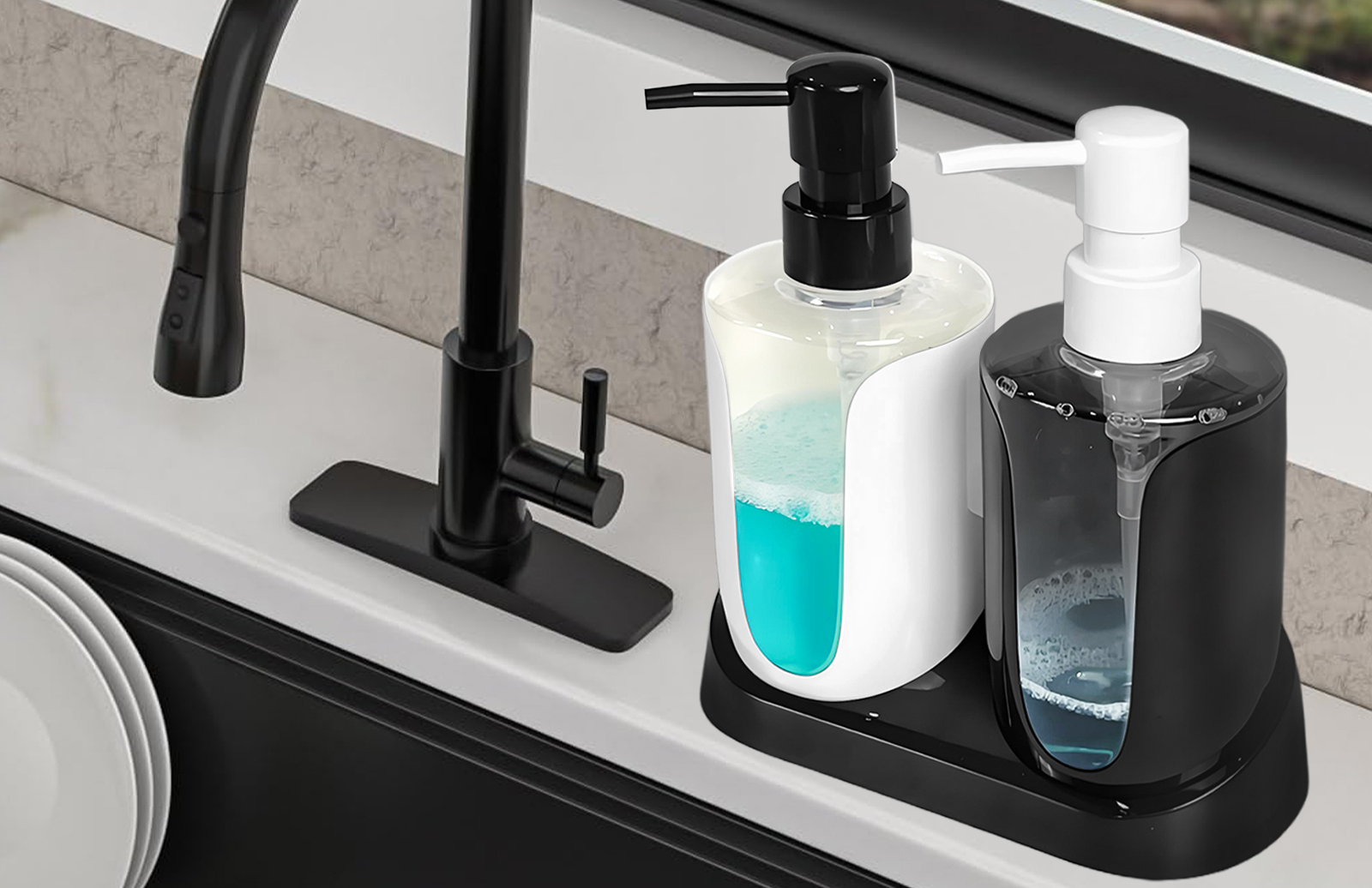
In 2026, international buyers are no longer evaluating a commercial soap dispenser only by its factory price. A distributor in Europe, a hotel supplier in the Middle East, a marketplace seller in North America and a cleaning-products importer in Southeast Asia all face the same wider question: how much does the product cost after packaging, international transport, customs processing, regional storage, last-mile delivery, returns and spare-parts support are included? For a relatively low-value but high-volume washroom accessory, logistics can decide whether a product remains competitive after it crosses a border.
This is where a well-designed manual soap dispenser has a structural advantage. Compared with a functionally equivalent sensor model, it can use a simpler bill of materials, eliminate the motor and sensor compartment, avoid battery-related accessory space, reduce the number of damage-sensitive components and support more compact packaging. These benefits do not mean that every manual dispenser is automatically smaller or cheaper to ship. The advantage appears only when the housing, inner bottle, pump, mounting kit and carton are engineered as one logistics system. Our company develops that system for commercial projects and supports both OEM and ODM customization.
No international organization currently publishes a worldwide “penetration rate” specifically for manual commercial soap dispensers. It would therefore be misleading to invent a percentage. The more defensible conclusion is that the conditions supporting multi-region distribution are strengthening: cross-border e-commerce volumes remain historically high, international air cargo reached a record level in 2025, trade between developing economies expanded faster than the global average, and hygiene infrastructure still requires broad investment. When a product is compact, robust, easy to localize and inexpensive to replenish in small lots, it is better positioned to convert those macro conditions into regional shelf presence.
1. What the 2025–2026 international data actually tells buyers
Cross-border parcels are growing, but the network is fragmented
The Universal Postal Union, the United Nations specialized agency for the postal sector, stated in its State of the Postal Sector 2025 that cross-border e-commerce volumes had never been higher. At the same time, the UPU warned that the network carrying those flows had fragmented into a costly patchwork of parallel systems and that international parcel growth was concentrated in a limited number of regions. This combination matters. Demand exists, but sellers cannot assume that one carrier, one warehouse or one packaging format will work equally well everywhere.
For a manual soap dispenser supplier, the practical response is not to wait for a perfectly unified network. It is to build a product that can move through postal parcels, express networks, consolidated air freight, less-than-container-load ocean freight and regional distributor routes without requiring a different core structure for each channel. A compact manual platform makes that flexibility easier. A buyer can test a new market with cartons rather than a full container, replenish a fast-moving region by air and move stable base demand by sea.
Air cargo and cross-border B2C flows remained resilient
The International Air Transport Association reported in January 2026 that global air cargo demand reached a record volume in 2025. Full-year cargo tonne-kilometres increased 3.4% from 2024, while international operations increased 4.2%. IATA also showed that growth was uneven across corridors. That is an important detail: the opportunity is not simply “more air freight,” but the ability to redirect inventory toward corridors where demand and capacity are available.
DHL Group’s 2025 annual reporting stated that its eCommerce division recorded volumes above the prior-year level in nearly all markets and experienced particularly strong cross-border B2C volume growth. DHL’s 2025 shopper research covered 24,000 online shoppers across 24 markets and again emphasized that delivery choice, reliability and sustainability influence conversion. A commercial dispenser may often be purchased B2B, yet the same logistics expectations now shape marketplace sellers, small distributors and professional buyers: delivery must be predictable, tracking must be clear, and the landed price must remain understandable.
Trade is expanding across more than the traditional routes
UN Trade and Development reported that global trade expanded by about USD 500 billion in the first half of 2025. Its December update also found that South–South trade—trade between developing economies—grew by around 8% over the previous four quarters, faster than the global average. This supports a multi-region strategy that goes beyond Europe and North America. Demand can also be developed through the Gulf region, Southeast Asia, Latin America and selected African markets, especially where hospitality, food service, offices, schools, factories and public facilities need standardized washroom equipment.
However, UNCTAD also warned that tariffs, complex regulation, logistics bottlenecks and restructuring supply chains were raising the cost and unpredictability of trade. The lesson is straightforward: a supplier cannot control every tariff or route disruption, but it can control product weight, carton volume, damage rate, documentation quality and the number of spare parts required after delivery. Manual dispensers are attractive because those controllable factors can be optimized aggressively without sacrificing the basic function of delivering soap reliably.
2. Why manual soap dispensers can achieve a lower logistics cost
Chargeable weight rewards compact engineering
International parcel carriers do not always charge only by scale weight. UPS states that dimensional weight may apply to domestic and international package services and that the billable weight is determined by comparing actual and dimensional weight. FedEx explains that right-sizing packaging can reduce costs, and its international dimensional-weight guidance commonly uses length × width × height divided by 5,000 when dimensions are measured in centimetres. DHL Express also commonly uses a 5,000 divisor for volumetric weight, although every shipper must confirm the current contract and route rules.
This pricing method creates a direct commercial reason to reduce empty space. Consider an illustrative comparison, not a quotation or guaranteed specification. Assume that a manual dispenser can be packed in a 13 × 10 × 22 cm retail carton with a gross weight of 0.48 kg. Its dimensional weight at a 5,000 divisor is 0.572 kg. Assume that a sensor model of similar reservoir capacity needs a 16 × 12 × 25 cm carton and weighs 0.78 kg. Its dimensional weight is 0.96 kg. Before carrier rounding and route-specific rules, 500 units represent approximately 286 kg of dimensional weight for the manual version versus 480 kg for the sensor version—a difference of about 194 kg, or 40%. The exact result must be recalculated with approved samples, final cartons and the buyer’s carrier contract, but the mechanism is real: every unnecessary centimetre can become billable weight.
The same principle applies to bulk transport. DHL Global Forwarding explains that air freight compares gross and volumetric weight, while less-than-container-load ocean freight is heavily influenced by cubic volume. In a full container, the buyer pays for the container, but a smaller unit carton still increases the number of saleable units loaded. Better cube utilization lowers freight cost per unit, reduces warehouse space per unit and makes regional transfers less expensive.
A simpler bill of materials reduces both weight and failure exposure
A manual dispenser typically requires a housing, reservoir, mechanical pump, spring or lever components, seals, mounting hardware and a lock where needed. A sensor dispenser adds an infrared or capacitive sensing system, circuit board, wiring, motor or actuator, battery compartment or power interface and additional protection against moisture. Those components can be valuable where touch-free operation is essential, but they also occupy space and create more interfaces that must survive vibration, drop events, humidity and long-distance handling.
Removing electronics does more than reduce grams. It can permit a shallower housing, a simpler inner tray, fewer protective inserts and a more rectangular carton. Rectangular, stackable packages use master-carton space more efficiently than irregular packages. For high-volume distributors, the improvement repeats through every stage: more units per export carton, more cartons per pallet, more units per cubic metre, fewer pallet positions in the destination warehouse and lower last-mile space consumption.
Manual products also avoid electronic dead-on-arrival cases caused by damaged boards, disconnected wires or depleted bundled batteries. This does not mean manual dispensers never fail. Pumps can leak, springs can fatigue and unsuitable soap can clog a nozzle. The difference is that the likely fault is usually concentrated in a low-cost mechanical module. When we design a removable pump and inner bottle, the distributor can ship a small spare part instead of returning or replacing the complete dispenser. That reduction in reverse logistics is often more valuable than the initial outbound freight saving.
Small-parcel replenishment becomes commercially practical
Cross-border expansion rarely starts with a full container in every country. A new distributor may want 48, 96 or 240 units to test demand. A marketplace operator may need weekly replenishment to several fulfilment centres. A hotel project may require an urgent top-up after the main sea shipment. A compact manual dispenser makes these mixed logistics models more economical because the order is less likely to be penalized by dimensional weight.
This supports a “base plus replenishment” strategy. Stable demand moves by ocean or rail where available; launch quantities and urgent shortages move by air or express; local spare pumps and bottles move as low-cost parcels. Buyers gain the confidence to enter more regions because they are not forced to hold excessive safety stock. This is one reason we describe multi-region penetration as a steady operational trend rather than a single global percentage: the product can be introduced market by market in manageable increments.
3. How compact manual dispensers support multi-region stock deployment
Europe: packaging efficiency becomes a compliance issue as well as a cost issue
The European Union’s Packaging and Packaging Waste Regulation entered into force in February 2025 and begins to apply from 12 August 2026. The European Commission states that the rules aim to minimize packaging and packaging waste, reduce primary raw-material use and support a circular economy. For importers, oversized cartons and unnecessary plastic inserts are therefore not only expensive; they are increasingly inconsistent with the direction of regulation and retailer sustainability requirements.
Our OEM and ODM projects can use right-sized cartons, recyclable paper-based cushioning where technically suitable, clear material identification and packaging data prepared for the customer’s compliance workflow. We can also design a common product platform with country-specific labels and instructions added late in the packing process. This reduces the risk of holding large quantities of the wrong language version and makes it easier to redistribute stock between European markets.
North America: dimensional pricing makes every carton decision visible
UPS and FedEx publicly explain dimensional-weight pricing because parcel networks must manage both aircraft or vehicle weight and available cubic space. For an importer selling through marketplaces, janitorial suppliers or direct e-commerce, a small change in the retail carton can alter fulfilment fees and customer delivery cost. A manual dispenser designed for parcel commerce should therefore be measured at the concept stage, not after the mould has been completed.
We can work backward from a target shipping tier. Housing depth, bottle shape, lever projection, mounting-kit placement and protective inserts can be adjusted to remove unused volume. Where the product architecture permits it, the inner bottle or pump can be packed in a protected cavity within the housing. The objective is not simply the smallest carton; it is the smallest carton that still passes the agreed drop, vibration and compression requirements. Under-packaging creates damage and returns, which are more expensive than a few saved cubic centimetres.
Middle East, Asia-Pacific, Latin America and Africa: modularity lowers entry risk
Regional distributors often serve hotels, restaurants, factories, schools, shopping centres and government projects with different preferences for capacity, colour and locking method. A fully unique product for each market would fragment production and raise minimum order quantities. A modular manual platform solves this by keeping the main housing and mounting geometry stable while changing selected modules: 500 ml, 800 ml or 1,000 ml bottle; liquid or foam pump; clear or narrow viewing window; key lock or concealed latch; white, black, grey or customized housing.
This approach lets a customer test several regions without financing several completely separate mould sets. It also simplifies after-sales support because many spare parts remain common. For developing markets, common pumps and bottles are especially important. The World Bank describes trade facilitation and logistics as the work of making goods move faster, cheaper and more predictably. Predictability does not end at customs clearance; it includes the ability to restore a dispenser quickly when a pump is damaged or lost.
The World Customs Organization’s cross-border e-commerce framework emphasizes advance electronic data and data quality for risk management. Therefore, multi-region expansion also requires disciplined product records: consistent SKU names, accurate material descriptions, country of origin, unit value, carton quantity, gross and net weight, dimensions, barcode and product images. Our OEM/ODM service can align packaging artwork and product coding with the buyer’s data structure, reducing mismatches between the physical carton, commercial invoice and marketplace listing.
4. Product engineering that preserves the freight advantage in real use
Compactness must not weaken durability
A low freight cost has no value if dispensers arrive cracked or fail after installation. We therefore balance wall thickness, internal ribs and material selection rather than simply removing plastic. Depending on the project, the housing can use ABS or another suitable engineering polymer, while the reservoir can use a chemically compatible material such as PP or HDPE. Metal covers can also be developed where the target environment requires a premium appearance or higher resistance to abuse.
Verification can include dimensional inspection, pump-cycle testing, leakage testing, wall-mount pull testing, lock testing, filled-bottle storage at agreed temperatures, carton drop testing and master-carton compression evaluation. When a customer provides the actual soap, we can test viscosity compatibility, dosage stability and leakage after repeated operation. A compact carton is approved only after it protects the product under the agreed transport conditions.
The pump should be treated as a replaceable service module
The pump controls user experience, soap consumption and maintenance frequency. A dosage that is too small causes repeated presses; a dosage that is too large wastes soap and leaves residue. Liquid soap, foam soap and gel require different flow paths and valve structures. We therefore do not recommend choosing a pump only by appearance or headline output.
For OEM/ODM development, the customer can specify the product type, viscosity range, target dose, expected daily cycles and cleaning method. We then select or develop a compatible module and define acceptance criteria. A removable pump reduces the cost of warranty support because a replacement module is light, compact and easy to send internationally. We can also include a calculated spare-pump ratio in each shipment so the regional distributor can solve common service cases without waiting for a new import order.
Removable inner bottles reduce reverse logistics
A removable bottle can be cleaned, replaced or changed for a different formulation without discarding the outer housing. For commercial sites, this shortens service time. For distributors, it creates a practical spare-parts business and lowers the number of complete units returned. The bottle can be designed with rounded internal transitions, a wide neck and a clear level-control area to make inspection and filling easier.
There is an important boundary. In healthcare or other high-risk infection-control zones, a sealed cartridge system may be preferred under the facility’s protocol. A refillable manual dispenser should never be marketed as universally suitable for every clinical application. Our platform can be adapted for different refill concepts, but final selection must follow local regulations and the customer’s infection-control requirements.
5. OEM and ODM customization for profitable global distribution
OEM: faster market entry with controlled localization
OEM is suitable when the customer wants a proven core product under its own brand. We can customize logo application, colour, surface texture, bottle capacity, pump type, dosage, viewing window, lock, mounting accessories, instruction language, barcode, retail carton and master-carton marking. Because the core structure remains stable, development time and tooling investment are lower than for a fully new product.
For cross-border stock, we recommend separating universal and regional elements. The housing, bottle and pump can remain common, while labels, manuals, barcodes and outer cartons are produced in smaller regional batches. This postponement strategy reduces obsolete inventory. A customer can move universal components to the market with the strongest demand and finalize the local packaging closer to shipment.
ODM: design the product around a logistics target
ODM is appropriate when the buyer needs a unique shape, a specific wall-hole pattern, a proprietary refill, an unusual capacity or a carton optimized for a marketplace shipping tier. We begin with the operating and logistics brief: target markets, transport modes, order quantities, target unit weight, maximum carton dimensions, pallet pattern, soap type, daily usage, installation environment and expected service life.
The engineering process can include industrial design, 3D structure, prototype evaluation, design-for-manufacture review, packaging simulation, pilot tooling, functional testing and trial production. A logistics-focused ODM project asks questions early: Can two housings nest safely? Can the lever be protected without a thick foam insert? Can the mounting kit fit inside the body? Can one master carton serve both retail and project orders? Can common spare pumps support all regional variants? These decisions determine the landed cost long before the first commercial shipment.
Quality documentation protects the landed-cost calculation
Global buyers need consistency between quotation, sample and mass production. We can agree on material specifications, critical dimensions, visual standards, dosage tolerance, leakage criteria, cycle-test requirements, packaging dimensions, gross-weight limits and AQL inspection. Carton data should be measured from production samples rather than estimated from a drawing because a few millimetres across thousands of units can change pallet or container utilization.
We can also support customer-specific inspection reports, barcode verification, packing lists, spare-parts schedules and multilingual user instructions. Exact certification requirements depend on the product configuration and destination market, so they should be confirmed before tooling and packaging approval. Clear documentation reduces customs questions, listing errors, warehouse receiving discrepancies and the expensive rework that occurs when a region receives the wrong version.
6. A practical landed-cost model for procurement teams
To compare manual and sensor dispensers fairly, procurement teams should calculate more than the purchase price. A useful landed-cost model includes ex-factory price, unit packaging, export carton volume, gross weight, origin transport, international freight, customs duty and tax, brokerage, destination handling, warehouse space, pick-and-pack cost, last-mile delivery, expected damage, return rate, replacement parts and service labour.
The manual model often gains advantage in four places. First, a smaller and lighter package can reduce chargeable weight. Second, mechanical construction can lower transit damage and dead-on-arrival risk. Third, inexpensive spare pumps and bottles can replace complete-unit returns. Fourth, the absence of sensors, motors and routine batteries can reduce long-term service inventory. The buyer should insert its own data rather than rely on a generic percentage.
A pilot shipment provides the most reliable evidence. We recommend measuring ten approved production samples, confirming retail and master-carton dimensions, requesting carrier quotations for the target lanes, running drop and vibration tests, and recording installation and service time at a trial site. The resulting cost per installed and functioning dispenser is the number that should guide the purchase decision.
Conclusion: logistics-efficient design turns a simple dispenser into a global product
The 2026 opportunity is not based on a claim that manual dispensers will replace every sensor product. Touch-free systems remain appropriate in many premium and high-control environments. The opportunity comes from matching the product to the route and use case. UPU data shows historically high but fragmented cross-border e-commerce flows; IATA recorded record air cargo demand; UNCTAD identified growth in both global and South–South trade; DHL reported strong cross-border B2C volumes; and EU packaging rules are pushing the market toward less wasteful packaging. Together, these signals favour products that are compact, durable, easy to document and economical to replenish.
Our manual soap dispensers are developed around those requirements. Through OEM and ODM services, we can customize the housing, removable bottle, pump, dosage, capacity, lock, viewing window, colour, logo, mounting system, packaging and spare-parts plan. More importantly, we can design these elements together so that customization does not destroy the freight advantage. For importers, distributors, hotel suppliers, cleaning-product brands and project contractors, the result is a product that can enter one region in a small test shipment, scale through consolidated freight and maintain service through lightweight spare modules.
The next step for a serious project is to replace assumptions with measured data. Provide the target markets, annual quantity, preferred capacity, soap type, packaging channel and maximum carton requirements. We can then prepare a product and packaging proposal that allows the buyer to compare unit price, chargeable weight, container utilization and expected service cost on the same sheet. That is how a manual dispenser becomes not merely a lower-priced item, but a more controllable global distribution asset.
commercial manual soap dispenser · cross-border soap dispenser supplier · small-parcel soap dispenser · compact soap dispenser packaging · wall-mounted manual soap dispenser · refillable soap dispenser · removable inner bottle dispenser · liquid soap dispenser · foam soap dispenser · gel soap dispenser · 500 ml soap dispenser · 800 ml soap dispenser · 1000 ml soap dispenser · ABS soap dispenser · stainless steel soap dispenser · leak-resistant soap pump · replaceable pump module · adjustable soap dosage · lockable soap dispenser · soap level viewing window · hotel soap dispenser · restaurant soap dispenser · office washroom dispenser · school soap dispenser · factory washroom dispenser · shopping mall soap dispenser · airport soap dispenser · public restroom dispenser · janitorial supply distributor · hospitality supply wholesaler · commercial hygiene importer · cross-border e-commerce seller · soap dispenser OEM · soap dispenser ODM · private-label soap dispenser · custom logo soap dispenser · custom color soap dispenser · custom packaging service · soap pump compatibility testing · bulk soap dispenser manufacturer



