


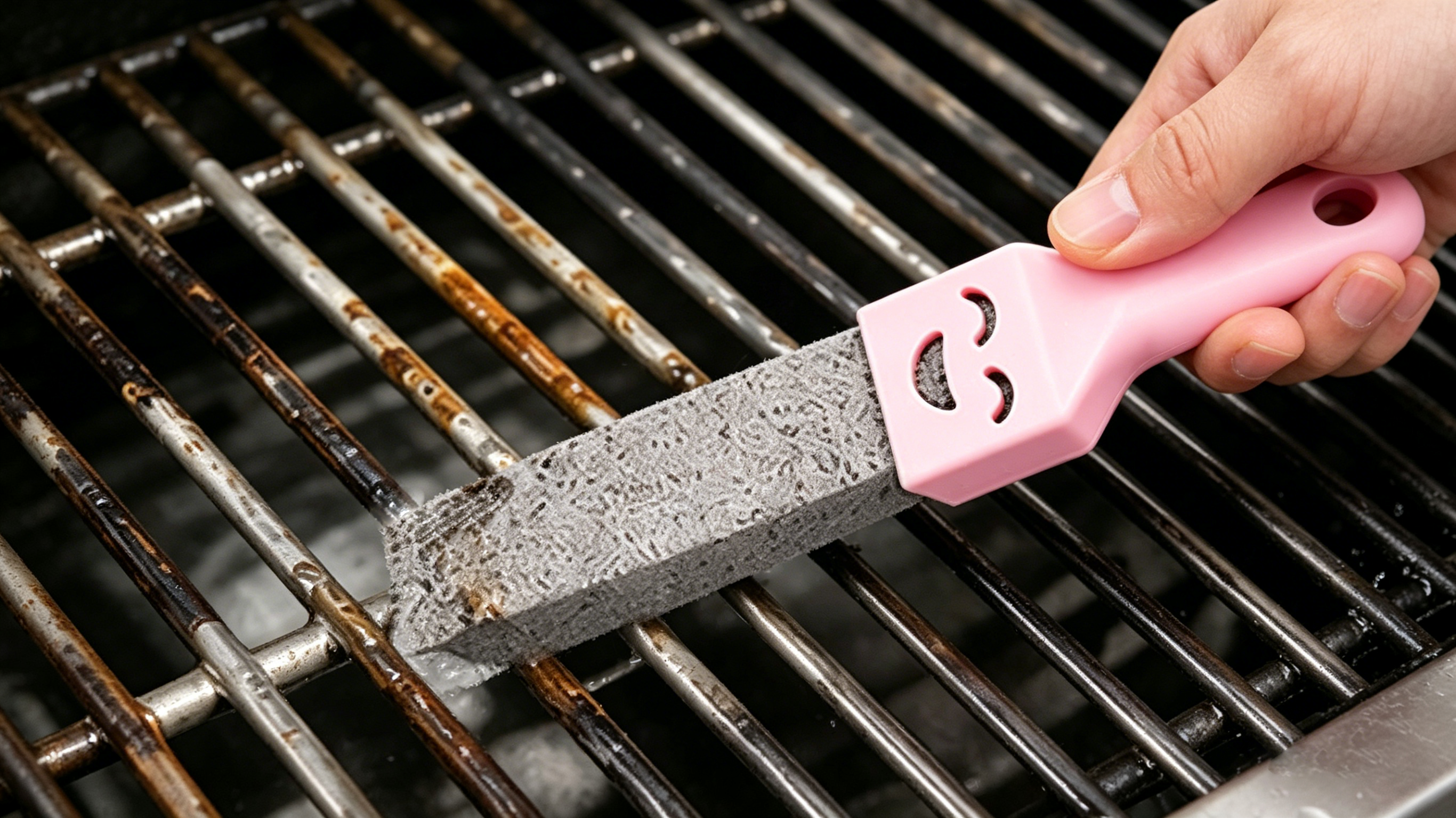
In 2026, the stainless steel stain-removal magic stick became one of the fastest-growing products in our Cleaning tools line. Across our sales channels, sample requests, B2B discussions, marketplace projects, kitchen cleaning product development, and OEM/ODM inquiries, this product series recorded an 85% year-over-year growth signal. This figure reflects the growth observed in our own commercial channels, not a public global market statistic. The reason for the strong demand is simple: consumers want a practical tool that can physically remove black carbon scale, burnt pot-bottom residue, light rust marks, scorched stains, and stubborn kitchen deposits without immediately reaching for strong chemical cleaners.
Our stainless steel stain-removal magic stick is designed for real kitchen pain points. The bottom of a pot turns black after repeated heating. A stainless steel pan develops burnt-on marks after high-temperature cooking. A gas-stove support, grill rack, wok base, iron pan, stainless steel sink edge, or metal kitchen tool may develop rust-like stains, carbon buildup, or brown scorch marks. Many users try to solve these problems with liquid cleaners, soaking agents, powders, or harsh degreasers. Sometimes those products work, but they may be messy, strongly scented, difficult to rinse, or unsuitable for households that prefer simpler physical cleaning. Our product offers another route: targeted mechanical friction.
Why kitchen users are looking for chemical-light cleaning tools
Modern consumers are more aware of what they use inside the home. They want effective cleaning, but they also want fewer strong odors, fewer complicated chemical steps, and less unnecessary residue around cookware. The U.S. Environmental Protection Agency’s Safer Choice program helps consumers and businesses find cleaning and other products that perform while using ingredients safer for human health and the environment. This does not mean every kitchen task can be completed without any cleaning agent, but it does show a clear direction: buyers increasingly prefer safer, simpler, more transparent cleaning choices.
The stainless steel magic stick fits this direction because it starts with physical action rather than chemical strength. For many daily cases, users can begin with water and controlled friction. For more stubborn stains, they can pair the tool with mild soap, warm water, or a suitable non-corrosive cleaner. The key value is choice: instead of immediately using a harsh chemical cleaner, the user can try mechanical removal first. This is especially attractive for pot bottoms, cookware exteriors, grill racks, and metal kitchen surfaces where the problem is often carbonized residue, burnt food film, or surface oxidation.
Cleaning is not only chemistry: friction matters
The Centers for Disease Control and Prevention explains that cleaning is done with water, soap, and scrubbing, and that cleaning removes germs, dirt, and impurities from surfaces. This is important because it reminds consumers that mechanical action is part of real cleaning. A cleaner sitting on the surface is not always enough. Scrubbing pressure, contact area, texture, and repeated movement often determine whether residue actually lifts away.
Our product is built around that principle. The stainless steel magic stick gives users a focused contact point and a stronger friction feel than a soft sponge or cloth. When used correctly on suitable hard metal surfaces, it can help loosen black scale, rust marks, and scorched residues. It is not a disinfectant and it is not a medical product. It is a physical cleaning tool for visible dirt and stubborn deposits. That positioning is honest, practical, and easy for customers to understand.
The market for household cleaning tools continues to grow
The Business Research Company describes household cleaning tools and supplies as essential products used to keep homes clean, hygienic, and organized, and notes that major companies in the category focus on products that improve cleaning efficiency, convenience, and hygiene. The broader household cleaning products market is also expected to grow from USD 134.5 billion in 2025 to USD 147.44 billion in 2026, according to The Business Research Company. These figures support the reality that consumers are still investing in better home cleaning solutions.
For our product, this trend matters because cookware cleaning is a daily, visible, and frustrating household task. A dirty pot bottom is not hidden. It is seen when cooking, washing, storing, or taking photos for social content. A burnt pan looks old even when it still works well. A gas-stove rack with carbon stains makes the whole kitchen look less clean. Therefore, a small tool that helps restore the appearance of metal cookware has strong emotional value: the user feels the kitchen is cleaner, the cookware looks newer, and the product pays for itself by extending the usable appearance of existing items.
Why black pot-bottom scale is so hard to remove
Black pot-bottom scale forms because heat, oil, food residue, carbonized particles, flame contact, and repeated cooking cycles combine on the exterior surface of cookware. The longer the residue stays, the harder it becomes. Ordinary dish soap may remove fresh oil, but it often cannot remove old carbonized buildup. A soft sponge may glide over the stain without breaking it. A cloth may absorb grease but fail to cut through the hard layer. That is why consumers become frustrated and look for stronger tools.
The stainless steel magic stick addresses this problem through surface friction. It concentrates rubbing force on the stained area and allows the user to work gradually. The user can wet the target area, soften the residue, scrub in a controlled direction, rinse, and repeat. This process is simple, visible, and satisfying. The stain does not disappear because of a marketing claim; it lifts because mechanical contact breaks down the surface layer little by little.
Rust marks and scorched stains need targeted treatment
Rust-like marks and scorched stains are common around kitchen metal surfaces. A pot bottom may develop brown spots after long-term use. A metal rack may show rust marks after repeated washing and poor drying. A stainless steel sink area may show mineral deposits, oxidation-like marks, or darkened corners. A grill plate may develop burnt-on layers from oil and food. These stains are visually strong and often make the product look neglected.
Our magic stick helps users target these marks directly. Unlike a large sponge, it can focus pressure on small areas. Unlike a liquid cleaner, it gives tactile feedback: the user can feel whether the stain is loosening. This is useful for household kitchens, restaurants, camping cookware, outdoor grills, stainless steel sink edges, gas-stove supports, iron pans, and other hard kitchen items. However, users should always understand the surface first. The product is best for uncoated stainless steel, iron, and suitable hard metal surfaces. It should not be used on nonstick coatings, enamel, painted surfaces, polished mirror-finish decorative surfaces, soft plastic, or delicate items unless the user first tests an inconspicuous area.
No strong chemical cleaner does not mean no care
The phrase “no chemical cleaner needed” is powerful, but it must be explained responsibly. For many daily stains, water plus physical friction may be enough. For heavier deposits, warm water, dish soap, baking soda, or a suitable mild cleaner may help. The product reduces dependence on strong chemical cleaners in many common cases, but it does not mean every stain in every kitchen can be removed with no liquid, no soaking, and no effort.
This honest explanation makes the product more credible. Consumers dislike exaggerated promises. They want a tool that works in real life. Our recommendation is simple: start with the gentlest method. Wet the surface, scrub slowly, rinse, check the result, and repeat if needed. For old carbon deposits, let warm water soften the area first. For rust-like stains, use controlled pressure and avoid spreading the stain to delicate areas. For coated cookware, do not use abrasive tools on the coating. Good instructions protect the product reputation and reduce returns.
Why stainless steel material matters
Stainless steel is valued in cleaning tools because it is durable, corrosion-resistant under normal use, strong enough for repeated friction, and easy to rinse. A stainless steel stain-removal stick can be used repeatedly without collapsing like a soft sponge. It does not quickly become soaked and swollen. It does not require complicated preparation. It can be stored in a kitchen cleaning kit, near the sink, with grill tools, or inside a household cleaning drawer.
For B2B buyers, the material story is also important. Stainless steel communicates durability and professional cleaning power. When shown in product photos or videos, it looks more serious than a disposable sponge. It fits kitchen cleaning, cookware maintenance, grill cleaning, outdoor cooking, and heavy-duty household cleaning categories. In OEM/ODM projects, we can adjust size, handle design, edge shape, surface texture, packaging, logo, and bundle sets to match different markets and price levels.
Real kitchen scenarios: where the product performs best
The strongest use case is the exterior bottom of stainless steel pots and pans. This area is exposed to flame, oil, heat, and carbon buildup. Users often ignore it until the bottom becomes completely black. A second strong use case is iron cookware and wok exteriors, where dark marks and rust-like spots appear with repeated use. A third use case is gas-stove supports and metal racks, which collect burnt oil and food residue. A fourth use case is stainless steel sink corners, drain edges, and metal kitchen tools with stubborn marks.
These scenarios all share one feature: the surface is hard, durable, and already exposed to heavy kitchen use. That is where a physical friction tool makes sense. The product is not meant for soft coatings or delicate decorative finishes. It is meant for the hard cleaning jobs that ordinary cloths and soft sponges cannot handle well. This clear positioning is one reason customers understand the value quickly.
Professional cleaning trend: practical tools win
Interclean’s 2026 Trend Report focuses on professional cleaning in practice and emphasizes that innovation succeeds when it works in real daily operations. This matters for a kitchen cleaning tool because a product cannot rely only on a beautiful package. It must help the user remove visible dirt faster, with less confusion and more control. In professional kitchens, canteens, hotels, family kitchens, BBQ setups, and cleaning service kits, practical tools are valued because they reduce time and frustration.
Our stainless steel magic stick is a practical tool, not a complicated device. It does not need batteries, charging, app pairing, replacement liquid cartridges, or special installation. It works through hand pressure and repeated movement. That simplicity makes it suitable for households, restaurants, street-food stalls, catering kitchens, hotels, outdoor barbecue users, dorm kitchens, and marketplace buyers. The learning curve is low, and the effect can be demonstrated immediately.
Why this product is highly suitable for e-commerce
DHL’s 2026 E-Commerce Trends Report surveyed 29,000 online shoppers and 5,800 e-commerce businesses across 29 countries. In this environment, products that can show a clear before-and-after result have a strong advantage. The stainless steel magic stick is perfect for visual selling. A product video can show a blackened pot bottom, wet the area, scrub with the stick, rinse, and reveal a cleaner metal surface. The customer understands the value in seconds.
For Amazon, TikTok Shop, AliExpress, Shopee, Lazada, Shopify, Walmart Marketplace, kitchenware stores, barbecue accessory shops, and cleaning-tool brands, this product has excellent demonstration power. Sellers can create content around burnt pot bottoms, rusty grill racks, scorched pan exteriors, gas-stove supports, and stainless steel sink marks. The product is small, lightweight, easy to ship, easy to bundle, and easy to explain. That makes it a strong e-commerce SKU.
Live commerce: before-and-after cleaning is made for video
McKinsey reports that live commerce can generate conversion rates up to ten times higher than conventional e-commerce in certain contexts. A stainless steel stain-removal stick fits live commerce especially well because the host can show the cleaning process in real time. The stain is visible, the scrubbing action is visible, and the result is visible. This creates trust faster than a static product description.
A live-selling script can be very simple: show an old pot bottom, compare it with a soft sponge, explain why ordinary soap is not enough for carbonized stains, use the magic stick with water, rinse the surface, and show the improvement. Then explain suitable surfaces, warning surfaces, OEM/ODM options, bundle packs, and daily use instructions. This kind of product does not need an abstract story. The proof is in the demonstration.
Safety and surface compatibility must be explained clearly
A strong cleaning tool must come with clear usage guidance. The stainless steel magic stick should be used on suitable hard surfaces, not on all surfaces. It is suitable for many uncoated stainless steel exteriors, iron cookware, pot bottoms, stove racks, grill racks, and durable metal kitchen surfaces. It should not be used on nonstick coating, ceramic nonstick coating, enamel coating, painted surfaces, soft plastic, glass cooktops, polished decorative finishes, or surfaces where scratches would be unacceptable. Users should always test a small hidden area first.
This warning is not a weakness. It protects the customer and the brand. A product that removes black scale through friction must be honest about abrasion. Buyers appreciate clear instructions. For OEM/ODM clients, we can print simple warning icons on packaging: “for hard metal surfaces,” “do not use on nonstick coating,” “test first,” “use with water,” “rinse after use,” and “keep away from children.” Clear communication reduces misuse and improves reviews.
OEM customization: make the product fit your brand
Our company supports full OEM customization for stainless steel stain-removal magic sticks. We can customize product size, shape, thickness, grip design, surface texture, handle material, hanging hole, logo, color accents, packaging box, blister card, instruction sheet, barcode, multi-language labels, private label, supermarket packaging, e-commerce packaging, and bundle sets. The product can be sold as a single stick, two-pack, kitchen heavy-duty set, grill cleaning set, cookware care set, or cleaning-tool gift pack.
Different channels need different positioning. For Amazon, the package should focus on before-and-after photos and surface compatibility. For TikTok Shop, the video must show black stain removal. For supermarkets, the packaging should explain the benefit in three seconds: “remove burnt pot-bottom stains,” “physical friction,” “water-use first,” “for hard metal surfaces.” For restaurant supply channels, durability and bulk packaging matter. OEM helps turn a simple cleaning tool into a brand-ready product.
ODM development: build a complete kitchen cleaning line
ODM allows deeper development beyond logo printing. We can develop a stainless steel magic stick for pot bottoms, a smaller detail-cleaning stick for sink corners, a larger grill-cleaning bar, a handled version for heavy-duty use, a soft-grip version for households, a hanging version for retail display, or a full kitchen-cleaning kit with scrubber, cloth, brush, and scraper. Each version can target a different customer group.
The development should start from the cleaning scenario. Pot bottoms need focused friction. Grill racks need strength and reach. Sink corners need a smaller head. Household users need easy grip and clear instructions. Professional kitchens need durability and bulk supply. E-commerce needs visible before-and-after proof. ODM helps clients build a product line instead of selling only one generic scrubber.
Quality control: abrasion, durability, edge finish, and packaging
Quality control is critical because customers judge the product by both performance and safety. If the tool is too weak, it will not remove stains. If it is too rough or badly finished, it may damage surfaces or feel unsafe. If edges are sharp, users may worry about handling. If packaging does not explain suitable surfaces, misuse may happen. If batches are inconsistent, reviews will suffer.
We control material quality, stainless steel grade selection according to customer requirements, surface texture, edge smoothness, grip feel, product size, rust resistance under normal use, cleaning performance, packaging strength, instruction clarity, barcode placement, logo printing, carton packing, and batch consistency. For B2B buyers, one good sample is not enough. Every production batch must match the approved sample. Stable quality protects repeat orders and marketplace ratings.
How consumers should use the product
For best results, the user should first confirm that the target surface is suitable. Wet the stained area with water. If the stain is old, let warm water soften it for a short time. Rub the area with controlled pressure. Avoid pressing too hard at the beginning. Rinse the surface and check the progress. Repeat as needed. After cleaning, rinse both the cookware and the cleaning stick, then dry them. For cookware that will contact food, rinse thoroughly before use.
Users should not use the tool on coated cookware interiors. They should not use it on nonstick surfaces. They should not mix unknown chemical cleaners with strong friction tools. They should keep the product away from children and store it dry. These instructions are simple but important. A strong tool becomes a better product when customers know how to use it correctly.
Why buyers should launch this product in 2026
The 85% growth signal in our internal channels shows that buyers are responding strongly to kitchen tools that solve visible, stubborn cleaning problems. The Business Research Company supports the broader growth of household cleaning tools and household cleaning products. CDC reinforces that scrubbing is part of cleaning. EPA’s Safer Choice program reflects consumer interest in safer and more transparent cleaning choices. Interclean points to practical tools that work in real operations. DHL and McKinsey show why visible, demonstrable products can perform well in e-commerce and live commerce.
Our stainless steel stain-removal magic stick combines these trends in one compact product: physical friction, no immediate need for harsh chemical cleaners in many everyday cases, strong before-and-after visual impact, suitability for pot bottoms and hard metal kitchen surfaces, easy shipping, easy bundling, and full OEM/ODM customization. In 2026, consumers are not only buying a scrubber. They are buying a way to make old cookware look usable again, reduce kitchen frustration, and clean stubborn stains with a simple physical tool. That is exactly the value our product delivers.
stainless steel stain removal magic stick, stainless steel cleaning stick, pot bottom cleaner, burnt pan cleaner, scorched stain remover, rust stain cleaning stick, black scale remover, kitchen cleaning tool, physical friction cleaner, chemical light cleaning tool, stainless steel scrubber stick, cookware stain remover, burnt pot bottom scrubber, grill rack cleaner, stove rack scrubber, hard metal surface cleaner, kitchen rust remover tool, heavy duty kitchen scrubber, stainless steel pot cleaner, cookware restoration tool, Cleaning tools OEM, Cleaning tools ODM, custom logo scrubber, private label kitchen cleaner, stainless steel scrubber manufacturer, OEM kitchen cleaning tool, ODM kitchen scrubber, Amazon kitchen cleaning product, TikTok cleaning product, AliExpress cleaning tool, Shopee kitchen scrubber, Shopify cleaning product, supermarket cleaning tool, restaurant kitchen cleaner, barbecue grill cleaning tool, home cleaning bestseller, cookware care product, chemical free first cleaning, OEM ODM cleaning product, kitchen cleaning bestseller



