


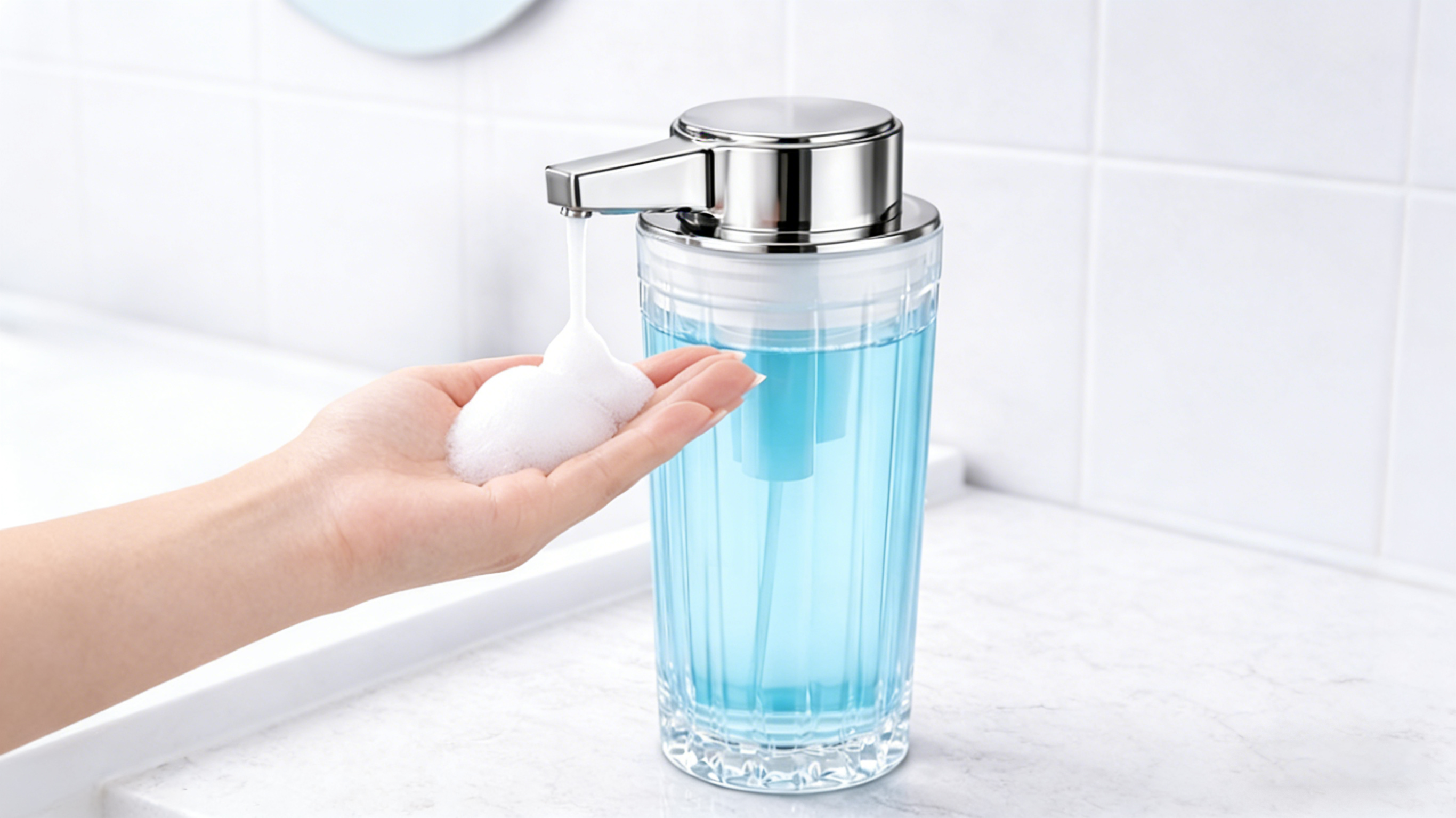
 In 2026, the low-power long-battery-life automatic sensor soap dispenser has become one of the fastest-growing smart hygiene products in our product line. Across our sales channels, sample requests, B2B consultations, and OEM/ODM projects, this model recorded an 81% year-on-year increase. This figure reflects the growth signal observed in our own business channels, not a public global market statistic. However, the reason behind the demand is very clear: buyers are looking for a touchless soap dispenser that is convenient, durable, rechargeable, easy to maintain, and able to run for up to six months on a full charge under normal configured use conditions.
Our low-power sensor soap dispenser is designed for exactly this need. It combines an infrared sensing system, optimized standby power consumption, rechargeable battery design, stable pump output, Type-C charging, controlled soap volume, and a clean modern housing that fits both home and commercial spaces. For home users, the main value is convenience: no frequent battery replacement, no constant charging anxiety, and a cleaner sink area. For hotels, offices, restaurants, shopping malls, schools, clinics, and public restrooms, the value is even stronger: fewer maintenance interruptions, lower consumable replacement workload, and a better user experience for high-frequency handwashing areas.
The market is moving toward touchless and smarter soap dispensing
The global market background supports the growth of this product category. Fortune Business Insights reports a growing shift toward design-oriented and touchless soap dispensers, noting that demand for touchless dispensers is rising as awareness of hygiene and contamination-free solutions increases in homes and commercial environments. Mordor Intelligence also highlights product improvements such as better dispensing mechanisms, enhanced durability, refill-friendly designs, touch-free technologies, and smart monitoring capabilities as drivers of adoption because they improve user convenience and operational efficiency.
These market observations match what we see in customer inquiries. Buyers no longer focus only on the outer shape of a dispenser. They ask practical questions: How long does the battery last? Is it rechargeable? Does it use Type-C? Does it drip? Can the dispensing volume be controlled? Does it work with liquid soap or foam? How often will staff need to check it? For 2026, the winning product is not simply a sensor dispenser; it is a low-maintenance, long-running, design-ready hygiene device.
Why low power consumption is the real commercial value
Many automatic soap dispensers look similar from the outside, but power management creates a major difference in real use. A dispenser may have an attractive design and a responsive sensor, but if it needs to be charged too often or if batteries need frequent replacement, the user experience quickly becomes frustrating. In commercial spaces, this problem becomes even more serious. One hotel, restaurant chain, office building, or shopping mall may use dozens or even hundreds of dispensers. If each unit requires frequent battery replacement, the maintenance workload becomes a recurring cost.
Low-power design reduces this hidden cost. By optimizing the sensor standby mode, motor drive efficiency, circuit layout, pump activation time, and sleep-wake logic, a dispenser can deliver reliable automatic dispensing while consuming less power between uses. Under normal configured usage conditions, our model can support up to six months of use on a full charge. This does not mean every environment will achieve exactly the same duration because usage frequency, soap viscosity, temperature, battery capacity, dispensing volume, and charging habits all affect runtime. But the design goal is clear: reduce charging frequency, reduce battery-change labor, and make daily operation easier.
Six-month full-charge use changes the maintenance logic
A six-month full-charge cycle is not just a technical specification. It changes how users manage the product. For a home user, it means the dispenser becomes a normal part of the bathroom or kitchen rather than a device that constantly needs attention. The user can charge it, place it near the sink, and use it for months without thinking about batteries. This is important because consumers do not want a hygiene product that creates a new household chore.
For commercial buyers, the impact is even bigger. Facility managers can plan maintenance by schedule instead of reacting to sudden low-battery failures. Housekeeping staff can check battery status during routine inspection rather than replacing batteries randomly. Hotels can reduce the risk of a guest finding a non-working dispenser. Offices can avoid employee complaints. Restaurants can keep handwashing stations operational during business hours. A long battery life turns the dispenser from a fragile gadget into a dependable facility accessory.
Reducing battery replacement cost and consumable workload
Traditional battery-operated automatic dispensers create several costs beyond the purchase price. Staff need to buy batteries, store them, replace them, dispose of used batteries, and check whether a malfunction is caused by the sensor, the pump, or low power. In high-traffic environments, this repeated maintenance can become expensive and time-consuming. Fortune Business Insights also notes that advanced soap dispensers can include sensors, batteries, and electrical components that require timely maintenance and replacement, and that frequent battery discharge can negatively affect user experience.
A rechargeable low-power design helps reduce this pressure. Instead of replacing disposable batteries, staff can recharge the unit through a Type-C port. Instead of keeping many spare batteries on site, the facility can manage charging cycles. Instead of discovering battery problems after users complain, managers can build inspection routines around longer intervals. The product does not eliminate maintenance, but it lowers the frequency and complexity of one of the most common maintenance tasks.
Type-C charging fits modern user habits
Type-C charging is another reason the product is easier to accept. The European Commission has promoted USB-C as a common charging solution for many portable electronic devices, explaining that the rules help simplify everyday life, reduce unnecessary charger purchases, and reduce electronic waste. USB-IF also maintains official USB Type-C and Power Delivery specifications and compliance documents, making Type-C one of the most recognized charging interfaces in modern consumer electronics.
For soap dispensers, the benefit is practical. Users are already familiar with Type-C cables. Homes often have Type-C chargers for phones, tablets, lights, small fans, earphones, and personal care devices. Commercial maintenance teams also prefer familiar charging interfaces because they reduce training and cable confusion. While a soap dispenser should be designed with proper electrical safety, port protection, and moisture considerations, Type-C helps make the product feel modern, convenient, and easier to maintain.
Touchless dispensing supports a cleaner user experience
The touchless function remains the core user-facing value. With a manual pump, the user must press the same surface that other users may have touched before applying soap. With a sensor dispenser, the user places a hand under the outlet, the sensor detects motion, and the device dispenses soap automatically. This reduces the need to touch the dispenser before washing hands.
It is important to describe this benefit responsibly. A touchless soap dispenser is not a medical sterilization device, and it does not replace proper handwashing. Its value is to make soap access easier and reduce contact with a shared pump surface. In homes, this creates a cleaner and more convenient sink routine. In commercial bathrooms, it supports a more modern handwashing experience. In food service, hospitality, and office environments, it helps improve the perception of hygiene infrastructure.
CDC and WHO show why soap access still matters
CDC explains that washing hands with soap is more effective than using water alone because surfactants in soap lift soil and microbes from the skin, and people tend to scrub more thoroughly when using soap. WHO also emphasizes that hand hygiene is not a luxury and that people should be able to access hand hygiene infrastructure and products where care is provided. These public health messages reinforce a simple commercial reality: if soap is easier to access, users are more likely to complete the handwashing routine properly.
Our dispenser does not change the fundamental handwashing steps. People still need to wet hands, apply soap, scrub thoroughly, rinse, and dry. But it improves one important step: soap becomes available without pressing a shared pump, without squeezing a bottle, and without handling a slippery container. This is why automatic dispensers are popular not only in hospitals and clinics, but also in kitchens, bathrooms, schools, restaurants, offices, and hotels.
Stable dispensing controls waste and improves user satisfaction
Battery life is not the only cost issue. Soap consumption also matters. If a dispenser releases too much soap, the facility spends more on refills and the sink area becomes messy. If it releases too little, users may wave their hands repeatedly, causing frustration and inconsistent use. A good automatic dispenser should provide stable output, proper volume, and a nozzle design that reduces dripping.
Our product can be configured with fixed or adjustable dispensing volume depending on the customer’s project. For home use, a comfortable single-volume setting may be enough. For commercial use, multiple output levels can help match different soap types, user traffic, and cost-control goals. For foam versions, the pump and liquid ratio should be designed differently from liquid soap versions. For liquid versions, viscosity compatibility and tube diameter matter. This is why OEM/ODM design must consider the actual formula and use case, not only the shell design.
Home use: kitchen, bathroom, children, and daily routines
In the home, the low-power long-battery-life sensor dispenser works especially well in kitchens and bathrooms. In the kitchen, users often have dirty hands after cooking, handling packaging, touching meat, washing dishes, or cleaning surfaces. Pressing a manual pump with dirty hands can leave residue on the dispenser. A touchless device makes the process easier. In the bathroom, it keeps the sink area more organized and makes handwashing feel more modern.
For families with children, an automatic dispenser can also make handwashing more engaging. Children may enjoy the sensor response and become more willing to use soap. A six-month battery life reduces the chance that the device stops working just when users start relying on it. We can customize color, shape, reservoir size, output volume, anti-slip base, indicator light, and child-friendly appearance for home brands and online retail channels.
Commercial use: hotels, offices, restaurants, malls, schools, and clinics
In commercial spaces, the product’s value becomes operational. Grand View Research notes that expansion in the commercial construction sector supports demand for plumbing fixtures including soap dispensers, and that hospitality spaces such as hotels, resorts, and hospitals are enhancing demand in these segments. Mordor Intelligence also states that the commercial application segment remains a key contributor to the soap dispenser market, driven by demand for efficient, durable, high-capacity dispensing solutions suitable for high-traffic environments.
These points explain why long battery life matters so much. A high-traffic restroom cannot rely on a dispenser that often runs out of power. A hotel cannot allow guest-facing accessories to fail frequently. A restaurant must keep handwashing stations ready. An office facility team wants fewer maintenance calls. A school or clinic needs durable and easy-to-service hygiene infrastructure. Our low-power dispenser supports these needs by extending working time, simplifying charging, and reducing repeated battery replacement tasks.
Design matters because the dispenser is always visible
A soap dispenser sits in a highly visible location: on a sink, kitchen counter, vanity, bathroom shelf, wall mount, hotel restroom, restaurant handwash station, or office washroom. A poorly designed dispenser can make the area look cheap or messy. A modern design, on the other hand, supports the overall look of the space. Fortune Business Insights highlights demand for design-oriented soap dispensers because consumers want bathroom accessories that are functional and visually aligned with modern interiors.
Our product can be developed in minimalist white, matte black, brushed silver, stainless-steel look, transparent reservoir, soft neutral colors, pastel finishes, or brand-specific colors. The body can be compact for home use or larger for commercial use. The charging port can be protected with a silicone cover. The liquid window can show remaining soap. The nozzle can be positioned to reduce dripping onto the body. Good design is not only about appearance; it is about making refilling, cleaning, charging, and daily use easier.
Why low power is also an e-commerce advantage
Online shoppers compare product specifications quickly. A dispenser with “six-month battery life on a full charge” immediately communicates convenience. In photos, videos, and short-form demonstrations, the seller can show the touchless response, Type-C charging, reservoir filling, adjustable output, low standby power concept, and clean sink setup. This makes the product easy to explain on Amazon, TikTok Shop, Shopify stores, supermarket e-commerce, hospitality supply platforms, and B2B catalogs.
Global Growth Insights describes the touchless automatic soap dispenser market as driven by public health initiatives, product innovation, and rising demand for hands-free hygiene solutions. It also notes that maintenance requirements can act as a restraint for buyers. A long-battery-life rechargeable design directly answers this concern. Instead of presenting touchless dispensing as only a hygiene feature, sellers can also present it as a lower-maintenance, lower-interruption, cost-conscious solution.
OEM customization: brand, packaging, reservoir, and charging details
Our company supports full OEM customization for low-power long-battery-life sensor soap dispensers. For OEM projects, we can apply the customer’s logo, brand color, packaging, barcode, instruction manual, language labels, retail box, e-commerce box, Type-C cable configuration, product sticker, private label design, and market-specific compliance documents depending on the buyer’s target region. This is suitable for homeware brands, bathroom accessory suppliers, hotel supply companies, Amazon sellers, supermarket chains, hygiene product distributors, and B2B importers.
OEM is not just about printing a logo. It should include market positioning. A home brand may need a compact design with premium color and gift packaging. A hotel supplier may need a larger reservoir and a more neutral professional look. A restaurant supplier may need durable output and easy refill. An online seller may need strong packaging, clear manual, product images, and SEO-friendly naming. We help customers match the same core technology with different sales channels.
ODM development: build the dispenser around real operation
For ODM projects, we can develop deeper technical and structural details. Options include battery capacity, sensor detection distance, pump type, output volume, liquid or foam version, reservoir capacity, transparent level window, anti-drip nozzle, wall-mounted or countertop design, waterproof port protection, charging indicator, low-battery indicator, PCB layout, shell material, surface finish, anti-slip base, child-friendly design, commercial high-capacity structure, and refill opening size.
ODM development should begin with the use case. If the dispenser is for home bathrooms, appearance and quiet operation are important. If it is for hotel restrooms, premium look, easy cleaning, and consistent quality matter. If it is for public restrooms, battery life, reservoir size, durability, and maintenance schedule are key. If it is for e-commerce, the product must demonstrate its value visually. Our role is to turn those needs into engineering, design, and production decisions.
Quality control: battery, sensor, pump, sealing, and batch consistency
Automatic dispensers require stricter quality control than simple manual pumps. If the battery fails, the sensor misreads, the pump clogs, the nozzle drips, the port is not well protected, or the reservoir leaks, users will quickly lose trust. For commercial buyers, repeated failures can create maintenance complaints and damage brand reputation.
We focus on battery performance, charging stability, sensor response, standby power consumption, pump durability, output consistency, soap compatibility, reservoir sealing, nozzle drip control, Type-C port protection, indicator function, shell finish, color consistency, logo quality, packaging protection, and transport testing. For B2B customers, a good sample is only the beginning. Every production batch must match the approved sample in power performance, dispensing volume, finish, color, packaging, and user experience.
Why this product is worth launching in 2026
The 81% growth we observed in our own channels shows that buyers are strongly responding to the combination of touchless dispensing, low power consumption, long battery life, Type-C charging, and reduced maintenance cost. Fortune Business Insights and Mordor Intelligence confirm the market shift toward touchless, durable, refill-friendly, smart, and design-oriented dispensing solutions. CDC and WHO reinforce the importance of soap access and hand hygiene infrastructure. The European Commission and USB-IF support the broader trend toward Type-C charging convenience. Grand View Research and Global Growth Insights show why commercial and touchless dispenser categories continue to attract attention.
Our low-power long-battery-life automatic sensor soap dispenser brings these trends together in one product: up to six months of use on a full charge under normal configured conditions, fewer battery replacement tasks, Type-C charging, touchless operation, controlled soap output, modern design, home and commercial application, and full OEM/ODM customization. In 2026, buyers do not want a dispenser that creates extra work. They want a dispenser that quietly supports hand hygiene, reduces maintenance burden, and looks good in the space where it is installed. That is exactly the value our product delivers.
low power sensor soap dispenser, long battery life soap dispenser, six month battery soap dispenser, rechargeable automatic soap dispenser, Type-C sensor soap dispenser, touchless soap dispenser, infrared soap dispenser, automatic soap dispenser for home, commercial automatic soap dispenser, low maintenance soap dispenser, battery saving soap dispenser, USB-C soap dispenser, hands free soap dispenser, smart hygiene dispenser, electric soap dispenser, foam soap dispenser rechargeable, liquid soap dispenser automatic, hotel soap dispenser, office soap dispenser, restaurant soap dispenser, school soap dispenser, clinic soap dispenser, public restroom soap dispenser, kitchen soap dispenser, bathroom soap dispenser, adjustable volume soap dispenser, anti drip soap dispenser, soap dispenser OEM, soap dispenser ODM, private label soap dispenser, custom logo soap dispenser, soap dispenser manufacturer, automatic soap dispenser supplier, B2B soap dispenser, Amazon soap dispenser, hospitality soap dispenser, commercial hygiene products, smart bathroom accessories, OEM hygiene dispenser, ODM smart soap dispenser



